
Intangible Asset Valuation
Intangible assets — brands, customer relationships, technology, patents, software, and know-how — represent the majority of enterprise value in most modern businesses, yet they remain systematically undervalued or misrepresented in financial statements.
Rigorous intangible asset valuation is the foundation of defensible purchase price allocations, impairment testing, IP transfers, and shareholder disputes. Hectelion delivers independent valuations grounded in IFRS 3, IAS 36, and international valuation standards, tailored to the realities of Franco-Swiss transactions and litigation.
Patents, trademarks or software must be rigorously evaluated to ensure financial transparency, meet regulatory requirements and strengthen the confidence of investors and partners.



What is intangible asset valuation
Intangible asset valuation is the process of estimating the fair value of identifiable non-physical assets that generate measurable economic benefits for a company. Unlike goodwill — which captures residual value — intangible assets are individually identifiable and can be separated, transferred, licensed, or sold.
The three internationally recognised valuation approaches apply specifically to intangibles: the income approach (relief-from-royalty for brands and technology, multi-period excess earnings method — MPEEM — for customer relationships), the market approach (royalty rate benchmarks, comparable transactions), and the cost approach (reproduction or replacement cost, used for proprietary software and internal know-how).
Selecting the right method requires a deep understanding of the asset's economic characteristics, its legal protection, its remaining useful life, and its role in the broader business model.
Step 1
Scope of the mission
Define the object, context and precise objectives of the valuation.
Step 2
Document collection
Gather the legal, financial, technical and operational information necessary for the analysis.
Step 3
Modeling
Apply methods adapted to the nature of the assets.
Step 4
Preliminary report
Structure the results obtained in a clear, synthetic and reasoned document.
Step 5
Presentation of the results
Share the initial conclusions with the client, explain the evaluation logic and discuss the hypotheses.
Step 6
Update the model
Integrate feedback from the customer or advice, adjust assumptions, flows and parameters.
Step 7
Final report
Finalize, validate and deliver a complete, documented and defensible report.
When and why to commission an intangible asset valuation
Intangible asset valuations are required in four main contexts, each with distinct methodological and evidentiary standards. In M&A transactions, IFRS 3 requires acquirers to identify and measure at fair value all identifiable intangible assets of an acquired business as part of the purchase price allocation (PPA).

Transactions and restructuring
We help companies determine the fair value of their intangible assets, to clarify the distribution of this value during intragroup transactions and to secure their negotiations with third parties.
.svg)
fundraiser
We value patents, brands and other assets as attractive levers for investors, while justifying the conditions for entry into capital and regulating the transfer of rights during joint ventures.

Taxation and transfer pricing
We apply the principle of full competition and strengthen transfer pricing documentation, by meeting the specific requirements of the Swiss authorities during intragroup transactions.

Accounting and reporting
We support the accounting of values during an acquisition (PPA), the revaluation or impairment tests of intangible assets, in order to make your financial statements reliable.

Strategy and management
We identify the intangible assets that create the most value, help prioritize investments or divestitures and support the optimization or monetization of an intangible portfolio.

Legal protection and litigation
We intervene to support compensation claims, assess damages related to intangible assets and support license or transfer negotiations in a litigation context.
Our intangible asset valuation methodology
A method-driven, standards-compliant approach — combining income, market, and cost techniques to deliver defensible intangible asset valuations.
- Relief-from-royalty method (brands and technology)
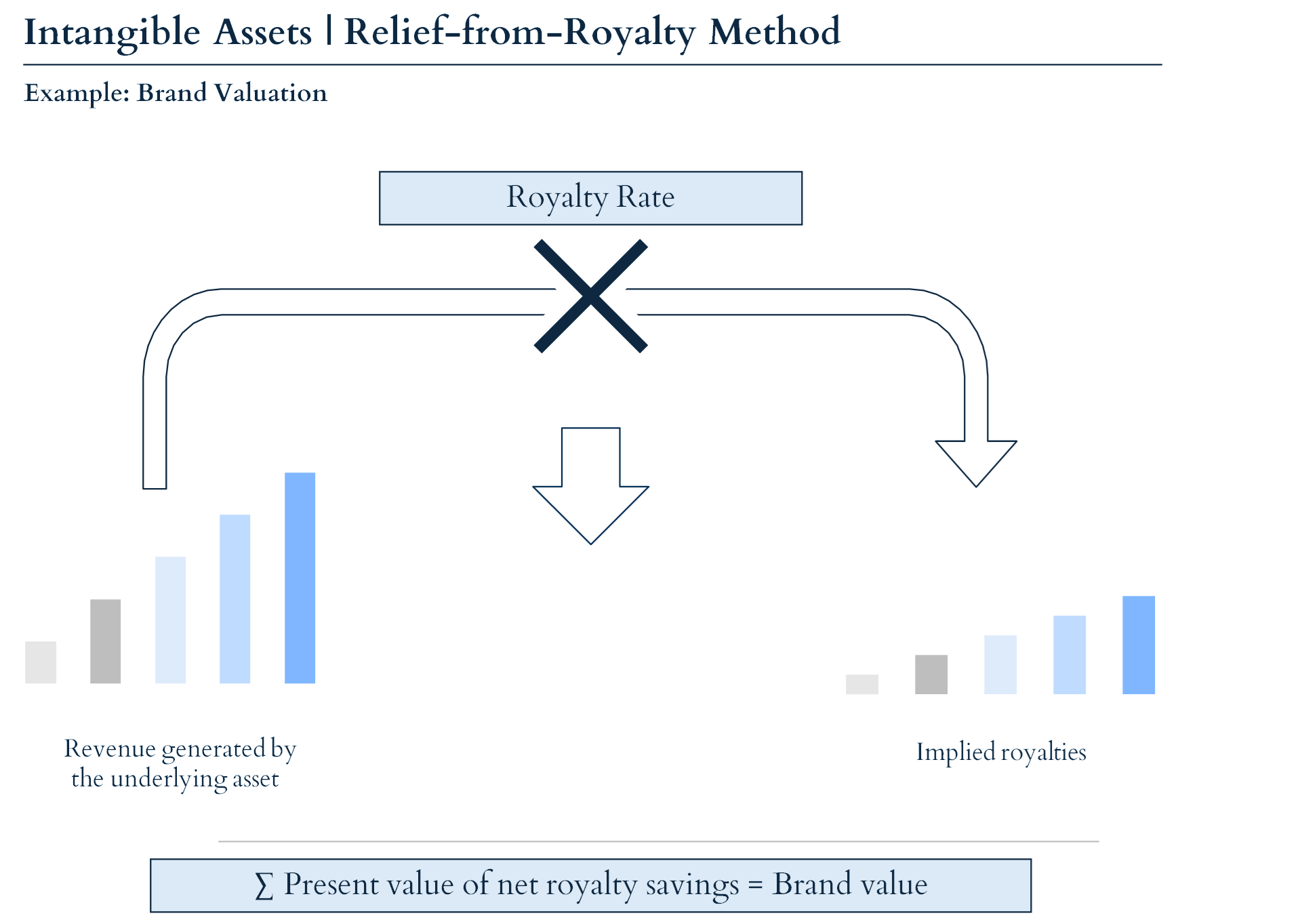
We estimate the value of a brand or technology by capitalising the notional royalty that the owner saves by holding the asset rather than licensing it. The royalty rate is benchmarked against comparable licensing transactions and validated against profitability metrics. This is the primary method for brands under IFRS 3 and IVS. - Multi-Period Excess Earnings Method — MPEEM (customer relationships)
We isolate the cash flows attributable solely to the customer relationship asset by deducting the returns required by all other contributing assets. The residual earnings are discounted at a rate reflecting the specific risk profile of the customer base, incorporating attrition modelling and cohort analysis. - With-and-without method (non-compete agreements, key contracts)
We estimate the value of an intangible by comparing the discounted cash flows of the business with and without the asset — capturing the economic cost of its absence. - Cost approach (proprietary software, internal know-how)
We estimate the reproduction or replacement cost of the asset, incorporating technical obsolescence, functional depreciation, and economic depreciation adjustments. - Royalty rate benchmarking and market comparables
We draw on licensing transaction databases, sector publications, and judicial precedents to calibrate royalty rates and corroborate income-based conclusions with market evidence. - Useful life and amortisation analysis
We assess the remaining useful life of each intangible — based on contractual terms, technological obsolescence, competitive dynamics, and historical renewal patterns — to support IFRS-compliant amortisation schedules.
Diverse range of clients advised
Family Offices
Executives/Management
Family shareholders
Private equity funds
Family businesses
SMES

operations analyzed
years of expertise
clients advised
Discover our TRACK RECORD
The transactions presented were carried out by, with the contribution of, or with the participation of members of the Hectelion team in the context of functions performed currently or previously.
Frequently Asked Questions
Through the updated future flows generated by its exploitation or by a reproduction cost method.
The most common approaches are “relief from royalty”, adjusted historical cost, and transaction method.
The economic value reflects future potential, the book value corresponds to the amount recorded on the balance sheet.
During an impairment test, an acquisition, a sale or an in-kind contribution.
It materializes the value of an intangible asset that is often overlooked, improving the perception of investors.
Yes, if these elements are identifiable, measurable, and likely to generate future economic flows.
By adjusting the projection period and the rate of economic depreciation or obsolescence.
A misallocation of the purchase price, a fiscal risk or an erroneous impairment test.