
Startup Valuation
Valuing a startup means quantifying potential inan environment of uncertainty — a discipline fundamentally different fromvaluing a mature business. From the seed stage, where value rests primarily onthe team and the market thesis, to the pre-IPO stage, where capital marketstandards apply, every phase of the lifecycle demands tailored methodologies,defensible assumptions and uncompromising analytical rigour.
At Hectelion, weproduce independent valuation reports structured to the standards recognised byinstitutional investors, tax authorities and jurisdictions — to secure yourBSPCE grants, support your fundraising rounds and bring objectivity to everytransaction on the capital.
.jpg)


What is a startup valuation?
Valuing a startup means estimating the fair value of itsordinary shares at a given point in time, taking into account the absence orlimited track record of financial history, the uncertainty inherent inprojections, and the characteristics specific to each stage of development —seed, early stage, Series A/B or pre-IPO.
Unlike a mature business, a startup is valued primarily on thebasis of its growth potential, the quality of its team, its addressable marketand its traction. This reality requires specific methodologies, adapted to therisk profile and maturity stage of the company.
The valuation report produced by Hectelion is structured, substantiatedand defensible before third parties: investors, tax authorities, jurisdictionsand co-founders.
Step 1
Scope of the mission
Define the purpose, context and specific objectives of the valuation: fundraising, BSPCE grant pricing, disposal, tax compliance or internal steering.
Step 2
Document collection
Gather the information required for the analysis: available financial data, business plan, cap table, shareholders' agreement, operational KPIs and legal documentation.
Step 3
Modeling
Apply the valuation methodologies appropriate to the stage of development and the context of the engagement. Cross-reference multiple approaches to ensure robustness and consistency.
Step 4
Preliminary report
Structure the findings in a clear, concise and substantiated document. Present the retained value range and the key underlying assumptions.
Step 5
Presentation of the results
Share the preliminary findings with the founders and discuss the assumptions retained, the sensitivities and the value drivers identified.
Step 6
Update the model
Incorporate feedback and any newly available information to refine the model and the retained value.
Step 7
Final report
Finalise, validate and deliver the complete report, usable in the context of a fundraising round, a BSPCE grant, a disposal or a dispute.
Why & when should you perform a startup valuation?
A startup valuation is required in specific contexts where knowledge of the fair value of ordinary shares is essential to make decisions, negotiate or comply with regulatory obligations.

Fundraising
Aligning founders and investors on a substantiated, credible pre-money valuation consistent with the investment thesis.

Grant of shares
Determining the fair value of ordinary shares at the date of BSPCE or stock option grants, in compliance with the requirements of the tax authorities.

Startup transaction
Objectifying the value of the startup in the context of a full or partial disposal, a buy-out between co-founders or an investor entry.

Tax & compliance
Substantiating the value of securities in the context of intra-group transfers, gifts, successions or transactions subject to tax authority scrutiny.

Governance
Measuring value creation at regular intervals, preparing for a future fundraising round or objectifying the valuation within the framework of a shareholders' agreement.

Disputes & arbitration
Producing an independent valuation in the context of a disagreement between shareholders, a dispute over a disposal price or an arbitration proceeding.
Startup valuation methodologies
Startup valuation does not rest on a single method. We combine several complementary approaches, selected according to the stage of development, the sector and the context of the engagement, to deliver a robustand defensible result.
- Scorecard Method: Benchmarks the startup against similar recently funded companies, adjusting the referencevaluation based on qualitative criteria.
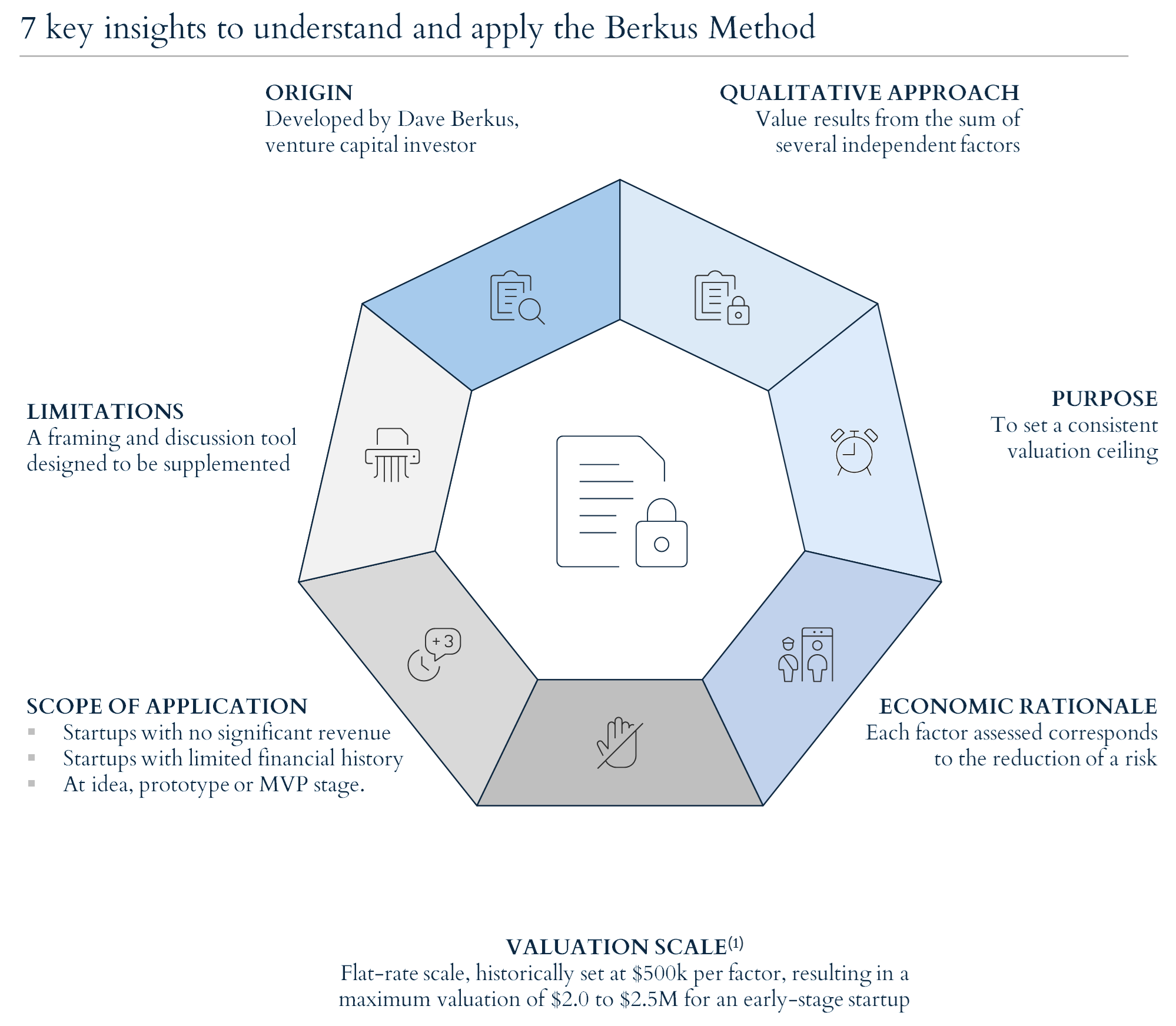
- Berkus Method: Assigns a value to each key component of the startup — idea, prototype, team, strategic relationships and commercial deployment.
- Risk Factor Summation: Adjusts a base valuation against a grid of specific risk factors.
- Required financing method: Values the startup based on the amount of funding required to reach the next milestone, taking into account the target dilution and thestructure of the envisaged round.
- Venture Capital Method (VC Method): Estimates the current value of the startup by reasoning backwards from the anticipated exit value, discounted at the investor'sexpected rate of return.
- Comparable transactions: Draws on valuations observed in recent transactions involving comparable startups in terms of sector, stage and business model.
- Discounted Cash Flows (DCF): Measures value on the basis of expected future cash flows,discounted at a rate reflecting the startup's risk profile.
- Real options: Incorporates thevalue of strategic flexibility — the ability to abandon, accelerate or pivot —in contexts of high uncertainty.
Diverse range of clients advised
Startup
Executives/Management
Family shareholders
Private equity funds
Family businesses
Family Offices
SMES

operations analyzed
years of expertise
clients advised
Discover our TRACK RECORD
The transactions presented were carried out by, with the contribution of, or with the participation of members of the Hectelion team in the context of functions performed currently or previously.
Frequently Asked Questions
A traditional business is valued primarily on the basis of its financial track record and profitability. A startup is valued above all on its growth potential, addressable market and quality of execution. This requires specific methodologies — Venture Capital, Scorecard, Berkus — that incorporate uncertainty and the risk profile specific to each stage.
BSPCE must be granted at the fair value of ordinary shares at the date of grant. Without a documented and defensible independent valuation, the French tax authorities may reclassify the gain as salary income upon disposal of the securities. An independent valuation report secures the mechanism for both founders and beneficiaries.
At seed stage, prior to significant revenues, we favour qualitative and hybrid methods: Scorecard Method, Berkus Method, Risk Factor Summation and the required financing method. These approaches allow us to structure a substantiated valuation even in the absence of financial history, drawing on the qualitative fundamentals of the startup.
DCF requires sufficient visibility on future financial projections. We generally apply it from Series A onwards, once the startup has measurable traction and credible projections over three to fiveyears. At seed or early stage, it is used as a complementary method, with widened sensitivity scenarios.
The pre-money valuation is the overall valuation of the startup before new capital enters, as negotiated with investors. The value of ordinary shares is the unit value of one ordinary share, which takes into account the capital structure and the preferential rights granted toinvestors (preferred shares, liquidation preference). These two concepts are distinct and must not be confused, particularly in the context of BSPCE grants.
Yes. Our valuation reports are structured to be defensible before the French and Swiss tax authorities and competent jurisdictions. They document the methodologies applied, the assumptions used,the comparable sources and the concluded value range, in accordance with recognised independent valuation standards.
Yes. We support startups and their founders in France and Switzerland. Our reports can be produced in French or English depending on the requirements of the stakeholders involved.
No. A rigorous and defensible valuation requires cross-referencing several complementary methods. Each approach illuminates a different dimension of value — market potential, comparable transactions,execution risk — and their combination ensures the robustness and credibilityof the result.
Between two and four weeks depending on the complexity of the file, the stage of the startup and the availability of documents. Urgent engagements — particularly for BSPCE grants or imminent due diligence processes — can be handled within shorter time frames.
A 409A valuation is an independent assessment ofthe fair market value of a startup's ordinary shares, required under US tax law(IRC Section 409A) when granting stock options to employees. Without a 409Avaluation conducted by a qualified independent appraiser, the IRS may reclassify stock options as immediately taxable compensation, with associated penalties. If your startup is incorporated under French or Swiss law with no employees or beneficiaries subject to US taxation, a 409A valuation does not directlyapply — the BSPCE framework serves a comparable function under French law.However, if your startup has US shareholders, employees or investors, or isconsidering a Delaware structuring, a 409A valuation becomes necessary. We cansupport you in this context.