
Integration of Artificial Intelligence in Business Valuation
When technology structures financial reasoning without replacing professional judgment.

Introduction: Between technological promise and methodological rigor
Artificial intelligence is progressively becoming embedded in corporate finance. Automation of calculations, speed of execution and standardisation of analyses are now tangible and widely accessible benefits.
However, when it comes to business valuation, technological enthusiasm must be tempered with caution. Valuation is not a purely technical exercise; it carries significant financial, legal and strategic implications.
As an often-cited principle in finance reminds us, the value of a business is never a standalone number, but the outcome of a structured line of reasoning. This observation remains particularly relevant in the era of AI. A clear distinction must therefore be made at the outset. A professional business valuation relies on recognised methodologies, in-depth analysis, expert judgment and assumed responsibility. By contrast, an automated indicative valuation aims to provide an order of magnitude intended to support an initial reflection, without claiming to determine a definitive or binding value.
It is precisely within this intermediate space that artificial intelligence can be useful, provided it is integrated with discipline and structure. AI does not replace the expert or human decision-making; it can, however, help structure, secure and accelerate certain preparatory stages. This article adopts a pragmatic perspective: identifying the real contributions of AI, clarifying its limitations, and explaining how Hectelion has deliberately integrated it within a controlled framework for indicative business valuation.
Why business valuation remains a fundamentally complex exercise
Business valuation is not a calculation exercise; it is an exercise in judgment and arbitration. It seeks to translate an economic reality—sometimes stable, sometimes evolving—into a defensible value range, consistent with recognised methodologies and aligned with the purpose of the valuation (sale, fundraising, investor entry, dispute, restructuring, incentive plans, etc.). Two companies with identical EBITDA figures may result in very different valuations simply because their risk profiles, trajectories or revenue quality are not comparable.
The first source of complexity lies in assumptions. In a DCF framework, marginal changes in the WACC or terminal growth rate can materially impact value. For example, a services SME generating CHF 1.0 million in EBITDA, valued using a 10% WACC and a 1.5% terminal growth rate, may see its enterprise value vary by several million if the WACC increases to 11% or if a more conservative terminal growth assumption is applied. The final figure is therefore not “found”; it is constructed based on assumptions that must be justified, consistent and contextually appropriate.
The second source of complexity relates to data quality and the necessary adjustments. Accounting EBITDA is almost never directly “valuatable” without normalisation. Non-recurring items, exceptional charges or income, management compensation misaligned with market levels, intra-group transactions, and certain accounting choices all require adjustment. A common example involves a company where the owner-manager underpays themselves—or conversely extracts excessive remuneration through the company—requiring normalisation that alters EBITDA and, consequently, value. Similarly, an unusually strong margin in a given year driven by a one-off contract must be assessed in terms of sustainability.
A third complexity concerns working capital requirements and actual cash generation. Many analyses focus on operating profit while overlooking cash dynamics. A company may display strong EBITDA yet consume cash if receivables increase, inventories rise or supplier advances decrease. For instance, a trading company doubling its revenue while customer payment terms extend from 45 to 75 days may experience liquidity pressure, materially altering risk perception and, indirectly, valuation.
A fourth, often underestimated, dimension involves capital expenditure and economic maintenance. In some sectors, assuming capex equals depreciation may be reasonable; in others, it is misleading. An industrial company deferring investments over two years may temporarily report attractive profitability, but valuation must reflect the catch-up capex required to sustain productive capacity. Conversely, a company undergoing heavy investment may show temporarily weakened cash flows while its underlying economic potential improves.
Valuation is also inherently sensitive to risk profile and revenue structure. Businesses with recurring revenues (SaaS, maintenance contracts, long-term agreements) are not valued in the same way as project-based models. Two companies generating CHF 10 million in revenue and CHF 1.5 million in EBITDA may command vastly different multiples if one benefits from 80% recurring revenue with controlled churn, while the other depends on a small number of clients and irregular tenders. Value reflects visibility, resilience and the ability to project future performance.
Finally, theoretical value must be confronted with market reality. Multiple-based approaches (trading comparables, transaction multiples) do not provide a single truth; they depend on scope, cycle, true comparability and necessary adjustments for size, growth, margin, geography and liquidity. Applying transaction multiples observed for a CHF 50 million revenue company to a CHF 5 million SME without size or liquidity discounts often leads to overvaluation. Conversely, ignoring genuinely comparable transactions may underestimate market appetite in a given sector.
In practice, a rigorous valuation rarely results in a single figure. It produces a value range derived from cross-checked approaches and critical assessment of assumptions. It is precisely this combination—methodologies, data, adjustments, risk, cash and comparability—that makes valuation fundamentally complex and explains why automation must assist the process without oversimplifying what ultimately requires professional judgment.
What artificial intelligence concretely brings to valuation
When integrated with discipline, artificial intelligence does not alter the nature of valuation but changes how certain steps are executed. Its primary contribution lies not in decision-making, but in structuring, securing and accelerating preparatory work—where errors and inconsistencies most frequently arise.
The first tangible contribution of AI relates to the structuring and normalisation of input data. Financial information provided by companies is rarely homogeneous. Reporting periods may not be comparable, metrics may be defined inconsistently across years, and key data may be missing or poorly presented. AI enables the imposition of a standardised analytical framework, detection of inconsistencies and reconstruction of a workable dataset. For example, when revenue or EBITDA is provided without clarification of scope or recurring nature, the tool can prompt clarification or apply predefined normalisation rules.
A second major contribution lies in automating repetitive and sensitive calculations. Valuation models contain numerous risk-prone areas: cash flow discounting, terminal value computation, net debt adjustments, and reconciliation between enterprise value and equity value. A sign error, misapplied assumption or inconsistent formula can generate significant distortions without immediate detection. When AI systematically executes these calculations, operational risk is substantially reduced. This does not eliminate the need for critical review, but it secures execution.
A third, often underestimated, contribution concerns the internal consistency of financial assumptions. In manual valuations, assumptions are frequently adjusted without full propagation across the model. AI ensures coherent transmission of assumptions throughout all calculations. For instance, changes in growth rates or WACC are automatically reflected in discounted cash flows, sensitivities and summary indicators, avoiding partial or inconsistent updates.
AI also provides significant value in rapid scenario analysis and sensitivity testing. Where traditional approaches require time-consuming manual iterations, automation enables quick testing of prudent, base and optimistic scenarios and assessment of their impact on value. A business owner can instantly visualise the effect of a one-point margin decline, extended working capital requirements or an adjusted discount rate. While this does not provide definitive answers, it meaningfully enriches strategic thinking.
Finally, AI contributes to the standardisation and readability of deliverables. Valuation reports gain credibility when they present clear structures, coherent indicators and explicit logic. Automation enables the production of consistent, comparable outputs that are easier for non-specialist executives or investors to understand. This does not replace analysis; it facilitates its interpretation.
In summary, AI does not “perform” the valuation. It acts as a lever of methodological discipline, securing execution, improving internal coherence and freeing time for what truly creates value in valuation work: critical analysis, risk assessment and informed dialogue with stakeholders.
What artificial intelligence will never replace
Despite its undeniable operational benefits, artificial intelligence quickly reaches its limits when valuation moves beyond calculation into interpretation. Business valuation is not solely a modelling exercise; it requires nuanced reading of often ambiguous, evolving and sometimes contradictory situations. These dimensions are not fully automatable.
The first fundamental limitation concerns professional judgment. Valuing a business requires taking a position on performance sustainability, business plan credibility and the relevance of growth assumptions. A common example involves a company exhibiting strong growth over two years. AI can extrapolate this trend but cannot determine whether growth is structural, driven by post-crisis catch-up, a one-off opportunity or excessive dependence on a single client or product. This discernment stems from experience and contextual understanding, not automation.
A second limitation relates to real risk assessment beyond statistical parameters. Models incorporate discount rates, risk premiums and scenarios but may fail to capture underlying vulnerabilities. A company may present solid financial metrics while relying heavily on a key individual without succession planning. This human risk, critical for investors, does not mechanically translate into automated models and must be identified and assessed by the valuer.
Another major limitation lies in strategic understanding of the business model. Two companies in the same sector may report similar figures while pursuing radically different strategies. One may prioritise growth at the expense of profitability; the other may focus on stability and cash generation. AI can process data but cannot grasp strategic intent or long-term positioning coherence—yet value depends heavily on this perspective.
AI is also incapable of assessing qualitative, non-formalisable factors that play a central role in valuation. Governance quality, corporate culture, relationships with key partners and management credibility materially influence risk perception and value but are not easily quantifiable or standardisable.
Finally—and most critically—AI bears no responsibility. A professional valuation engages the valuer both methodologically and ethically. It must be explainable, defensible and, if necessary, contestable. In transactions, disputes or investor discussions, it is not the tool that answers, but the professional. Value is not merely calculated; it is argued.
Ultimately, AI can support the valuer but cannot replace the core of the discipline: judgment, risk analysis, strategic understanding and responsibility. Clearly defining this boundary is essential if AI is to enhance valuation quality rather than create an illusion of precision.
Hectelion’s approach: clearly distinguishing automated indicative valuation from professional valuation
At Hectelion, the integration of artificial intelligence is based on a deliberately clear distinction between two uses that are often conflated but fundamentally different in nature and implications.
The first use concerns the free automation of an indicative business valuation report. This solution is designed as an accessible, educational and exploratory tool. Based on declarative information and standardised assumptions, it automatically generates a structured report providing an initial order of magnitude. Its purpose is to offer initial financial benchmarks, enhance understanding of value drivers and support preliminary reflection, without professional engagement or responsibility attached to the result.
In this context, automation is intentionally extensive. Parameters are standardised, rules are homogeneous and scope is clearly defined. The generated report does not claim to capture all company-specific features or integrate complex strategic, human or contextual factors. It is not a professional valuation, but a framing tool useful upstream of decisions or deeper discussions.
The second use is fundamentally different. Within valuation mandates entrusted to Hectelion, the firm’s proprietary automated models serve as a technical foundation rather than a decision mechanism. They secure calculations, structure analyses and ensure high methodological consistency. However, all key parameters are human-driven: growth assumptions, cash flow structure, financial adjustments, risk analysis, methodological choices, weightings and interpretation of results.
In these mandates, AI and automation act as tools in service of the expert—not the reverse. They enhance robustness and traceability, but value is derived from professional, contextualised and accountable reasoning. Responsibility for the valuation rests fully with Hectelion, both methodologically and ethically.
This distinction is essential. Free automation democratises access to an initial financial reading. Professional valuation remains an expert act requiring analysis, judgment and responsibility. Confusing the two would undermine the credibility of valuation as a discipline.
By structuring its use of AI in this way, Hectelion adopts a clear stance: leveraging technology to strengthen quality and efficiency without ever delegating what belongs to human expertise.
Business valuation and AI integration: origins, framework and objectives of Hectelion’s solution
Hectelion’s AI-enabled indicative valuation solution emerged from a recurring observation in corporate finance advisory practice: prior to any structuring transaction, many business owners and shareholders seek a reliable initial benchmark without being ready—or able—to immediately engage in a full valuation mandate.
In many cases, the question is not yet about defending value in a transaction but about overall economic coherence: positioning the business within a realistic range, identifying key value drivers and testing the realism of implicit assumptions. At this preliminary stage, the absence of structure may lead to subjective overvaluation or underestimation of actual stakes.
Hectelion’s solution fits within this upstream logic. It relies on the deliberately controlled integration of AI to produce an automated indicative valuation based on generally accepted financial methodologies. The approaches applied—transaction comparables, indirect trading multiples, yield-based methods, discounted cash flows (DCF) and practitioner methods—are those commonly used in Swiss, French and broader European contexts. Their application is standardised, homogeneous and reproducible to ensure methodological consistency across cases.
AI is not introduced to add excessive sophistication, but to structure and secure execution. Data is collected via a dedicated form and integrated into an automated chain based on standard financial models. Automation limits execution bias, ensures calculation coherence and generates a structured, readable and educational report. The final deliverable presents an indicative enterprise value range, cross-method coherence analysis, and a breakdown into equity value and value per share.
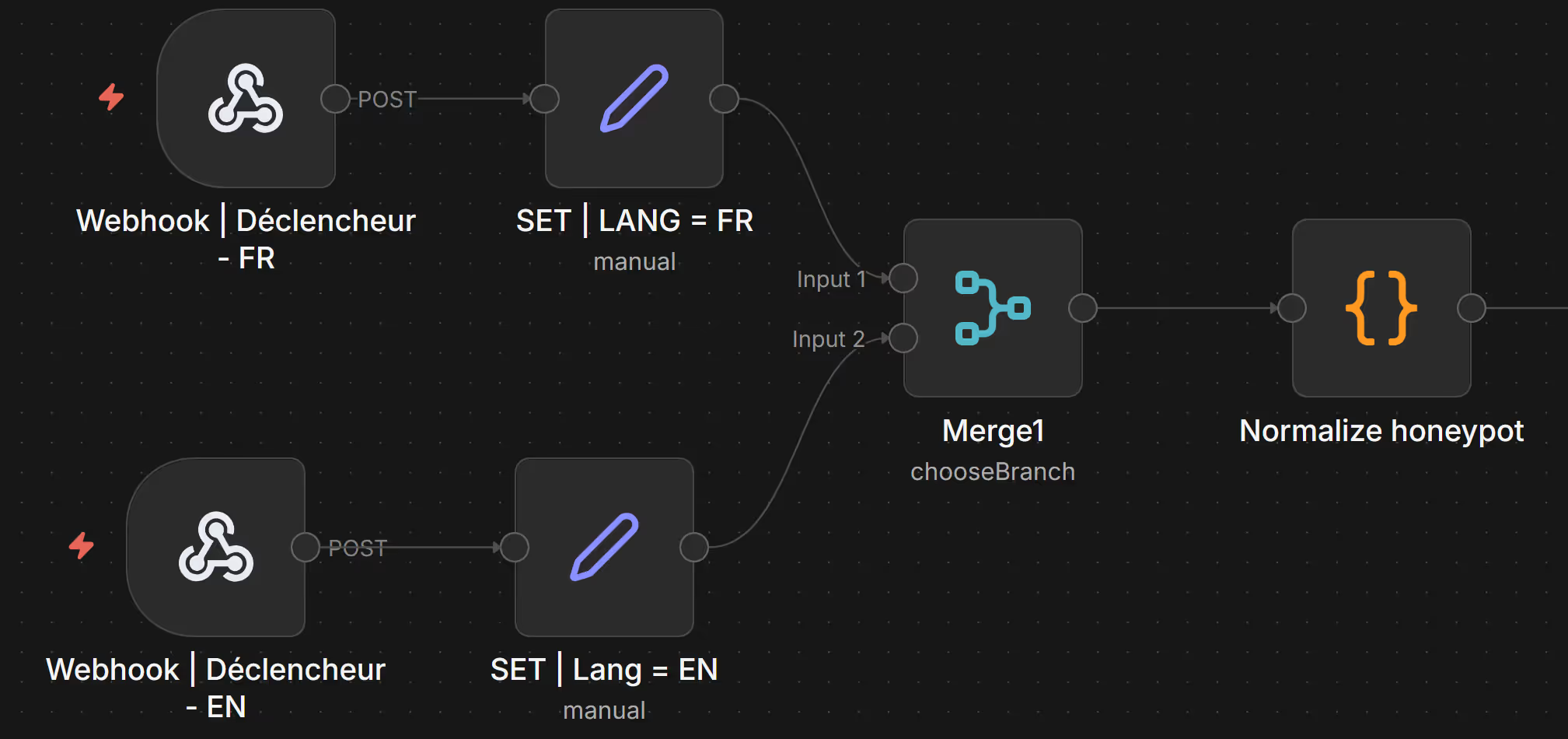
This solution primarily targets business owners, founders, shareholders and entrepreneurs in strategic reflection phases: anticipated sale, fundraising preparation, succession, capital restructuring or simple financial clarification. It may also serve as a preliminary discussion support with investors, financial partners or advisors by providing a shared, structured financial reference.
The objective is not to deliver a binding opinion of value nor to replace independent expertise. The indicative estimate is provided free of charge, based on unaudited declarative information and intended solely to support reflection. It does not account for legal, tax or operational specificities and cannot be used as such in transactional or contentious contexts.
In this sense, AI integration serves a specific purpose: democratising access to a first structured financial reading while maintaining a clear distinction from professional valuation engagements conducted by Hectelion. The tool frames analysis, objectifies reflection and, where relevant, prepares subsequent in-depth work where human analysis, professional judgment and responsibility remain central.

Managing Director’s perspective: clarifying before deciding
As a corporate finance advisory firm, we are confronted daily with a simple yet frequently overlooked reality: before making structuring decisions, business leaders first seek to understand before they act. Understanding where their company stands, what realistic value ranges are, and which parameters truly drive value. Too often, this upstream phase relies on intuition, rough comparisons or insufficiently rigorous tools.
It was from this observation that we decided to develop an AI-enabled business valuation estimation solution—not to automate expertise or trivialise valuation, but to structure the initial approach. Certain preliminary steps can be standardised without loss of meaning: collecting basic financial data, applying recognised methodologies within a homogeneous framework, and generating a coherent initial value range. AI enables precisely this, provided it is used with discipline and humility.
We deliberately designed this solution as an open, free and controlled tool. Open, because business leaders should be able to access an initial financial reading without excessive barriers. Free, because the objective is not to sell a value but to illuminate reflection. Controlled, because an indicative estimate must never be confused with a binding professional valuation. This distinction is essential for both analytical quality and disciplinary credibility.
Within mandates entrusted to Hectelion, our approach is fundamentally different. Proprietary automated models provide technical and methodological foundations, but all parameters, assumptions and judgments are human-driven. Valuation becomes a full expert act integrating strategic analysis, risk assessment, specific adjustments and professional responsibility. The tool supports the work; it does not replace it.
Our conviction is that well-integrated AI enhances advisory quality. Poorly used, it creates an illusion of precision. By clearly separating automated indicative estimation from professional valuation, we have chosen clarity, rigor and responsibility—principles we intend to uphold in service of business leaders, investors and the quality of financial debate.
Conclusion: Artificial intelligence as a tool, expertise as a compass
Integrating artificial intelligence into business valuation does not challenge the foundations of the discipline. It changes tools, accelerates certain steps and enhances operational coherence without altering its core nature. Valuation remains an exercise in analysis, judgment and responsibility that cannot be delegated to an algorithm.
Used with discipline, AI is a powerful lever to structure initial financial reflection, secure standard calculations and improve result readability. It helps clarify orders of magnitude, objectify assumptions and prepare more informed dialogue among business leaders, investors and advisors. However, it cannot alone produce a binding value nor capture the strategic, human and contextual complexity inherent to each business.
By clearly distinguishing automated indicative estimation from professional valuation, Hectelion has chosen a responsible integration of technology—democratising access to an initial financial reading while preserving what defines advisory value: critical analysis, risk understanding and the ability to assume a reasoned position.
Artificial intelligence is neither an end nor a promise in itself.
It is a tool.
Expertise remains the compass.
Would you like to train in business valuation?
Hectelion offers business valuation training programmes combining rigorous theoretical frameworks, practical methodologies and analysis of real-world cases. These programmes are designed for business leaders, entrepreneurs and finance professionals seeking to strengthen their understanding of valuation mechanisms and secure strategic decision-making.
👉 Learn more about the training
Author
Aristide Ruot, Ph.D
Founder | Managing Director