
FCFE vs FCFF: the formula that changes your startup valuation by 30%
Reading from the cash flow statement, 5 errors, Swiss SaaS case study

Introduction: two offers, a five-million gap, a single methodology error
FCFF is the cash flow available to all capital providers, discounted at the WACC to obtain Enterprise Value. FCFE is the cash flow available to shareholders alone, discounted at the cost of equity to obtain Equity Value directly. Confusing the two flows or their discount rates distorts a valuation.
A SaaS founder receives two offers six weeks apart: CHF 20M and CHF 15M. Same company, same EBITDA, same business plan. The first acquirer discounted the cash flows using FCFE; the second used FCFF with a poorly integrated debt structure. The CHF 5M gap does not come from negotiation — it comes from a model choice applied without consistency with the discount rate.
FCFF (Free Cash Flow to the Firm) measures the cash flows available to all capital providers — shareholders and creditors — before any debt payment. FCFE (Free Cash Flow to Equity) measures what remains to equity holders alone after debt repayment and interest charges. Two metrics, two discount rates, two distinct values. Franco-Swiss M&A practice uses both. Confusing them produces errors that trigger no alert in the spreadsheet.
"Valuing a company using FCFE or FCFF means choosing to view value before or after leverage. The result should be identical in theory. In practice, assumptions diverge and the gap can exceed 20%."
Damodaran, A., Investment Valuation, Wiley, 2012.
In the Franco-Swiss M&A market for technology startups and SMEs, the choice between FCFF and FCFE is not an academic question. It directly determines the value communicated to an acquirer, the amount of a fundraising round, and the defensibility of an independent valuation before a statutory auditor or tax authority. In 2026, with structurally higher discount rates than in 2021, the impact of the model choice on terminal value is amplified.
Why do two theoretically equivalent models produce radically different valuations in practice? When should you use one rather than the other? And what errors silently derail the model without triggering any alert in the spreadsheet?
This article presents the origin of both concepts, their precise definitions, application contexts, the step-by-step calculation methodology, the 5 systematic errors to avoid, the advantages and limitations of each approach, a worked case study on a Swiss SaaS startup with CHF 20M revenue, a 10-question FAQ, and Hectelion’s positioning on these mandates.
Audit (due diligence) and value your business now
Upload your accounts: Acontos’ AI rebuilds your normalised EBITDA and applies your sector’s multiples. Launch the free simulator →
Origin: from Modigliani-Miller to direct reading of the Franco-Swiss cash flow statement
The distinction between firm value and equity value emerged in academic literature through the work of Modigliani and Miller, published in 1958 in The American Economic Review under the title "The Cost of Capital, Corporation Finance and the Theory of Investment". Their theorem establishes that a company’s value is independent of its capital structure in a perfect market, raising the central question: if total value does not change with the level of debt, how does one move from firm value to equity value?
It was Damodaran who operationally formalised both metrics in Investment Valuation (first edition, Wiley, 1994), proposing two distinct calculation methods: discounting FCFF at the WACC to obtain Enterprise Value, and discounting FCFE at the cost of equity to obtain Equity Value directly. Both methods must converge under identical assumptions.
In Franco-Swiss M&A practice, FCFF has established itself as the mid-market standard for transactions involving PE funds or institutional acquirers. FCFE is more widely used in VC fundraising rounds and valuations of lightly-leveraged companies. The structure of the cash flow statement under French GAAP and Swiss GAAP FER allows direct reading of both metrics without complex restatement — a significant operational advantage over the strictly academic approach starting from EBIT.
Definition: SFC, FCFF and FCFE — three cash flow levels not to be confused
SFC (Self-Financing Capacity) equals net income plus depreciation and amortisation. FCFF equals SFC minus the change in working capital requirement minus capital expenditure. FCFE equals FCFF plus the net change in financial debt. Each level measures cash at a distinct stage of the cash flow statement.
SFC, FCFF and FCFE: three distinct levels
The three concepts are logically linked but not interchangeable. Each represents a distinct level of cash flow in the cash flow statement.
- SFC (Self-Financing Capacity): the French and Swiss GAAP equivalent of "cash earnings" — cash generated by the business before any movement in working capital or capital expenditure.
- SFC = Net Income + D&A
- FCFF (Free Cash Flow to the Firm): cash available to all capital providers after accounting for working capital requirements and capital expenditure.
- FCFF = SFC − ΔWCR − CapEx
- FCFE (Free Cash Flow to Equity): cash available to shareholders after accounting for financial debt movements. Two equalities allow direct cross-verification from the cash flow statement.
- FCFE = FCFF + Net change in financial debt
The change in cash is the resultant of all cash flows for the period, decomposed into three distinct categories: CFO (Cash Flow from Operations), CFI (Cash Flow from Investing) and CFF (Cash Flow from Financing).
Change in cash = CFO + CFI + CFF
Would you like to have your company valued, conduct financial due diligence or structure a transaction?
→ Book a call — 30 minutes, confidential
Context: FCFF for M&A mandates, FCFE for fundraising rounds
FCFF suits M&A mandates, due diligence and situations where the capital structure will change, such as an LBO or refinancing. FCFE suits fundraising rounds, VC valuations of lightly-leveraged startups and companies with stable or no debt. The discount rate must always match the flow: WACC for FCFF, cost of equity for FCFE.
When to use FCFF
FCFF is recommended in the following situations: capital structure expected to change significantly (LBO, post-acquisition refinancing, recapitalisation), cross-sector comparisons between companies at different leverage levels, buy-side and sell-side financial due diligence mandates, standard Franco-Swiss mid-market valuation, and situations where debt is a negotiated parameter of financial structuring.
When to use FCFE
FCFE is recommended for companies with no debt or stable, predictable debt, direct reading from the treasury budget presented to investors, VC funds valuing lightly-leveraged startups, and founders seeking to directly measure the value of their stake without going through Enterprise Value, within the context of an independent valuation.
The absolute rule of discount rates
Consistency rule between cash flow type and discount rate. Any inversion produces a valuation error undetectable by the spreadsheet. Source: Damodaran, A., Investment Valuation, Wiley, 2012; Hectelion.
Both approaches yield the same Equity Value under identical assumptions: EV (FCFF) − net debt = Equity Value (FCFE). If both models diverge, an assumption is inconsistent. Identifying this inconsistency is one of the fundamental quality controls in an independent valuation mandate.
Methodology: the nine steps to calculate FCFF and FCFE from the cash flow statement
Calculating FCFF and FCFE takes nine steps from the cash flow statement: normalise EBITDA, build the SFC, derive CFO, deduct CapEx, derive FCFF, move to FCFE through debt movements, calculate the discount rates, estimate terminal value, then reconcile the two approaches to confirm they converge.
Step 1: normalise EBITDA. The common starting point for both models. Normalised EBITDA excludes non-recurring items, restates management remuneration at market level, and adjusts exceptional charges. Applying FCFF or FCFE to an unnormalised EBITDA produces an indefensible valuation.
Step 2: build the SFC. SFC = Net Income + D&A. Handle non-cash provisions and reversals. A risk provision accrued but not disbursed is added to net income within SFC, and will be integrated into working capital or net debt depending on its nature.
Step 3: derive CFO. CFO = SFC ± ΔWCR. Normalised working capital, expressed in days of revenue, is the defensible basis for projection. For a startup growing at 30% per year, observed WCR mechanically swells each financial year. Using observed ΔWCR without smoothing produces structurally negative free cash flows that artificially reverse when growth slows, creating an illusion of value creation at maturity.
Step 4: deduct CapEx. Net change in intangible and tangible assets from the cash flow statement. Distinguish maintenance CapEx (preserves existing value, integrated in both projection phases) from growth CapEx (generates future value, relevant in the expansion phase but to be excluded from terminal value). Note: CFI may contain items other than CapEx (acquisition of financial securities, disposal of financial assets); CapEx must be extracted specifically from fixed asset lines.
Step 5: derive FCFF. FCFF = SFC − ΔWCR − CapEx = Net Income + D&A − ΔWCR − CapEx. In a simplified cash flow statement where CFI contains only net CapEx, this value corresponds to the "Free Cash Flow to Operations" line (CFO + CFI).
Step 6: move to FCFE. FCFE = FCFF + net change in financial debt. Verification: FCFE = change in cash + dividends paid. If this equality is not met, the cash flow statement contains an error.
Step 7: calculate discount rates. The WACC for FCFF incorporates the after-tax cost of debt and the cost of equity weighted by their share in the target capital structure. Ke for FCFE is calculated using the augmented CAPM: Rf + β × (Rm − Rf) + size premium + specific premium. For a Swiss growth-stage startup, size premium and specific premium typically represent 4 to 6 additional percentage points above the standard CAPM.
Step 8: terminal value. Perpetuity formula: FCFF_N5 / (WACC − g), without projecting additional growth on the last observed cash flow. This convention is more conservative and more defensible to an acquirer. Terminal value represents 60 to 70% of total Enterprise Value for a high-growth startup. Its sensitivity to the terminal growth rate is the most critical parameter of the model.
Step 9: reconciliation. EV (calculated by discounting FCFF) − net debt = Equity Value. This value must converge with the Equity Value obtained by directly discounting FCFE. A gap signals an inconsistency in debt assumptions or discount rates.
The 5 errors that distort valuations without triggering any alert in the spreadsheet
Error 1: mixing the two FCFF calculation approaches. The practical approach (NI + D&A − ΔWCR − CapEx) starts from net income after interest and tax. The academic approach (EBIT × (1−t) + D&A − ΔWCR − CapEx) starts from operating income before interest. Both converge under identical assumptions but cannot be mixed. Using the practical approach with the academic approach’s discount rate produces a double-counting of debt, silently inflating Enterprise Value.
Error 2: using observed rather than normalised ΔWCR. For a startup whose revenue grows at 30–40% per year, WCR mechanically swells. Projecting observed ΔWCR produces structurally negative free cash flows that artificially reverse when growth slows. Normalised WCR expressed in revenue-days is the only defensible basis in valuation and financial due diligence.
Error 3: integrating growth CapEx into terminal value. In the terminal phase, only maintenance CapEx remains. Including growth CapEx beyond the investment phase artificially compresses terminal FCFF and undervalues terminal value. This error is particularly frequent on capitalised intangible assets (software development, R&D) and in intangible asset valuation mandates.
Error 4: mismatching discount rate and cash flow type. Discounting FCFE at the WACC overstates Equity Value by neutralising leverage. Discounting FCFF at Ke ignores the cost of debt. Neither error triggers an alert in the spreadsheet: both produce a numerically plausible but structurally incorrect result. The gap on final value can reach 20–40%.
Error 5: omitting dividends in the FCFE verification. The relationship FCFE = change in cash + dividends paid is a direct accounting check. Omitting dividends in this reconciliation masks an artificially low FCFE and leads to understating effective shareholder remuneration. This error is frequent in companies whose owners receive a significant portion of their remuneration as dividends — a common pattern in Franco-Swiss SMEs.
Advantages: what FCFF and FCFE bring to a valuation mandate
FCFF has a structural advantage: it is independent of capital structure, making it comparable across companies and stable over long projections. It is the mid-market standard for Franco-Swiss M&A mandates, due diligence and multi-criteria valuations. It is independent of the acquirer’s financing choices, making it directly comparable across companies in the same sector at different leverage levels.
FCFE directly measures shareholder value without going through Enterprise Value. It is more intuitive for founders and natural for VC funds that reason in terms of equity return. Within a financial structuring context, it allows the founder to see what the company genuinely generates for them after debt service, without restatement.
Limitations: when FCFF and FCFE can be misleading
FCFF requires an assumption about the target capital structure to calibrate the WACC. For a seed-stage startup whose leverage is changing rapidly, this assumption can be difficult to defend and introduces circularity into the model (WACC depends on the market value of equity, which is itself derived from the DCF).
FCFE exhibits high sensitivity to debt assumptions: a CHF 500k variation in the debt repayment projection can shift Equity Value by several millions. It is also difficult to calibrate for structurally loss-making early-stage companies whose financing cash flows are erratic from year to year.
Both models share a fundamental limitation: their output depends 80% on the quality of the underlying business plan. A rigorously constructed DCF built on unrealistic growth assumptions remains a poor DCF. The robustness of a DCF valuation is measured by the quality of the sensitivity analysis that accompanies it. This is why Hectelion cross-validates the DCF with market multiples and revalued net assets in its independent valuation mandates.
Examples: Company A, a Swiss SaaS startup with CHF 20M revenue
Company A: Swiss B2B SaaS startup (fictitious data, kCHF)
Company A is a B2B SaaS startup based in Lausanne, specialising in supply chain management software for Swiss industrial SMEs. Revenue of kCHF 20,000 in Year 1, growing at 30% per year. Negative net income in Years 1 and 2, positive in Year 3. Cumulative financial debt of kCHF 4,000 at end of Y1, kCHF 6,000 at end of Y2, reduced to kCHF 5,000 at end of Y3 through partial repayment. Interest rate on debt: 5%.
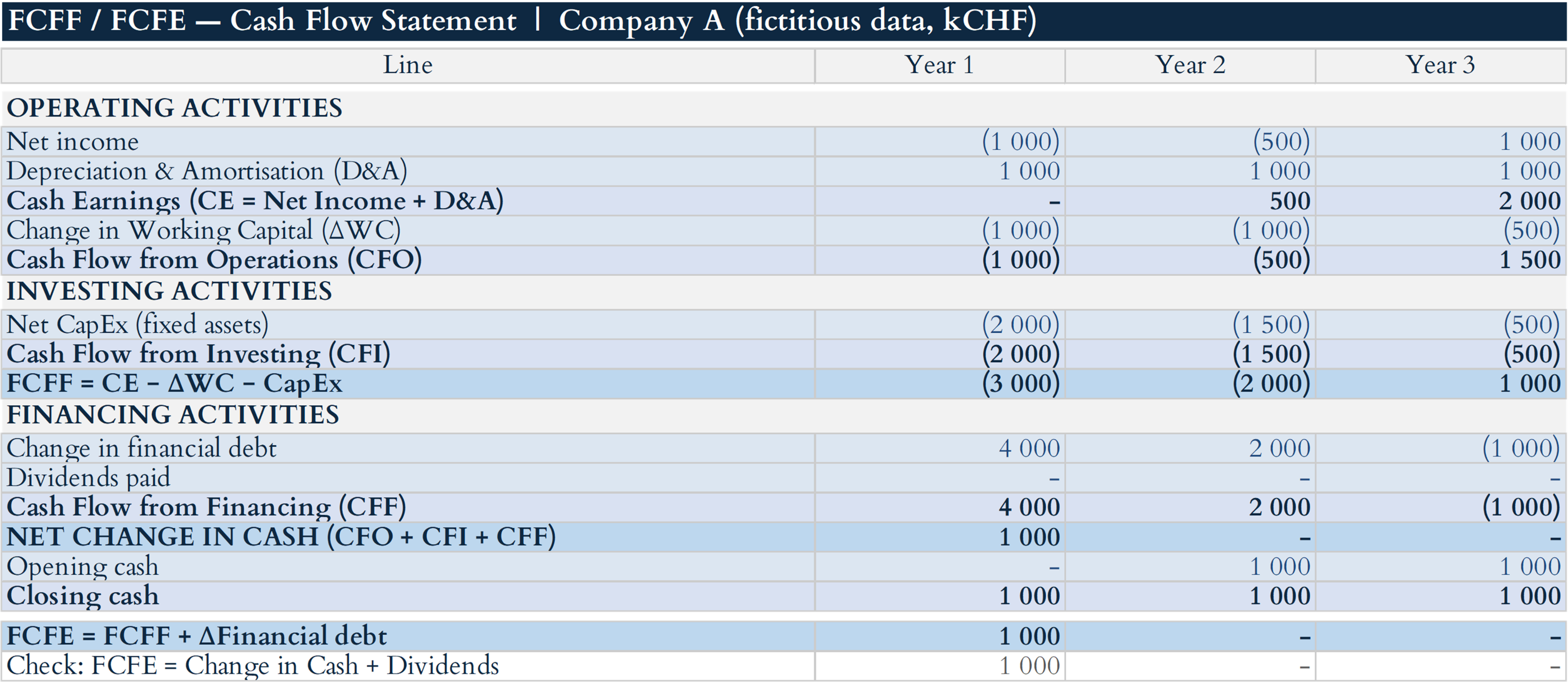
Direct reading of FCFF and FCFE
FCFF = SFC − ΔWCR − CapEx = (3,000) in Y1, (2,000) in Y2, 1,000 in Y3. The company is in an intensive investment phase in Y1 and Y2: negative cash flows reflect product build-out and early customer acquisition, not deterioration in recurring activity. In this simplified case where CFI contains only net CapEx, FCFF = CFO + CFI numerically.
FCFE is calculated by adding the net change in financial debt to FCFF. The accounting verification is direct:
Year 1: FCFF (3,000) + ΔDebt 4,000 = 1,000 = change in cash 1,000 + dividends 0. Check.
Year 2: FCFF (2,000) + ΔDebt 2,000 = 0 = change in cash 0 + dividends 0. Check.
Year 3: FCFF 1,000 + ΔDebt (1,000) = 0 = change in cash 0 + dividends 0. Check.
DCF valuation over 5 years (FCFF)
Valuation assumptions: WACC of 13% (Rf 1.2%, market premium 6%, beta 1.2, size premium 3%, specific premium 2%), terminal growth rate of 3%, net debt at end of Y3 of kCHF 4,000 (debt kCHF 5,000, cash kCHF 1,000).
FCFF projection N+1 to N+5 (kCHF): 2,000 — 3,000 — 4,000 — 4,500 — 5,000. Terminal Value (perpetuity): 5,000 / (0.13 − 0.03) = 50,000 kCHF. Present value of Terminal Value: 50,000 / (1.13^5) = 27,138 kCHF. Sum of discounted FCFF: 12,365 kCHF. Enterprise Value: 39,503 kCHF. Equity Value: 39,503 − 4,000 = 35,503 kCHF.
The sensitivity table below presents Equity Value in kCHF by WACC and terminal growth rate, after deduction of net debt of kCHF 4,000.
WACC / g terminal2%3%4%11%42,10046,20051,50013%33,00035,50038,50015%26,80028,40030,300
Equity Value — Company A (kCHF) by WACC and terminal growth rate, after deduction of net debt kCHF 4,000. TV formula: FCFF_N5 / [(1+WACC)^5 × (WACC−g)]. Source: Hectelion, illustrative case.
The valuation range extends from kCHF 26,800 (conservative scenario: WACC 15%, g 2%) to kCHF 51,500 (optimistic scenario: WACC 11%, g 4%), a ratio of 1 to 2 based solely on the variation in discount rate and terminal growth assumptions. This amplitude justifies producing a sensitivity analysis in every independent valuation report.
Managing Director’s Note
In the startup valuation mandates we conduct at Hectelion, the FCFF vs FCFE question typically surfaces after the spreadsheet is built, not before. The founder already has a figure in mind. What we observe is that this figure is almost always built on an implicit FCFE, without using the term, and discounted at a rate that is actually the WACC. Result: an overvaluation of 15 to 25%, invisible in the model.
The real question is not which method to use. It is: is the chosen method consistent with the discount rate, the treatment of net debt, the WCR projection, and terminal CapEx? These four consistencies are rarely verified simultaneously in the models we receive for independent review.
Our approach at Hectelion is bicephalous: we build both models in parallel, force them to converge, and if they do not, we look for the inconsistent assumption. FCFF / FCFE convergence is not an aesthetic objective. It is the only way to know the model is correct.
Aristide Ruot, Ph.D. — Founder & CEO, Hectelion
Audit (due diligence) and value your business now
Upload your accounts: Acontos’ AI rebuilds your normalised EBITDA and applies your sector’s multiples. Launch the free simulator →
FAQ: 10 questions on FCFF and FCFE
Q1: what is the difference between FCFF and FCFE?
FCFF measures cash flows available to all capital providers (shareholders and creditors) before debt payment. FCFE measures what remains for shareholders afterwards. FCFF discounted at the WACC gives Enterprise Value. FCFE discounted at Ke gives Equity Value directly.
Q2: can you get the same Equity Value with both methods?
Yes, under identical assumptions. EV (FCFF) − net debt = Equity Value (FCFE). If both models diverge, an assumption is inconsistent, typically in the financial debt projection or the chosen discount rate.
Q3: which discount rate should you use for each cash flow?
FCFF at the WACC, FCFE at Ke (cost of equity, calculated using augmented CAPM). Any inversion of this rule produces a structural error undetectable in the spreadsheet.
Q4: can FCFE be negative for a profitable startup?
Yes. If the startup is repaying debt during a growth phase while maintaining high CapEx, FCFE can be negative even with positive net income. FCFE = FCFF + ΔDebt: net debt repayment mechanically reduces FCFE.
Q5: how do you handle variable debt in FCFE?
Project the net change in financial debt (new debt minus repayments) year by year. FCFE will be positive in years of fundraising and potentially negative in years of net repayment. This is why FCFE is more unstable than FCFF for startups in an active financing phase.
Q6: which method do PE funds use in practice?
PE funds use FCFF discounted at WACC to value a target within their acquisition mandates, then derive Equity Value via net debt. FCFE is more widely used in internal equity return analyses (equity IRR) after acquisition debt structuring.
Q7: what is the difference between SFC and FCFF?
SFC is strictly the cash generated before any movement in working capital and before capital investment: SFC = Net Income + D&A. FCFF completes SFC by incorporating the WCR change and CapEx: FCFF = SFC − ΔWCR − CapEx. SFC is therefore greater than FCFF during investment phases and periods of WCR growth.
Q8: how do you read FCFF from a Swiss or French cash flow statement?
FCFF = SFC − ΔWCR − CapEx. In a simplified statement where CFI contains only net CapEx, the "Free Cash Flow to Operations" line (CFO + CFI) gives this result directly. If CFI contains other items (financial security acquisitions, asset disposals), CapEx must be extracted specifically from fixed asset lines to calculate FCFF.
Q9: are FCFF and EBITDA equivalent?
No. EBITDA is a balance before tax, WCR and CapEx. FCFF incorporates all three elements. For a startup, the gap between EBITDA and FCFF can represent 30 to 50% of EBITDA, primarily due to development CapEx and WCR growth. Applying an EBITDA multiple avoids this calculation, which explains practitioners’ preference for multiples at early-stage.
Q10: when does Hectelion recommend one over the other in a valuation mandate?
Hectelion builds both models in parallel and forces them to converge. FCFF is the primary model for mid-market M&A mandates and due diligence. FCFE is used for consistency checking and as a presentation metric for founders and VC funds. The convergence of both models is the central quality criterion in our independent valuation reports.
Would you like to have your company valued, conduct financial due diligence or structure a transaction?
→ Book a call — 30 minutes, confidential
Conclusion: FCFE vs FCFF: two paths to the same value, rarely the same result
FCFF and FCFE are two readings of the same economic reality: cash generated by the business, before or after financial leverage. Theoretically equivalent, they produce distinct valuations in practice as soon as debt, discount rate or WCR assumptions diverge. For a Swiss startup with CHF 20M revenue, the valuation range from varying discount rate and terminal growth assumptions alone can span a factor of two.
The fundamental rule is simple and absolute: FCFF at the WACC, FCFE at Ke. Any other combination produces a structural error undetectable in the spreadsheet. The 5 errors described in this article share a common characteristic: they produce a numerically plausible result with no visible alert.
The robustness of a DCF is not measured by the precision of its output figures. It is measured by the internal consistency of the model, the quality of the underlying business plan, and the rigour of the sensitivity analysis. This is why Hectelion cross-validates FCFF, FCFE and market multiples in its independent valuation mandates.
Summary of the FCFE vs FCFF publication
- SFC = Net Income + D&A.
- FCFF = SFC − ΔWCR − CapEx.
- FCFE = FCFF + Net change in financial debt.
The change in cash decomposes into CFO + CFI + CFF.
FCFF discounted at the WACC gives Enterprise Value; FCFE discounted at Ke gives Equity Value directly. Both must converge under identical assumptions: EV (FCFF) − net debt = Equity Value (FCFE). The 5 errors to avoid are: mixing calculation approaches, using observed rather than normalised ΔWCR, integrating growth CapEx into terminal value, inverting discount rates, and omitting dividends in the FCFE verification. For a Swiss SaaS startup with CHF 20M revenue, Equity Value ranges from kCHF 26,800 to kCHF 51,500 depending on discount rate and terminal growth assumptions.
Sources
- Berk, J. & DeMarzo, P. — Corporate Finance, 5th ed., Pearson, 2020 — ISBN 978-0-13-518380-9
- Damodaran, A. — Investment Valuation: Tools and Techniques for Determining the Value of Any Asset, 3rd ed., Wiley, 2012 — ISBN 978-1-118-13073-5
- French Accounting Standards Authority (ANC) — French GAAP (PCG) — anc.gouv.fr
- Hectelion SA — Internal observations on the Franco-Swiss M&A market and startup valuation mandates, 2026
- Modigliani, F. & Miller, M. — "The Cost of Capital, Corporation Finance and the Theory of Investment", The American Economic Review, vol. 48, no. 3, June 1958, pp. 261–297 — JSTOR 1809766
- Ruot, A. — Business Valuation: Comparing Traditional Valuation Methods and Real Options in the Petroleum Industry, doctoral thesis, CY Cergy Paris University, THEMA Laboratory, defended 13 December 2024 — theses.fr/2024CYUN1313
- Swiss GAAP FER — fer.ch
Author
Aristide Ruot, Ph.D.
Founder | CEO, Hectelion SA