
Impairment testing (IAS 36 / FER 27)
Impairment testing is the mandatory annual exercise of asset impairment required by IAS 36 (IFRS) and Swiss GAAP FER 27, by which the entity ensures that the carrying amount of its assets — goodwill, fixed assets, intangible assets, CGUs — does not exceed their recoverable amount at the closing date.
Beyond the accounting obligation, the impairment test underpins the reliability of consolidated financial statements, secures communication with auditors and protects executives from any subsequent challenge for inadequate provisioning.



What is an impairment test (asset impairment)?
The impairment test consists in comparing the carrying amount of an asset — or a cash-generating unit (CGU) — to its recoverable amount, defined as the higher of its fair value less costs of disposal and its value in use (Discounted Cash Flow). When the carrying amount exceeds the recoverable amount, an impairment loss must be recognised in the income statement.
Required annually by IAS 36 for goodwill and intangible assets with indefinite useful lives, and on a case-by-case basis whenever an indicator of impairment exists (operational underperformance, deterioration of the economic environment, significant increase in WACC, etc.), the impairment test is one of the most scrutinised topics by Big Four auditors during annual and half-year closings.
In a Swiss GAAP context, FER 27 imposes a similar logic: mandatory annual test for capitalised goodwill, comparison with value in use or net realisable value, and rigorous documentation of retained assumptions — discount rate, projection horizon, terminal growth rate, normative margins.
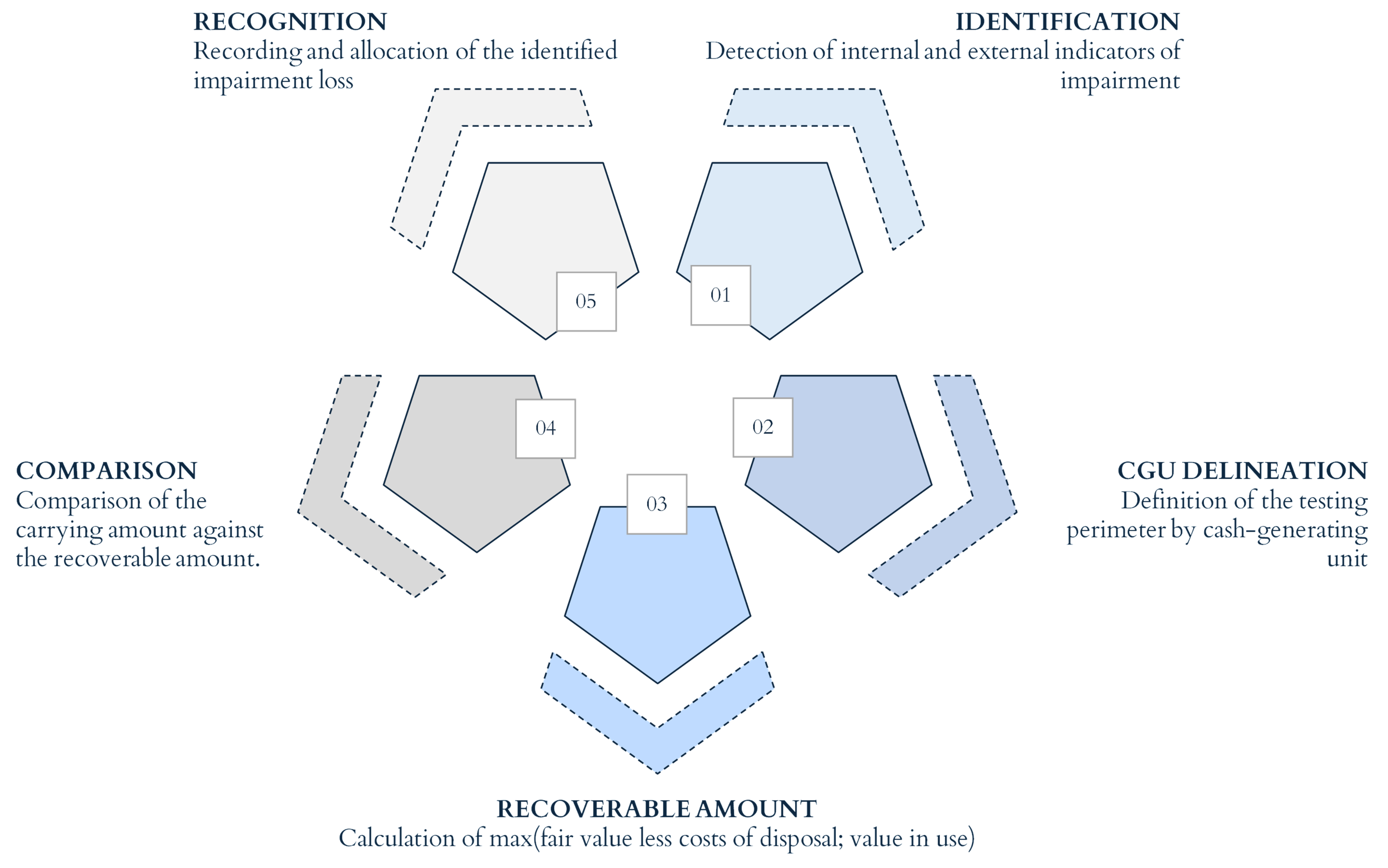
Step 1
CGU identification and goodwill allocation
Identify cash-generating units at the lowest level at which goodwill is monitored, and allocate goodwill between CGUs according to IAS 36.10 criteria.
Step 2
Detection of impairment indicators
Assess internal indicators (operational underperformance, restructuring) and external indicators (WACC, macroeconomic environment, listed comparables) at the test date.
Step 3
Value in use calculation (DCF)
Model projected cash flows over 5 to 10 years, calculate the WACC specific to each CGU and determine the terminal value (Gordon-Shapiro or exit multiple).
Step 4
Fair value less costs of disposal calculation
Estimate the CGU's fair value via multiples (transactions or listed) and deduct marginal disposal costs to compare with value in use.
Step 5
Sensitivity tests and trigger thresholds
Test sensitivity to critical assumptions (WACC, terminal growth, normative margins) and identify impairment trigger thresholds required by IAS 36.134.
Step 6
Delivery of the audit-grade impairment memo
Deliver a complete memo documenting assumptions, calculations, market data sources and sensitivities — defensible before Big Four statutory auditors and IFRS auditors.
Why and when to perform an impairment test?
An impairment test is mandatory at each annual closing for goodwill and intangible assets with indefinite useful lives, and triggered by any indicator of impairment during the year — budget underperformance, market downturn, restructuring or significant increase in cost of capital.

Annual closing
Performing the mandatory annual impairment test for goodwill and intangible assets with indefinite useful lives — IAS 36 and Swiss GAAP FER 27 requirement for consolidated accounts.

Half-year closing
Conducting an interim test at a half-year closing when an indicator of impairment appears — budget underperformance, market deterioration or WACC increase.

Post-acquisition (PPA follow-up)
Annually testing the value of intangible assets recognised in a prior PPA and residual goodwill to secure post-acquisition accounting follow-up.

Restructuring or turnaround
Documenting impairment losses following a restructuring, strategic change or partial disposal of business — securing the accounting and tax treatment.

Conflict with the auditor
Providing an independent second opinion when a statutory auditor contests the recoverable amount retained by the company — securing the position in case of material disagreement.

Preparation of a disposal
Assessing impairment risks upstream of a disposal to anticipate the P&L impact of the transaction and secure the quality of financial statements presented to buyers.
Our Impairment Testing methodology
A structured six-step approach, compliant with IAS 36, Swiss GAAP FER 27 and International Valuation Standards (IVS), producing documentation defensible before Big Four statutory auditors and tax authorities.
- CGU identification and goodwill allocation
We identify cash-generating units (CGUs) at the lowest level at which goodwill is monitored for internal management purposes, and allocate consolidated goodwill between CGUs in accordance with IAS 36.10 criteria. - Detection of impairment indicators
We systematically assess internal indicators (operational underperformance, missed strategic plan, restructuring) and external indicators (deterioration of the economic environment, WACC increase, depreciation of listed comparables) at the test date. - Value in use calculation (DCF)
We model projected cash flows over an explicit horizon (5 to 10 years depending on the CGU's economic cycle), calculate the WACC specific to each CGU, and determine the terminal value via the Gordon-Shapiro method or exit multiple. - Fair value less costs of disposal calculation
We estimate the CGU's fair value via the multiples method (comparable transactions, listed multiples) and deduct marginal disposal costs — to compare this value to the value in use and retain the higher as the recoverable amount. - Sensitivity tests and robustness analyses
We stress-test the recoverable amount against critical assumptions (WACC, perpetuity growth rate, normative EBITDA margin) and identify impairment trigger thresholds — disclosures required by IAS 36.134. - Delivery of the audit-grade impairment memo
We deliver a complete memo documenting all assumptions, calculations, market data sources and sensitivity analyses — structured to withstand examination by statutory auditors and IFRS auditors and compliant with IAS 36 disclosure requirements.
Diverse range of clients advised
SMES
Executives/Management
Family shareholders
Family businesses
Family Offices
Private equity funds

operations analyzed
years of expertise
clients advised
Discover our TRACK RECORD
The transactions presented were carried out by, with the contribution of, or with the participation of members of the Hectelion team in the context of functions performed currently or previously.
Frequently Asked Questions
The impairment test consists in comparing the carrying amount of an asset — or a CGU — to its recoverable amount, defined as the higher of fair value less costs of disposal and value in use (DCF). If the carrying amount exceeds the recoverable amount, an impairment loss must be recognised in the income statement.
IAS 36 requires an annual test for goodwill and intangible assets with indefinite useful lives, regardless of indicators. For other assets (fixed assets, intangibles with defined useful lives), the test is triggered as soon as an impairment indicator appears — underperformance, restructuring, deterioration of the economic environment.
A CGU is the smallest identifiable group of assets generating cash inflows largely independent of those from other assets. For goodwill testing, IAS 36.80 requires allocation at the lowest level at which goodwill is monitored for internal management purposes, without exceeding an operating segment.
Value in use is calculated by discounting projected future cash flows over an explicit horizon (5 to 10 years), at the CGU-specific WACC. A terminal value is added using the Gordon-Shapiro method or exit multiple. Cash flows must be pre-tax and the WACC pre-tax (IAS 36.55).
IAS 36 (IFRS) and FER 27 (Swiss GAAP) follow a similar logic — annual goodwill test, comparison of carrying amount to recoverable amount — but FER 27 allows two treatments for goodwill (capitalisation and amortisation, or direct charge to equity) and is generally less prescriptive on DCF methodology.
A standard impairment engagement takes between 3 and 6 weeks depending on the number of CGUs to test, the complexity of projections and the quality of available data. For goodwill to be tested across 3-5 CGUs in a Franco-Swiss mid-cap context, expect 4 weeks on average.
Under IAS 36, yes for most assets (reversal possible if the recoverable amount increases), but NO for goodwill — any goodwill impairment loss is irreversible (IAS 36.124). Under Swiss GAAP FER 27, reversal is possible for goodwill if the capitalisation-amortisation method is applied.
For a standard engagement covering 3 to 5 CGUs in a Franco-Swiss mid-cap context (revenue CHF 50M to CHF 500M), expect between CHF 20,000 and CHF 80,000. Recurring annual engagements benefit from a 30-40% discount from the 2nd year onwards thanks to accumulated knowledge of CGUs and models.
IAS 36 requires a pre-tax CGU-specific WACC reflecting the specific risks of its cash flows. The build-up involves: risk-free rate (10-year OAT or Swiss Confederation), market premium, sector beta adjusted to the CGU's capital structure, size premium and — where relevant — specific risk premium.
Impairment is generally carried out by the company itself then reviewed by its Big Four auditor. Engaging an independent firm like Hectelion upstream allows: (1) securing the methodology before the auditor review; (2) bringing an external opinion in case of material disagreement on the recoverable amount; (3) saving time at the closing date.