
Securities tokenisation and valuation
Tokenisation and DLT (Distributed Ledger Technology) asset valuation is the independent valuation exercise of tokens, security tokens, NFTs and digital assets registered on a blockchain — whether they represent shares, debt, real-world assets, utility rights or means of payment.
An emerging niche at the heart of the Swiss regulatory framework (DLT Act, FINMA Token Categorisation Guidance), the valuation of these assets combines traditional financial-instrument valuation methods with token-economy-specific expertise — protocol economics, velocity, secondary-market liquidity and regulatory risk.



What is securities tokenisation and pre-issuance valuation?
Securities tokenisation (security token offering, STO) consists in representing traditional financial rights — shares, partnership interests, debt, fund units — in the form of digital tokens registered on a distributed ledger (blockchain). Unlike the classic ICOs that flourished in 2017-2018, STOs rely on a strict legal framework: tokens are securities subject to the same obligations as traditional securities (prospectus, transparency, AMF/FINMA compliance).
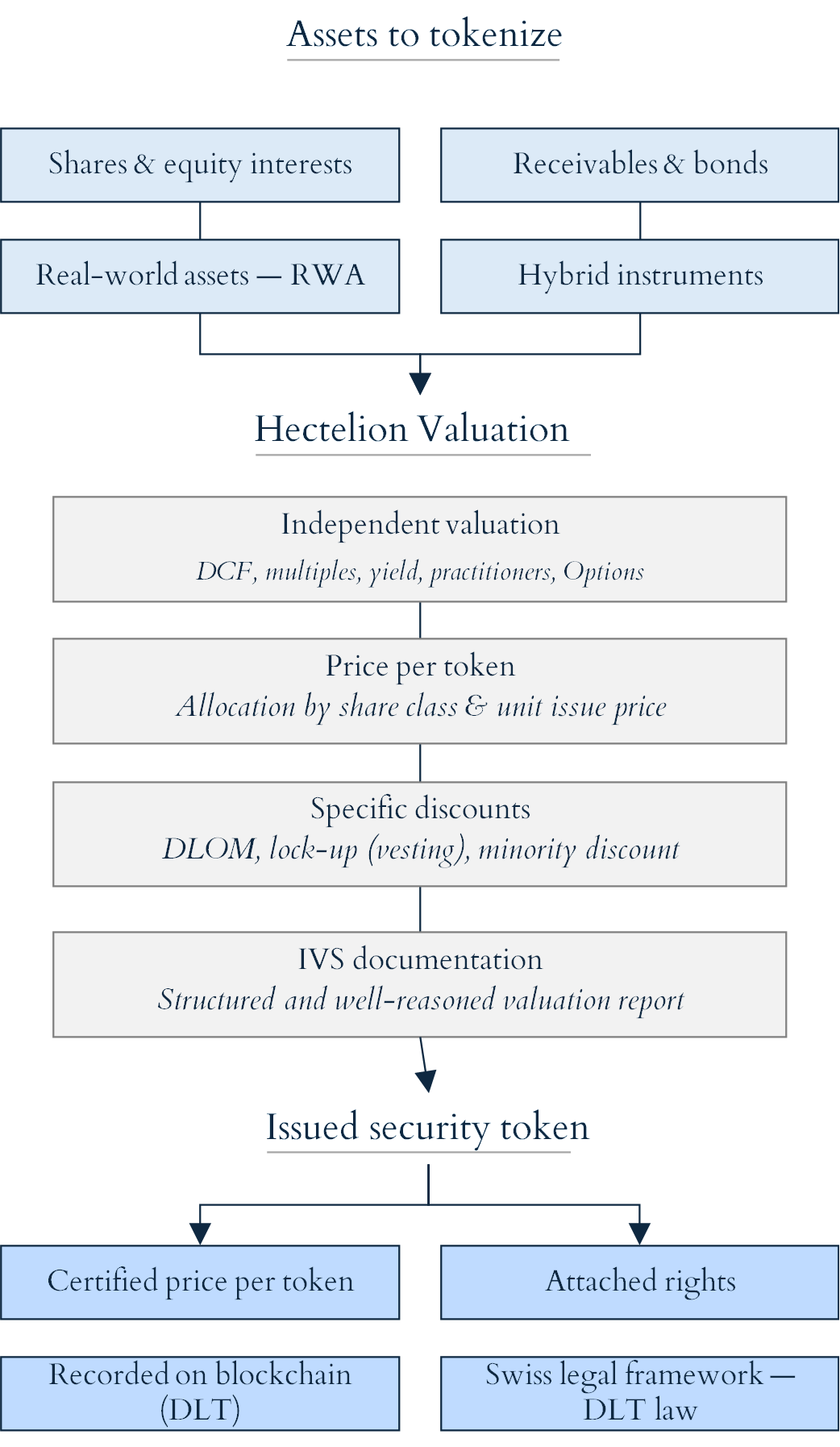
Pre-issuance valuation is the founding step of any tokenisation operation. It determines the issuance price per token based on an independent business valuation (DCF, comparable multiples, specific financial-instrument valuation) and a rigorous allocation between tokenised and non-tokenised securities classes. Without this valuation, the operation exposes the issuer to future challenges from investors and major regulatory risk.
Switzerland offers the world's most advanced regulatory framework for STOs via the DLT Act (in force 2021): legal recognition of value-rights registered on blockchain (CO art. 973d-973i), DLT licence for trading platforms and clarification of the accounting regime. Hectelion intervenes in partnership with your fintech legal counsel to combine valuation expertise and regulatory compliance. Hectelion is not a FINMA-regulated institution. The independent valuation we produce is an unregulated financial valuation service, distinct from reserved activities (trading, prospectus, custody) which fall exclusively to your fintech legal firm and licensed DLT platforms.
Step 1
Tokenisation operation rationale
Analyse the structure (tokenised scope, supply, attached rights, vesting) and coordinate with your fintech legal counsel for upstream FINMA classification.
Step 2
Independent business valuation
Apply DCF, listed-company multiples and transaction multiples depending on the maturity of the company (early-stage, scale-up, mature).
Step 3
Valuation of token-attached instruments
Value specific rights (conversion options, preferred dividends, liquidation preference, vesting) via Black-Scholes, binomial models or OPM.
Step 4
Calculation of issuance price per token
Determine the unit price per token: equity value allocated to the tokenised class, divided by issued supply, with adjustments (discounts/premiums).
Step 5
Token-specific discount analysis
Integrate discounts specific to security tokens: illiquidity (DLOM), lock-up (vesting), governance — documentation according to IVS principles.
Step 6
Delivery of the pre-STO valuation report
Deliver a complete valuation report intended for your management and accredited legal counsel, who use it under their sole responsibility (internal support for whitepaper, prospectus or investor documentation). Hectelion does not intervene in prospectus drafting, tax advice or token marketing.
Why and when to perform a pre-tokenisation valuation?
A pre-tokenisation valuation is required whenever a company plans to issue security tokens — whether for an STO fundraising, partial tokenisation of capital, distribution of tokenised shares to employees or a digital assets platform (real estate, art, private equity).

Security Token Offering (STO)
Pre-issuance valuation of an STO operation intended for qualified Franco-Swiss investors — determination of issuance price per token and structuring of attached rights.

Partial capital tokenisation
Tokenising a fraction of share capital to open shareholding to new investors without full dilution — independent valuation of the tokenised class and the residual class.

Tokenised shares for employees
Valuing and structuring an allocation of tokenised shares as part of an employee incentive plan — a modern alternative to traditional BSPCE and stock options.

Real-world asset (RWA) tokenisation
Valuing a tokenisation operation on real estate, art, infrastructure or private equity assets — issuance price determination and programmed liquidity structuring.

DLT platform and regulated issuance
Supporting a licensed DLT platform (2021 DLT Act) in valuing listed assets and defining pricing rules for the secondary market.

Pre-sale / IPO tokenisation
Conducting pre-tokenisation valuation as a preparatory step for a future sale or IPO — tokenisation offers intermediate liquidity for existing shareholders.
Our pre-tokenisation valuation methodology
A structured six-step approach, combining valuation methods recognised by the IVSC and the legal specificities of the Swiss DLT framework, producing a documented report usable internally by your management and legal counsel.
- Tokenisation operation framing
We analyse the envisaged structure: tokenised scope (share capital, hybrid instruments, asset fraction), securities class concerned, total planned supply, issuance schedule, attached rights (governance, dividends, programmed liquidity). Coordination with your fintech legal counsel to validate upstream FINMA classification (asset / security token). - Independent business valuation
We apply the recognised business valuation methods: Discounted Cash Flow (DCF) with sensitivity analyses, listed comparable-company multiples, comparable-transaction multiples. We account for sector specificities and the maturity of the company (early-stage, scale-up, mature). - Valuation of financial instruments attached to tokens
When tokens incorporate specific rights (conversion options, preferred dividends, liquidation preference, vesting mechanisms), we apply specialised valuation methods (Black-Scholes, binomial models, OPM). - Calculation of the issuance price per token
We determine the unit price per token from the equity value allocated to the tokenised class, divided by the issued supply, with adjustments for any discounts and premiums. - Token-specific discount analysis
We integrate discounts specific to security tokens: illiquidity discount (DLOM) if no active secondary market, lock-up discount (imposed vesting period), premium or discount according to attached governance rights. - Delivery of the pre-STO valuation report
We deliver a complete valuation report intended for your management and accredited legal counsel, who may, under their sole responsibility, use it as an internal support document in the preparation of the whitepaper, prospectus or investor documentation. Hectelion does not intervene in prospectus drafting, tax advice or token marketing.
Diverse range of clients advised
SMES
Executives/Management
Family shareholders
Family businesses
Family Offices
Private equity funds

operations analyzed
years of expertise
clients advised
Discover our TRACK RECORD
The transactions presented were carried out by, with the contribution of, or with the participation of members of the Hectelion team in the context of functions performed currently or previously.
Frequently Asked Questions
Securities tokenisation, or Security Token Offering (STO), consists in issuing traditional financial securities (shares, bonds, fund units, debt) in the form of digital tokens registered on a distributed ledger (blockchain). Unlike unregulated ICOs, security tokens are securities subject to the same legal obligations as traditional securities — transparency, prospectus, AMF/FINMA regulatory compliance.
An ICO (Initial Coin Offering) typically issues utility tokens (rights to use a service) or payment tokens, often without a strict regulatory framework. An STO (Security Token Offering) issues security tokens representing financial rights (shares, bonds) and is subject to securities regulations (AMF in France, FINMA in Switzerland) — prospectus, compliance, prior legal classification.
The issuance price per token results from the company's equity value (determined by DCF, multiples or hybrid methods) allocated to the tokenised securities class, divided by the total supply of issued tokens. Adjustments are applied: illiquidity discount (DLOM) if no secondary market, lock-up discount if vesting period, premiums or discounts depending on attached rights (governance, preferred dividends).
For the production of an independent pre-STO valuation report, no FINMA accreditation is required — it is an expertise service. However, the STO issuer (the company that tokenises) must comply with securities obligations (prospectus, FINMA classification, AML declaration) — hence the importance of coordinating with a specialised fintech legal firm from the start of the project.
A security token can incorporate most rights of a traditional security: voting rights (governance), dividend rights (preferred or not), liquidation rights, pre-emptive rights, information rights. Blockchain specifics: smart-contract-programmed vesting, per-investor holding caps, automatic transfer restrictions (KYC/AML compliance coded into the token) and automatic dividend distribution via smart contract.
A standard pre-tokenisation valuation engagement takes between 4 and 8 weeks depending on the maturity of the company, the complexity of tokenised financial instruments (simple equity vs equity + options + vesting) and the coordination required with your fintech legal counsel. For a mid-market scale-up with a classic tokenisation structure, expect 5-6 weeks on average.
For a standard engagement covering business valuation (DCF + multiples), valuation of token-attached instruments (options, vesting) and issuance price calculation, expect between CHF 20,000 and CHF 80,000 depending on complexity. Fees are fixed (never contingent on STO success) to guarantee valuation independence.
Access depends on the legal regime and FINMA / AMF token classification. In Switzerland, STOs are generally reserved for qualified investors (FinSA art. 4) unless a full prospectus is validated. In France, the AMF distinguishes public offering from private placement. This legal question is handled by your fintech legal counsel — Hectelion produces the underlying economic valuation, independent of the distribution regime.
Our methodology integrates close coordination with your fintech legal counsel throughout the engagement: (1) upstream to validate FINMA classification and tokenised scope; (2) during the engagement to ensure the rights structuring is legally defensible; (3) downstream for consistency between the valuation report and the prospectus / whitepaper. If you do not yet have fintech counsel, we can refer you to partner firms in Switzerland.
The base is identical at 90% — same methods (DCF, multiples), same methodological rigour, same IVS standards. The 10% specific points relate to: (1) allocation between tokenised and non-tokenised securities classes; (2) valuation of specific rights coded in the smart contract; (3) illiquidity or lock-up discounts specific to the token; (4) consistency with the FINMA / AMF legal classification. It is therefore a classic valuation enriched by tokenisation expertise.