
System Readiness Level (SRL): Definition, Assessment and Impact on the Cost of Capital (WACC)
SRL and WACC: how a system's maturity translates into a risk premium

Introduction: why a system's maturity shapes its cost of capital
Why do two companies with the same revenue, in the same market, raise capital at radically different rates? The answer often lies in a variable that classic financial models struggle to capture: the true technological maturity of the system that carries the value proposition. The System Readiness Level (SRL), or system maturity level, is precisely the indicator that measures the extent to which a set of technologies, once integrated, is ready to operate in its target operational environment. Rooted in defence and space engineering, it extends the Technology Readiness Level (TRL) by adding the decisive dimension of integration, as formalised by the ESA in its reference TRL scale.
"The SRL is a measure of a system's ability to function within a defined operational mission, even as it continues to mature.", Sauser, Ramirez-Marquez et al., From TRL to SRL: The Concept of Systems Readiness Levels, 2006.
In 2026, three forces are converging to make the SRL a topic for the finance function, not just for engineers. First, the deeptech wave and reindustrialisation, driven in France by France 2030 and in Switzerland by Innosuisse, are pouring capital into projects whose value depends entirely on still-uncertain technological maturity. Second, the durable rise in interest rates has made capital more expensive and made imprecision in risk estimation intolerable. Third, industrial acquirers now pay an explicit premium for de-risked technological assets and apply a steep discount to those that are not. This article defines the SRL, traces its origins, explains how it is built, proposes a correspondence grid between maturity level and risk premium in the calculation of the weighted average cost of capital (WACC), then illustrates the mechanics through two worked cases, before setting out five mistakes to avoid, a ten-question FAQ and a summary.
Turn your technological maturity into a valuation argument
Before getting into the detail, keep the essentials in mind: one point of system maturity gained can be worth several points of WACC saved, and therefore tens of percent of additional enterprise value. If you are preparing a fundraising round, a deeptech acquisition or the sale of an industrial SME whose value rests on an innovative process, book a 30-minute conversation with Hectelion to translate your SRL level into defensible discount-rate assumptions. Our valuations rely on a multi-method methodology aligned with IVSC standards and on a Franco-Swiss reading of technological risk.
Definition: what is the System Readiness Level (SRL)?
The System Readiness Level (SRL) is a composite index that measures how ready a complete system is to fulfil its operational mission. It does not merely assess the maturity of each technological building block in isolation; it incorporates the maturity of the interfaces between those blocks. Concretely, the SRL results from combining two families of indicators: the Technology Readiness Level (TRL), which rates the maturity of each technology on a scale of 1 to 9, and the Integration Readiness Level (IRL), introduced by Gove, Sauser and Ramirez-Marquez in 2007, which rates on a scale of 1 to 9 the maturity of each integration point between two technologies, from a simple finding of compatibility (IRL 1) to integration proven in an actual mission (IRL 9). The founding model of Sauser and Ramirez-Marquez computes the SRL as the matrix product of the TRL and IRL vectors, normalised on a scale of 0 to 1. One essential point to avoid any misreading: the SRL is a scale of maturity, not of risk. The higher the SRL, the more operational the system, hence the less risky it is and the lower the discount rate applied; a low SRL, on the contrary, signals an immature, riskier system that calls for a higher risk premium.
This distinction is crucial for a valuer. A company may line up individually mature components (high TRLs) while remaining fragile at the system level, because their integration has never been demonstrated under real conditions (low IRLs). The SRL captures precisely this integration risk, which is often the true bottleneck between a laboratory prototype and a profitable industrial product. That is why it offers a richer risk signal than the TRL alone, and therefore a sounder basis for calibrating a discount rate. For the normative definition of the underlying TRL, the international reference remains the standard ISO 16290:2013.
Origins: from the American space programme to corporate finance
The technology maturity scale was born at NASA in the 1970s, to discipline commitment decisions on costly and irreversible space technologies. The TRL concept was then formalised, adopted by the U.S. Department of Defense, and later standardised at international level by ISO 16290:2013 for space systems and taken up by the European Commission. The latter made it a pillar of its framework programmes: the dedicated general annex of the Horizon programme defines the nine levels and now serves as a common language for the entire European innovation ecosystem, as set out in the TRL grid in Annex G and the Funding & Tenders portal FAQ.
The TRL nonetheless suffered from a recognised limitation: it assesses isolated technologies, not integrated systems. To fill this gap, Brian Sauser, José Ramirez-Marquez and their co-authors at the Stevens Institute of Technology introduced the System Readiness Level in 2006, coupling the TRL with an Integration Readiness Level. In parallel, the Department of Defense developed the Manufacturing Readiness Level (MRL) to measure industrial maturity, documented in the MRL Deskbook. From this heritage a whole family of maturity indicators was born. Their transposition to corporate finance is recent, but its logic is clear: if risk decreases as maturity progresses, then maturity must be read in the cost of capital.
Why integrate the SRL into valuation and the cost of capital
Integrating the SRL into valuation objectifies technological risk, disciplines the specific risk premium with a reproducible and auditable anchor, aligns the valuation with verifiable development milestones, creates a common indicator for engineers and CFOs, and strengthens sensitivity analysis by linking each maturity band to a premium range that shows the value effect of a missed milestone.
Integrating the SRL into a valuation answers five converging motivations. First, it objectifies an intuition that every deeptech investor holds without always quantifying it: an unintegrated technology is riskier than a technology validated in a real environment. Translating this intuition into a measurable level moves the discussion beyond opinion. Second, it disciplines the specific risk premium. In a build-up approach, the premium tied to technological immaturity is often set by guesswork; the SRL provides a reproducible, auditable anchor.
Third, it aligns the valuation with the project's real milestones rather than management's declared timetable. A crossed SRL is a verifiable fact, not a promise. Fourth, it makes the dialogue between engineer and CFO productive: the same indicator serves to steer development and to calibrate the discount rate, which aligns internal incentives. Fifth, it improves the robustness of sensitivity analysis. By explicitly linking each SRL band to a premium range, the valuer can show the board the effect of a missed milestone on value, and therefore justify allocating development capital where it compresses risk the most.
How the SRL is built and translated into a risk premium
The SRL is built in six steps: map the system into technologies and interfaces, rate each technology in TRL, rate each interface in IRL, compute the composite index normalised between 0 and 1, place it in a Sauser maturity band, then associate each band with a technological risk premium added to the cost of equity.
Building an SRL and translating it into financial terms follow a six-step methodology.
Step 1: map the system. The product is broken down into elementary technologies and into integration points between those technologies, which defines the system matrix.
Step 2: rate each technology in TRL. Each block receives a level from 1 to 9 according to the standardised scale, from the observed scientific principle (TRL 1) to the system proven in operation (TRL 9).
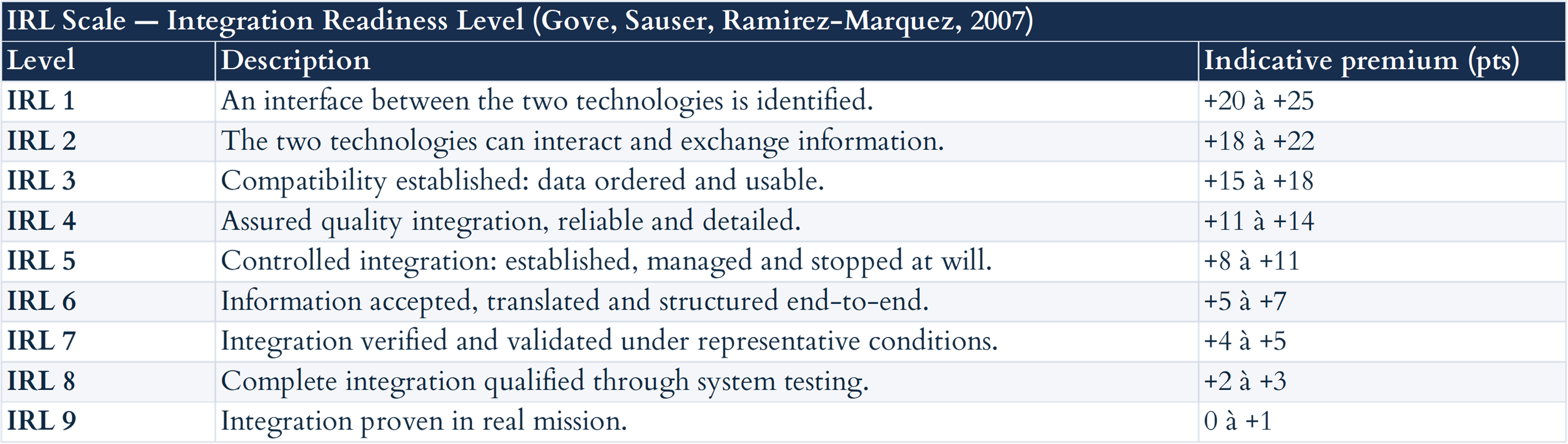
Step 3: rate each interface in IRL. Each integration point receives a maturity level, from a simple finding of compatibility to integration validated in mission.
The TRL scale used at Step 2 is standardised and identical to the one detailed in our dedicated publication on the Technology Readiness Level (TRL).
This third step relies on the IRL scale formalised by Gove, Sauser and Ramirez-Marquez in 2007, modelled on the logic of the TRL but applied to the links between technologies rather than to the blocks themselves.
Step 4: compute the composite SRL. The TRL and IRL vectors are combined according to the matrix model to obtain an index normalised between 0 and 1, then the system is placed in one of the five maturity bands of the Sauser framework (Concept Refinement 0.10-0.39, Technology Development 0.40-0.59, System Development & Demonstration 0.60-0.79, Production & Deployment 0.80-0.89, Operations & Support 0.90-1.00, per the Sandia report SAND2010-7595).
Step 5: associate a risk premium with the band. This is Hectelion's own methodological contribution: each SRL band corresponds to a range of technological risk premium, added to the cost of equity in a build-up logic. The orders of magnitude below draw on the discount rates observed in venture capital, from 30% to 70% depending on stage, documented in particular by the work of Aswath Damodaran on the cost of capital.
A worked example sheds light on the matrix calculation, and it is the one reproduced by our downloadable calculator. Take a two-block system: a proven sensor (TRL 9, i.e. 1.00 after normalisation on 9) and an algorithm still in the laboratory (TRL 5, i.e. 0.56), linked by an interface of intermediate maturity (IRL 5, i.e. 0.56). The model assigns each block a partial SRL that combines its own TRL with the IRL of its link: for the sensor, (1.00 + 0.56 × 0.56) / 2 ≈ 0.65; for the algorithm, (0.56 × 1.00 + 0.56) / 2 = 0.56.
The system SRL is the average of these partial SRLs, i.e. about 0.605. The result is instructive: despite a perfectly mature sensor, the system caps at 0.605 because the incomplete interface drags it down. A simple average of the TRLs would have shown 7 out of 9, i.e. about 0.78, and masked this integration risk; that is precisely what the matrix computation of the SRL brings out. This SRL of 0.605 places the system in the system development and demonstration band, to which the Hectelion grid associates a premium of +4 to +7 points.
Hectelion's indicative correspondence grid is as follows.

Step 6: inject the premium into the WACC and propagate the effect onto enterprise value through the discounting of cash flows, as illustrated below.
Example: integrating the SRL into the WACC calculation
The SRL enters the WACC in three movements: build a base cost of equity by capitalisation (risk-free rate, beta times market premium, size premium), add the technological risk premium of the SRL band, then weight the result with the after-tax cost of debt. The premium affects only the equity component of the cost of capital.
Integrating the SRL into the WACC follows three movements. First, the base is established, that is, the cost of equity of a mature comparable, built up by capitalisation (build-up): a risk-free rate, increased by the product of the sector beta and the market premium, then by a size premium. Next, the technological risk premium from the SRL band is added. Finally, this cost of equity is weighted with the cost of debt to obtain the WACC. The SRL premium therefore affects only the equity component of the cost of capital.
Starting from an illustrative base of 9% (risk-free rate of 1.0%, beta of 1.1 applied to a market premium of 5.5%, size premium of 2%), the SRL premium translates directly into cost of equity as follows.
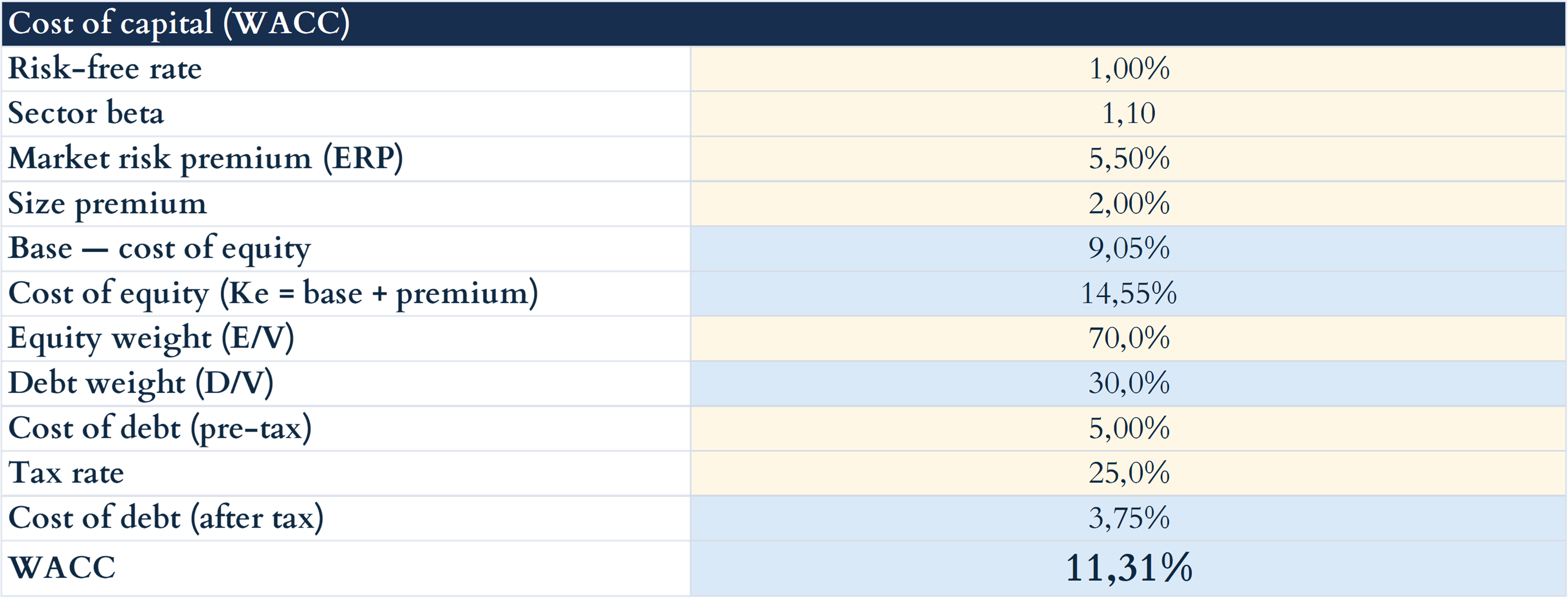
It remains to move from the cost of equity to the WACC, and this is exactly the calculation the calculator reproduces.
Take again the sensor + algorithm system: its SRL of 0.605 places it in the system development and demonstration band, to which a premium of +4 to +7 points corresponds, i.e. +5.5 retained, well below the +15 cap. Detailing the build-up, the base comes out at 9.05% (risk-free rate of 1.0%, beta of 1.1 applied to a market premium of 5.5%, size premium of 2.0%); the cost of equity therefore reaches 9.05% + 5.5 = 14.55%.
Financed 70% by equity and 30% by debt, with a cost of debt of 5.0% before a 25% tax, i.e. 3.75% after tax, the company shows a WACC of (0.70 × 14.55%) + (0.30 × 3.75%) = 10.19% + 1.13% = about 11.31%. The same company financed entirely by equity, like a pre-revenue start-up, would retain a WACC equal to its cost of equity, i.e. 14.55%.
Two lessons for the CFO. First, the SRL premium applies only to the equity portion: debt dilutes its effect, which explains why a given progression in maturity weighs more on the value of an unleveraged start-up than on that of an SME financed with leverage. Second, the 9% base is only an example: it varies by sector, country, beta and size, and must be recomputed for each case before adding the SRL premium.
A methodological clarification, which extends the fourth mistake to avoid: in practice this premium is capped, and part of the failure risk is handled more rigorously on the cash flows, through a probability of success, rather than in the discount rate alone. Take the example again: if the expected exit in case of success is worth 30 MCHF and the probability of survival is estimated at 50% (failure value nil), the expected value is no longer 30 but 0.50 × 30 = 15.0 MCHF.
Cramming, conversely, the entire risk of an immature concept into the cost of equity would produce unusable rates. It is this dual approach, capped premium and probability of survival, that the SRL calculator we provide reproduces, in line with the work of Aswath Damodaran on valuing young companies.
When to use the SRL in a financial transaction
The SRL is most useful in deeptech or medtech fundraisings, industrial acquisitions where value rests on an innovative process, sale decisions weighing an immediate exit against a maturity milestone, impairment tests on technological assets, milestone-conditioned tranche financing and R&D portfolio arbitration. It adds little for mature services companies without a differentiating technological component.
Resorting to the SRL is called for in several trigger situations. During a deeptech or medtech fundraising, it helps justify the pre-money valuation by linking the discount rate to the technological milestone reached, rather than to a multiple of comparables that are barely relevant for a pre-revenue company. During an industrial acquisition where part of the value rests on an innovative process or production line, it clarifies for the buyer the residual industrialisation risk and the discount to apply. During a sale, it helps the director decide between selling now or first crossing a maturity milestone to capture a higher premium.
The SRL is also relevant during an asset impairment test on technological fixed assets, when structuring milestone-conditioned tranche financing, or when arbitrating a portfolio of R&D projects where capital must be allocated to the projects that most efficiently reduce risk per franc invested. Conversely, it adds little value for a mature services company without a differentiating technological component, where classic comparable and cash-flow methods suffice.
Whom to call on to link technological maturity and valuation
Linking technological maturity and valuation calls for an advisor combining three competences: systems engineering to situate the SRL honestly, valuation expertise to translate maturity into defensible discount-rate assumptions, and knowledge of innovation financing ecosystems in France and Switzerland. Independent corporate finance firms such as Hectelion combine these skills on transactions of 2 to 500 MCHF.
Valuing a company whose value depends on its technological maturity requires a rare triple competence. First, a fine understanding of systems engineering to honestly situate the SRL level, without indulgence towards management's commercial narrative nor excessive engineering caution. Second, a command of valuation methods and of building the cost of capital, to translate this level into discount-rate assumptions that are defensible before an investor, an acquirer or an auditor. Third, a knowledge of innovation financing ecosystems, in France as in Switzerland, to calibrate the ranges against market reality.
Hectelion combines this dual Franco-Swiss expertise and conducts its valuations in full economic independence from traditional financial intermediaries. We operate on transactions of 2 to 500 MCHF, mobilising an IVSC-aligned valuation methodology and financial structuring expertise suited to milestone-based technological projects. For external growth or divestment transactions, our M&A advisory incorporates the reading of technological risk from the very framing of the deal.
Advantages: objectivity, traceability and strategic alignment
The first advantage of the SRL applied to valuation is objectivity. By substituting a measurable indicator for a subjective appraisal of the risk premium, the valuer reduces the share of arbitrariness and strengthens the credibility of its conclusions before an investment committee or an auditor. The debate no longer turns on the existence of risk, but on the correct classification of the system within a shared grid, which is a considerable advance in terms of governance.
The second advantage is traceability. Each rate assumption is tied to a documented maturity level, itself tied to verifiable technical milestones. This chain of justification withstands challenge and makes it easy to update the valuation at each milestone crossing. The third advantage is strategic alignment: by showing in black and white how much a point of maturity gained is worth, the SRL steers the allocation of development capital towards the milestones that create the most shareholder value, and turns an engineering roadmap into a value-creation roadmap.
Limitations: residual subjectivity, aggregation and data dependence
The first limitation lies in the residual subjectivity of the rating. Assigning a TRL or an IRL remains an expert judgement, and two valuers may differ by one level, especially in the intermediate bands. The SRL reduces arbitrariness, it does not eliminate it; its value depends on the rigour and independence of whoever does the rating. The second limitation concerns aggregation: reducing a complex system to a single index between 0 and 1 necessarily loses information, and the same SRL may cover very different risk profiles depending on the criticality of the interfaces involved.
The third limitation is data dependence and calibration. The correspondence grid between SRL band and risk premium rests on ranges observed in venture capital and on the valuer's judgement; it must be adapted to the sector, geography and market cycle, and cannot be applied mechanically. Finally, the SRL does not capture non-technological, regulatory, commercial or competitive risks, which must be handled separately. It is a powerful instrument for calibrating technological risk, not a black box that would dispense with fundamental analysis.
The 5 mistakes to avoid
Mistake 1: Confusing TRL and SRL
The most frequent mistake is to reason on the TRL alone while ignoring integration. A company may show components at TRL 7 or 8 while remaining at a low SRL because those components have never worked together under real conditions. Confusing the two leads to underestimating integration risk, which is precisely what causes the transition from prototype to product to fail. The valuer must always examine the maturity of the interfaces, and not only that of the blocks.
Mistake 2: Trusting the SRL declared by management
The maturity level announced by founders is almost always optimistic, not out of dishonesty but out of enthusiasm. Accepting this level without verification amounts to importing a bias directly into the discount rate, and therefore overvaluing the company. The SRL level must be established independently, from tangible evidence: tests, qualifications, feedback from a representative environment. A claimed milestone is not a crossed milestone until it is documented.
Mistake 3: Applying the premium grid mechanically
The correspondence between SRL band and risk premium provides a framework, not an absolute truth. Applying the ranges without adapting them to the sector, capital intensity, regulatory framework and market cycle produces wrong rates with false precision. A medtech device subject to regulatory approval does not carry the same risk as software at an equivalent SRL. The grid adjusts to the case, it does not replace it.
Mistake 4: Cramming all risks into the discount rate
As Aswath Damodaran points out regarding the valuation of young companies, a classic mistake is to compress the risk of failure into the discount rate. The SRL must calibrate technological risk, not serve as a catch-all also absorbing commercial risk, market risk or default risk. Mixing these risks into a single rate makes the analysis opaque and prevents any steering. It is better to treat the probability of failure explicitly in the cash-flow scenarios and reserve the SRL premium for its proper function.
Mistake 5: Forgetting to update the valuation at each milestone
A valuation based on the SRL only makes sense if it is revised as maturity evolves. A crossed milestone must immediately translate into a compression of the risk premium and an upward revaluation; conversely, a missed milestone must trigger a prudent revaluation. Freezing a valuation on an old SRL denies the very dynamic the indicator is meant to measure. The value of a technology company is a living quantity, indexed to its maturity trajectory.
Case 1: Series A round of a Swiss medtech at SRL 0.4
A Swiss medtech is developing a diagnostic device whose components are validated in the laboratory but whose clinical integration is only just beginning. The valuation places the system at an SRL of about 0.4, in the technology development band (TRL 4 to 5). The company is pre-revenue and finances itself entirely with equity, so that its WACC reduces to its cost of equity. The base, estimated from a mature medtech comparable, settles around 9%: CHF risk-free rate of 1.0%, sector beta of 1.1 applied to a market premium of 5.5%, i.e. 6.05%, increased by a size premium of 2%. To this base is added the technological risk premium tied to SRL 0.4, calibrated at +12 points within the band's range. The discount rate retained therefore comes out at about 21%.
The valuation stake can be read in the sensitivity to crossing the next milestone. Suppose an anticipated exit value of 60 MCHF over a five-year horizon. Discounted at 21%, its present value comes out at 60 / (1.21)^5 = 23.1 MCHF. If the company crosses its clinical pilot and moves its system to an SRL of about 0.6, the risk premium compresses from +12 to +5 points and the rate falls to about 14%. The same 60 MCHF exit is then worth 60 / (1.14)^5 = 31.2 MCHF. Crossing a single maturity band thus creates 8.1 MCHF of value, i.e. +35% of pre-money, without any commercial assumption having changed. This gap provides a decisive argument for discussing the timing and amount of the round, and for demonstrating the return on the capital allocated to the clinical pilot.
Case 2: Acquisition of a French industrial SME between SRL 0.7 and 0.9
A French industrial SME generates 4 million EUR of EBITDA, a significant part of which rests on an automated production line with a proprietary process. Demonstrated in a representative environment but not yet fully industrialised, this line places the system at an SRL of about 0.7. The reference WACC of a mature industrial SME settles around 8.5%: cost of equity of 12% (EUR risk-free rate of 3.0%, beta of 1.1 on a premium of 5.5%, size premium of 3%) and after-tax cost of debt of 3.375% (4.5% before a 25% tax), weighted at 60% equity and 40% debt. The incomplete industrial maturity justifies an additional premium of about +3 points on the share of cash flows dependent on the new process, taking the WACC to 11.5%.
The effect on value is substantial. Taking a free cash flow of 2.4 million EUR, i.e. 60% of EBITDA, and a perpetual growth of 2%, enterprise value comes out at 2.4 × 1.02 / (0.115 − 0.02) = 25.8 million EUR, i.e. an implied multiple of 6.4 times EBITDA. If the seller completes industrialisation and moves the system to an SRL of about 0.9, the risk premium becomes negligible, the WACC falls back to 9.0%, and enterprise value rises to 2.448 / (0.09 − 0.02) = 35.0 million EUR, i.e. 8.7 times EBITDA. Crossing the last maturity band before the sale is therefore worth 9.2 million EUR, i.e. +36% and 2.3 turns of EBITDA. For the buyer, this calculation sets the legitimate discount to apply as long as industrialisation is not proven; for the seller, it quantifies the value of waiting, and feeds a rigorous analysis of sector EV/EBITDA multiples.
A word from the managing director
"In the deeptech and industrial mandates we support, the first source of disagreement on price is almost never the market or the margin: it is the real maturity of the technology. The SRL gives us a common language to discuss it without indulgence or excessive caution."
"My conviction is that a point of system maturity can be measured, financed and sold. Explicitly linking the SRL level to the WACC risk premium makes visible to founders and boards the hidden value of a technical milestone crossed, and the fragility of a milestone claimed but not proven."
"Our role as an independent valuer is to establish this level honestly, then translate it into discount-rate assumptions defensible before an investor or an acquirer. It is this discipline, at the crossroads of engineering and finance, that secures transactions and protects value."
Aristide Ruot, Ph.D.
Founder | Managing Director, Hectelion SA
FAQ: the 10 essential questions on the SRL and the WACC
Introduction: what to keep in mind before the questions
The questions below take up the most frequent concerns of directors, CFOs and investors on the link between system maturity and cost of capital. The guiding idea to keep in mind is simple: the SRL measures technological risk, this risk translates into a premium in the discount rate, and any change in maturity must feed through to value. The rest is a matter of calibration and execution rigour.
Q1: What is the difference between TRL, IRL and SRL?
The TRL measures the maturity of an isolated technology on a scale of 1 to 9. The IRL measures the maturity of the integration between two technologies. The SRL combines these two dimensions to measure the maturity of the complete system with a view to its operational mission. The TRL answers the question "does this block work?", the IRL "do these blocks work together?", and the SRL "is the whole system ready to fulfil its mission?".
Q2: Is the SRL an official standard?
The TRL is standardised at international level by ISO 16290:2013 and codified by the European Commission in the annexes of its framework programmes. The SRL, by contrast, is an academic and industrial framework stemming from the work of the Stevens Institute of Technology, widely used in defence engineering, but which is not the subject of a single ISO standard. Its transposition to finance is a matter of methodological practice, which should be carefully documented.
Q3: How does the SRL concretely influence the WACC?
The SRL acts on the specific risk premium component of the cost of equity, in a build-up approach. The lower the SRL, the higher the premium added, which raises the cost of equity and therefore the WACC. As the system gains maturity, this premium compresses and the WACC falls, which mechanically raises the present value of future cash flows.
Q4: What risk premium should be associated with a given SRL?
Our indicative grid associates a premium of +15 to +25 points with an SRL of 0.1 to 0.4, +8 to +14 points with an SRL of 0.4 to 0.6, +4 to +7 points with an SRL of 0.6 to 0.8, +2 to +3 points with an SRL of 0.8 to 0.9, and 0 to +1 point beyond. These ranges, consistent with the discount rates observed in venture capital, must be adjusted to the sector, regulatory framework and market cycle.
Q5: Does the SRL apply to software and artificial intelligence?
Yes, provided the criteria are adapted. The notions of TRL and IRL transpose to software systems and artificial intelligence models, where integration maturity and robustness in a real environment are often the true risk factors. The maturation kinetics there are generally faster than in hardware, which justifies tighter premium ranges at an equivalent SRL.
Q6: How can the SRL announced by a start-up be verified?
Verification goes through the examination of tangible evidence: test reports, qualification records, results in a representative environment, pilot feedback. The independent valuer reconstructs the TRL/IRL matrix from this evidence rather than relying on the declared level. Any milestone claimed without probative documentation must be treated with caution and does not allow the premium to be compressed.
Q7: Does the SRL replace classic valuation methods?
No. The SRL is a tool for calibrating the discount rate, not a standalone valuation method. It fits into a multi-method approach combining discounted cash flows, comparable multiples and, where applicable, an asset-based approach. Its added value is to make the rate assumption more reliable in cases where technological risk dominates, where comparables are scarce or barely relevant.
Q8: What link is there between the SRL and public innovation funding?
Innovation funding agencies reason in TRL to target their schemes: Bpifrance and France 2030 generally expect a TRL 4 to enter deeptech programmes, while Innosuisse supports projects typically situated between TRL 3 and 6. Crossing a maturity milestone often unlocks new non-dilutive funding, which changes the capital structure and, in turn, the company's WACC.
Q9: Is the SRL useful for an impairment test?
Yes, when an impairment test bears on technological assets. The SRL level helps justify the discount rate of the asset's expected cash flows and assess the probability that the projections will materialise. A drop in maturity relative to the initial plan may constitute an impairment indicator, to be handled within the applicable accounting standards, whether IAS 36 or the Swiss standard Swiss GAAP FER 27.
Q10: From what transaction size is the SRL relevant?
The SRL is relevant as soon as a company's value depends materially on a technology whose maturity is uncertain, regardless of size. In practice, Hectelion mobilises it on transactions of 2 to 500 MCHF, whether a seed round, an industrial acquisition or a sale. The decisive criterion is not the amount, but the weight of technological risk in the formation of value.
Conclusion: making technological maturity a financial asset
The System Readiness Level is not an engineer's gadget clumsily imported into finance. It answers a real blind spot in the valuation of technology companies: the inability of classic models to quantify the integration risk of a system that has not yet proven it works under real conditions. By linking each maturity band to a risk premium range, the SRL turns a shared intuition into an auditable rate assumption, and makes technological maturity a financial asset that can be measured, financed and sold.
The two worked cases demonstrate it: crossing a single SRL band can create more than 35% of value, whether in pre-money for a medtech raising funds or in EBITDA multiple for an industrial SME being sold. This mechanic changes the conversation between directors, investors and acquirers, and steers the allocation of development capital towards the milestones that matter. Still, the maturity level must be established independently and translated rigorously. That is precisely the work of an independent valuer at the crossroads of engineering and finance.
Article summary
The System Readiness Level (SRL) measures the maturity of a complete system to fulfil its operational mission, by combining the maturity of each technology (TRL) and that of their integrations (IRL). Stemming from the work of the Stevens Institute of Technology and from the NASA and Department of Defense heritage, standardised for the TRL by ISO 16290:2013 and the European Commission, it offers a more complete risk signal than the TRL alone, because it captures the integration risk that causes the move from prototype to product to fail.
Applied to valuation, the SRL serves to calibrate the technological risk premium of the cost of equity, and therefore the WACC. A correspondence grid links each maturity band to a premium range, from the +15 to +25 points of a concept in research to the 0 to +1 point of an industrially proven system, consistent with the discount rates observed in venture capital. The more maturity progresses, the more the premium compresses, the more value rises.
The two practical cases quantify the stake: 8.1 MCHF of additional pre-money for a medtech moving from an SRL 0.4 to 0.6, and a re-rating from 6.4 to 8.7 times EBITDA for an industrial SME completing its industrialisation from an SRL 0.7 to 0.9. The five mistakes to avoid recall the necessary discipline: distinguish TRL and SRL, verify the declared level, adapt the grid, do not cram all risks into the rate, and revalue at each milestone. Hectelion, an independent Franco-Swiss firm, supports these analyses on transactions of 2 to 500 MCHF.
Sources
Author
Aristide Ruot, Ph.D.
Founder | Managing Director, Hectelion SA