
BSPCE: understanding, structuring and valuing the management package
BSPCE, the equity incentive for French startups and SMEs

Introduction: the BSPCE, the tool that aligns managers and shareholders without cash outflow
A BSPCE (bon de souscription de parts de créateur d'entreprise) is a French founder share warrant granting employees and managers the right to acquire shares at a price fixed on the grant date. It rewards value creation without cash outflow and stands at the core of startup management packages.
How can a management team be rewarded in line with the value it creates, without draining the cash of a young company or diluting the founders prematurely ? The bon de souscription de parts de créateur d'entreprise, or BSPCE, provides a distinctly French answer: a right to acquire shares at a price fixed on the grant date, exercisable later, once the company has gained value. Set out in article 163 bis G of the French General Tax Code, it is today the cornerstone of the management package of startups and growth SMEs.
« Founder share warrants grant their beneficiaries the right to subscribe to securities representing their company's capital at a price definitively fixed on the grant date. », French Official Tax Bulletin, BOI-RSA-ES-20-40.
In 2026, three tensions converge and make mastering the BSPCE decisive. First, the tax regime was deeply reworked by the 2025 Finance Act and then adjusted by the 2026 Finance Act, which now distinguish the exercise gain from the disposal gain and tighten the treatment of management packages. Second, the valuation of the warrant itself, long treated lightly, has become a matter of accounting compliance (IFRS 2 fair value) and tax security. Third, the instrument remains strictly French, which raises the question of its equivalent in franco-Swiss transactions. This article defines the BSPCE, traces its origin, explains why and how to grant it, details its valuation using the Black-Scholes-Merton model, the Cox-Ross-Rubinstein binomial tree and Monte Carlo simulation, presents its Swiss equivalent, then illustrates the whole with two worked cases, an FAQ and a summary.
Structure your management package with a defensible valuation
At Hectelion, we value BSPCE, BSA and other dilutive instruments using methods aligned with IVSC standards and market practice, to secure both your accounts and your relations with the tax authorities.
To discuss it, book a thirty-minute call through our online calendar, and let us address together the structuring and valuation of your incentive plan.
Our economic independence from traditional financial intermediaries guarantees an impartial valuation, usable before an auditor as well as before an investor.
Definition: what is a BSPCE ?
A BSPCE is a warrant giving its beneficiary, usually an employee or a manager, the right to subscribe to shares of their company at an exercise price fixed definitively on the grant date. This price, called the strike, cannot be lower than the fair value of the share on that same date: it is a condition of validity of the regime, and a frequent source of litigation when the valuation used is fragile. The beneficiary advances no money on grant; they only pay the exercise price on the day they choose to exercise, typically upon a sale of the company or an initial public offering, when the value of the share far exceeds the strike. The gap between the value of the share at exercise and the exercise price constitutes their gain.
Economically, a BSPCE is therefore a call option on the company's shares, issued to an individual within a specific tax and social framework. It differs from classic stock options through its more favourable regime and through strict eligibility conditions attaching to the issuing company. It differs from free shares, which transfer securities with no exercise price, and from sweet equity, which rests on a real investment by managers coupled with leverage. The BSPCE sits at the heart of the management package, alongside the ratchet and share warrants.
Origin: from a 1998 Finance Act measure to a venture capital standard
The BSPCE was introduced by the 1998 Finance Act, at a time when France sought to retain its technology talent in the face of the appeal of American stock options. The objective was clear: to allow young innovative companies, rich in prospects but poor in cash, to attract and retain rare profiles by offering them a share of future value creation. The scheme was first reserved for companies less than fifteen years old, unlisted or of small capitalisation, subject to corporate income tax and held to a minimum threshold by individuals.
Across successive finance acts, the regime was relaxed on some points and tightened on others. The 2025 Finance Act, then the 2026 Finance Act, marked a major shift by clarifying the boundary between the exercise gain, now tied to a salary logic, and the disposal gain, falling under the capital gains regime. These reforms reflect the legislator's intent to preserve the tool's appeal for startups while curbing its requalifying use in private equity management packages. The BSPCE has thus moved from a niche measure to an unavoidable standard of French venture capital.
Why grant BSPCE to your key teams
First, the BSPCE aligns the interests of managers and shareholders: the beneficiary only gains if the value of the company rises, which makes it a powerful long-term performance driver. Second, it preserves the company's cash, since no immediate remuneration is paid and no classic employer social charge is due on grant, unlike a bonus or a pay rise. Third, it offers the beneficiary a more favourable tax and social regime than most other forms of variable remuneration, subject to compliance with the legal conditions. Fourth, it acts as a retention tool through the vesting mechanism, which conditions the acquisition of rights on a lasting presence. Fifth, it sends a strong signal to investors, who see in a well-built BSPCE plan the proof of a committed management team and careful governance.
How to structure and grant a BSPCE plan
Structuring a BSPCE plan involves six steps: verifying the company's eligibility, setting an exercise price that reflects the fair value of the shares, defining vesting conditions, formalising the issuance through a general meeting authorisation, valuing the warrant at fair value, and organising ongoing monitoring of beneficiaries, departures, and exercises.
Building a BSPCE plan follows a rigorous sequence.
- The first step is to check the company's eligibility: legal form, age, capitalisation, holding by individuals and liability to corporate income tax must be verified against article 163 bis G of the Tax Code.
- The second step is setting the exercise price, which must reflect the fair value of the securities on the grant date; when a recent financing round exists, its price serves as a reference, failing which an independent valuation becomes indispensable.
- The third step defines the vesting: rights acquisition period, any initial lock-up, acceleration on change of control, and performance conditions where applicable.
- The fourth step formalises the issuance: general meeting authorisation, delegation to the executive, drafting of the plan rules and individual contracts.
- The fifth step, too often neglected, is the accounting valuation of the warrant at fair value, required by IFRS 2 for companies under international standards and useful to all for documenting the charge and securing the exercise price.
- The sixth step organises ongoing monitoring: register of beneficiaries, management of departures, treatment of exercises and articulation with the shareholders' agreement.
Each of these steps calls for a close articulation between legal counsel, accounting expertise and an independent financial valuer.
Valuing a BSPCE with the Black-Scholes-Merton model
Because a BSPCE is economically a call option, its fair value is determined using the tools of option theory. The Black-Scholes-Merton model, or BSM, provides the reference closed-form formula for a European call. The value of the warrant is written C equals S times N(d1), less K times e to the power minus rT, the whole times N(d2), where S is the current value of the underlying share, K the exercise price, r the risk-free rate, T the maturity and N the cumulative distribution function of the normal law. The terms d1 and d2 depend on the ratio of S to K, on the risk-free rate and above all on the annualised volatility of the underlying, denoted sigma, with d1 equal to the logarithm of S over K, plus r plus sigma squared over two, times T, all divided by sigma times the square root of T, and d2 equal to d1 less sigma times the square root of T.
An example clarifies the mechanics. For a share valued at 40 euros, an exercise price of 40 euros, a risk-free rate of 3%, a volatility of 45% and a maturity of five years, the BSM model gives a fair value of about 17.26 euros per warrant, that is 43% of the value of the share. This result is counter-intuitive for many executives: a warrant whose exercise price equals the value of the share, hence with no immediate intrinsic value, is already worth nearly half the share, because of the time and the uncertainty that work in favour of its holder. The value thus obtained must then be adjusted in an unlisted context: illiquidity discount, probability of departure before the end of the vesting, and usually no dividends. These adjustments rest on the valuer's judgement and make all the difference between a theoretical figure and a defensible value, as our team practises within our financial instrument valuation service.
The Cox-Ross-Rubinstein binomial tree: valuing a BSPCE in discrete time
The Cox-Ross-Rubinstein binomial model values a BSPCE in discrete time by splitting the maturity into small intervals where the share price can only rise or fall, then working back from terminal payoffs. It handles early exercise, performance conditions, and progressive vesting, and converges towards the Black-Scholes-Merton value as steps increase.
The Black-Scholes-Merton model assumes exercise on a single date and constant volatility, assumptions often too rigid for a real BSPCE, whose exercise may occur at several windows and whose rights vest in stages. The Cox-Ross-Rubinstein binomial model, or CRR, offers a more flexible alternative. It divides the maturity into a succession of small intervals over which the share can only rise by a factor u or fall by a factor d, with u equal to e to the power sigma times the square root of delta t, d equal to one over u, and a risk-neutral probability p equal to e to the power r delta t minus d, divided by u minus d. By working back up the tree from the terminal payoffs to the grant date, the value of the warrant is obtained.
The appeal of the binomial model lies in its ability to incorporate what the closed-form formula ignores: American-style early exercise, performance conditions tied to valuation thresholds, volatility varying over time or the effect of progressive vesting. On our example, the binomial tree naturally converges towards the Black-Scholes-Merton result as the number of steps increases: about 17.85 euros with five steps, 17.19 euros with fifty steps, then 17.26 euros with one thousand steps, that is the BSM value to within a few cents. This convergence is no accident: it shows that the two models describe the same economic reality, the binomial tree being simply a discretised version, more workable as soon as complex plan clauses must be modelled.
Monte Carlo simulation applied to the BSM: mastering the uncertainty on volatility
Monte Carlo simulation values a BSPCE by generating a large number of possible share price paths, computing the payoff of each path, then averaging and discounting the results at the risk-free rate. It suits warrants too complex for closed-form formulas and measures the impact of volatility uncertainty through sensitivity analysis.
When the structure of the warrant becomes too complex for a closed-form formula or even for a tree, or when the payoff depends on the path of the value rather than on its final level alone, Monte Carlo simulation takes over. It consists in generating a large number of possible paths of the underlying share following a geometric Brownian motion, consistent with the Black-Scholes-Merton assumptions: at each step, the value evolves as S times the exponential of r minus sigma squared over two, times delta t, plus sigma times the square root of delta t and a random draw from a normal law. For each path, the payoff at maturity is computed, averaged, then discounted at the risk-free rate. On our example, the simulation converges towards the BSM value: about 17.33 euros with five hundred thousand paths, against 17.26 euros for the closed-form formula.
Monte Carlo's decisive contribution for a BSPCE lies not only in modelling exotic clauses, but in the treatment of volatility, the parameter hardest to estimate for an unlisted company. With no stock price, the valuer must reconstruct sigma from listed comparable companies, sector indices and judgement, which introduces major uncertainty. The simulation makes it possible to measure its impact through a sensitivity analysis: at identical structure, the fair value of the warrant moves from about 11.26 euros for a volatility of 25% to 17.26 euros for 45%, then to 22.69 euros for 65%. In other words, a misjudgement of volatility varies the value of the plan by a factor of two. It is precisely this transparency on assumptions, rather than a single figure presented as a certainty, that makes a valuation robust before an auditor or the tax authorities.
Estimating the volatility and maturity of an unlisted company
For an unlisted company, volatility is estimated from listed comparable companies, cross-checked against sector indices, and typically ranges from 40% to 60% for a young technology firm. Maturity corresponds to the expected horizon to liquidity, often between four and seven years, and a DLOM of 15% to 30% frequently applies.
The three previous models share the same inputs, but two of them concentrate most of the uncertainty for an unlisted company: volatility and maturity. Volatility cannot be read on any stock price, for lack of a listing. The valuer reconstructs it from a basket of listed comparable companies, whose equity beta is unlevered to obtain an asset beta, before relevering it according to the target's financial structure, then deducing a consistent asset volatility. This result is cross-checked against sector volatility indices and adjusted for size and stage of development, a young technology company typically showing a volatility between 40% and 60%. Documenting this range, rather than a single point, is the mark of a serious valuation.
Maturity, for its part, corresponds to the expected horizon to liquidity: the likely date of a sale or an initial public offering, often between four and seven years, consistent with a fund's horizon or with the vesting period. To these two parameters is added the discount for lack of marketability, or DLOM, which reflects the impossibility of freely selling the share before the liquidity event; it is quantified through empirical studies or through models based on the price of protective options, and frequently lies between 15% and 30%. Ultimately, a dilutive instrument valuation is only worth as much as the rigour with which these assumptions are estimated, traced and justified, which is the core of our financial instrument valuation service.
The Swiss equivalent: employee participations and Circular No. 37
The BSPCE is a strictly French instrument: it does not exist under Swiss law, where the incentivisation of managers and employees goes through employee participations. Switzerland frames these plans through Circular No. 37 of the Swiss Federal Tax Administration, which distinguishes so-called genuine participations, such as employee shares and exercisable options, from improperly so-called participations, purely monetary in nature. The tax principle differs from the French logic: the monetary benefit is as a rule taxed at the time of acquisition for shares, or of exercise for options, as employment income, the subsequent capital gain on securities most often falling under the exempt private capital gain.
For a franco-Swiss group, this asymmetry calls for tailored structuring. A Swiss-resident manager of a French company holding BSPCE, or conversely a French executive benefiting from Swiss employee shares, stands at the intersection of two regimes and of a double taxation treaty. The valuation of these participations nonetheless obeys the same financial logic as set out above: they are options or shares whose fair value is determined by option pricing models. Our dual franco-Swiss expertise makes it possible precisely to articulate these two worlds, in connection with our work on the transfer of a business in Switzerland and on the qualified participation.
When to use BSPCE rather than another instrument
The BSPCE is the natural choice when a young eligible company wishes to incentivise employees or managers without mobilising cash and while offering them the most favourable regime. It is particularly suited to startups in the seed or growth phase, between two financing rounds, when the prospect of a sale or an initial public offering within a few years gives full meaning to a deferred exercise right. It also suits fast-growing technology SMEs that want to compete with larger groups on the ground of total remuneration.
Conversely, when the company no longer meets the eligibility conditions, for instance because it has exceeded the age or capitalisation threshold, one must turn to other instruments: share warrants, preference shares, free shares or sweet equity coupled with a ratchet mechanism. In leveraged buy-out transactions, the package frequently combines several of these building blocks, as we detail in our analysis of the financial structuring of acquisition arrangements. The choice of instrument therefore depends as much on eligibility as on the value-sharing objective and the risk profile accepted by the beneficiaries.
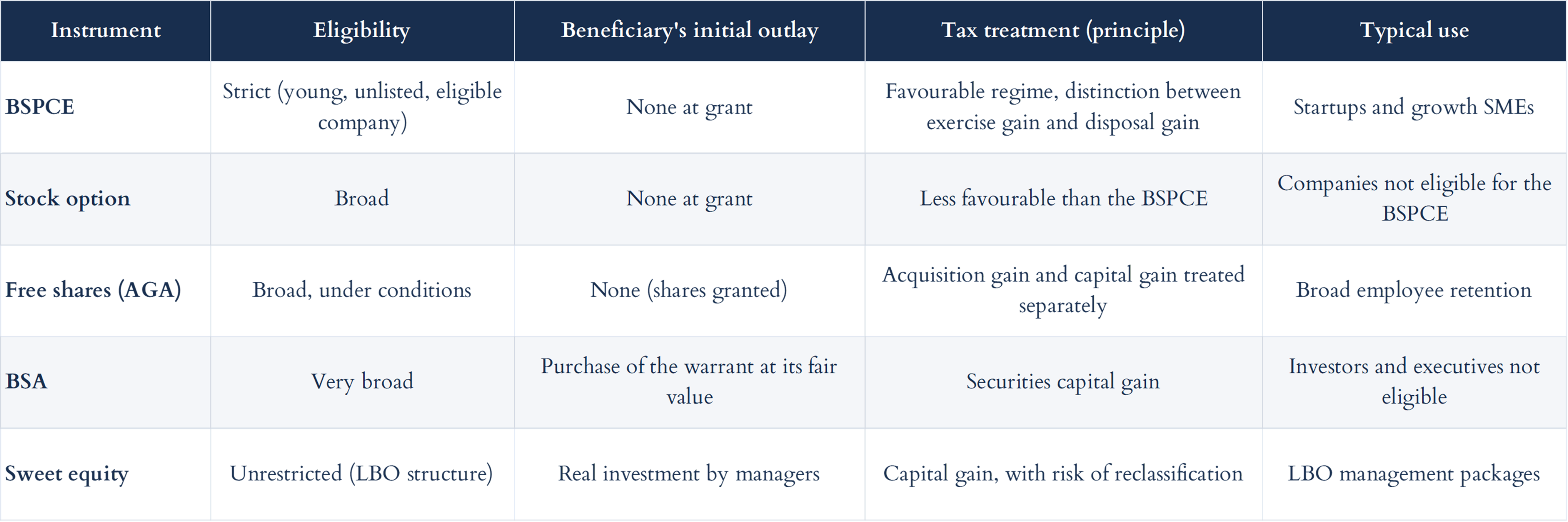
BSPCE, stock options, free shares, BSA and sweet equity: the comparison table
The BSPCE is only one instrument among several to share value with managers and employees, and the choice depends on the company's eligibility, the beneficiary's expected outlay and the sharing objective. The table below summarises the main families, from the founder share warrant to the free share, through the stock option, the share warrant and sweet equity. It clarifies the logic of each without substituting for a tailored analysis, so much do tax regimes evolve and overlap.
Whom to call on to structure and value a BSPCE plan
Three criteria should guide the choice of a partner. The first is independence: the valuation of the exercise price and of the warrant's fair value must come from a third party with no conflict of interest, so as to withstand the scrutiny of an auditor or of the tax authorities. The second is technical mastery of option pricing models, since a figure obtained without understanding the assumptions on volatility, maturity and illiquidity is indefensible. The third is the combined knowledge of the law and the finance of management packages, so intertwined are the legal, tax and financial dimensions.
Hectelion brings together these three qualities. An independent boutique firm, franco-Swiss, we value BSPCE and the full range of dilutive instruments using methods aligned with IVSC standards, with economic independence from traditional financial intermediaries. We act on transactions ranging from 2 to 500 MCHF and work hand in hand with your legal counsel and your accountant. Note that Hectelion is not FINMA-authorised and does not act on transactions involving listed companies falling under such authorisation.
Advantages: alignment, controlled taxation, cash preservation
The first advantage of the BSPCE is the alignment of interests it creates between beneficiaries and shareholders, each gaining only on condition that the value of the company rises. The second is a tax and social regime more favourable than most alternative forms of remuneration, subject to the eligibility conditions and to the adjustments introduced by recent finance acts. The third is cash preservation, a capital asset for a young company: no immediate remuneration, no classic employer charge on grant. To these benefits are added the flexibility of vesting design, the retention effect over time and the positive signal sent to investors, who value a management team invested in the capital.
Limitations: strict eligibility, tax insecurity, valuation complexity
The first limitation lies in eligibility: the conditions of age, capitalisation, legal form and holding exclude many companies, notably the more mature buy-out targets. The second is tax insecurity, revived by the 2025 and 2026 Finance Acts: the boundary between salary gain and capital gain, the capping of certain advantages and the risk of requalification impose constant vigilance, as the analyses of specialised firms underline. The third is the complexity of valuation: setting an exercise price too low exposes the company to a reassessment, while estimating the warrant's fair value requires expertise in option models. To these are added the dilution of existing shareholders, which must be anticipated in the interplay of ratchet clauses, and the need for impeccable documentation.
The 5 mistakes to avoid with a BSPCE plan
Mistake 1: setting an undervalued exercise price
The temptation to set an artificially low exercise price, to maximise the beneficiaries' future gain, is the most consequential error. A strike below the fair value of the share on the grant date weakens the entire regime and exposes it to requalification as salary, with reassessment and penalties. The safeguard is to document the value through a recent financing round or, failing that, through an independent valuation kept on file.
Mistake 2: neglecting the accounting valuation of the warrant
Many companies grant BSPCE without ever estimating their fair value, whereas IFRS 2 requires it under international standards and this value documents the charge and secures the exercise price. Ignoring this step means exposure to an accounting restatement in the event of an audit and depriving the company of an argument before the tax authorities. A valuation using option models, accompanied by a sensitivity analysis on volatility, fills this gap.
Mistake 3: rushing the vesting and departure clauses
A poorly designed vesting empties the tool of its retention function or, conversely, discourages talent through overly harsh conditions. The absence of clear good leaver and bad leaver clauses generates disputes on departures, often at the worst moment. The acquisition period must be calibrated, acceleration on change of control provided for and these clauses articulated with the shareholders' agreement.
Mistake 4: ignoring recent tax reforms
The BSPCE regime is not fixed: the 2025 and 2026 Finance Acts amended the distinction between exercise gain and disposal gain and tightened the treatment of management packages. Designing a plan on the basis of an outdated regime exposes the beneficiaries to unpleasant surprises. Active legal monitoring and advice up to date with the latest texts are indispensable before any grant.
Mistake 5: treating the BSPCE in isolation from the rest of the package
The BSPCE never exists alone: it forms part of a whole sometimes comprising sweet equity, preference shares, a ratchet and a shareholders' agreement. Analysing it without an overall view leads to inconsistencies in dilution, governance and value sharing. A global modelling of the package, integrating each instrument and its interactions, is the only rigorous approach.
Case 1: valuing a BSPCE plan in a French SaaS startup
A French startup publishing SaaS software, valued on the basis of its latest round at 40 euros per share, wishes to grant BSPCE to three key executives, at the rate of 5,000 warrants each, that is 15,000 warrants in total. The exercise price is set at 40 euros, equal to the value of the share, in accordance with the legal requirements. The valuer retains a volatility of 45%, estimated from a basket of listed comparable companies, a risk-free rate of 3% and a maturity of five years, with no dividend distribution.
The Black-Scholes-Merton model results in a fair value of about 17.26 euros per warrant, that is 43% of the value of the share, and therefore a gross fair value of the plan of about 258,900 euros. Applying an illiquidity discount of 20% and a probability of departure before term of 10%, the adjusted value comes to about 12.43 euros per warrant, that is nearly 186,400 euros for the whole. The gross accounting charge, spread on a straight-line basis over four years of vesting, amounts to about 64,700 euros per year. This case illustrates an essential lesson: even with an exercise price equal to the value of the share, the plan represents a substantial economic value, which must be measured, documented and accounted for rather than treated as a mere off-balance-sheet commitment.
Case 2: a BSPCE, sweet equity and ratchet package in an MBO
An eligible technology SME is the subject of a management buy-out on the basis of an enterprise value of EUR 30 million, corresponding to an EBITDA of EUR 5 million and a multiple of 6 times. The financing combines EUR 18 million of senior debt and EUR 12 million of equity, the latter split between the fund and the management team. The capital comprises 300,000 shares, that is an entry value of 40 euros per share. The managers receive 12,000 BSPCE, at an exercise price of 40 euros, whose BSM fair value on grant amounts to about 17.26 euros, that is an IFRS 2 charge of about 207,000 euros. In parallel, they invest EUR 0.6 million in sweet equity for 5% of the capital, with a ratchet accelerating their share beyond a return threshold.
At the end of five years, EBITDA reaches EUR 7.5 million; at the same multiple of 6 times, enterprise value stands at EUR 45 million, and deleveraging brings the debt from 18 to EUR 9 million, taking the value of equity to EUR 36 million, that is a multiple of 3.0 times for the investor and a price of 120 euros per share. The managers' gain then breaks down as follows: the 12,000 BSPCE, exercised at 40 euros and sold at 120 euros, yield 960,000 euros; the sweet equity, up from 0.6 to EUR 1.8 million, adds EUR 1.2 million of capital gain; the ratchet, calibrated at 15% of the excess beyond a return of 2.5 times, contributes EUR 0.9 million. In total, the team collects about EUR 3.66 million of value, for an initial outlay of EUR 0.6 million, illustrating the combined leverage of the three instruments. This case shows that the BSPCE, far from acting alone, articulates with sweet equity and the ratchet in an overall architecture that must be modelled globally.
BSPCE taxation in practice: exercise gain and disposal gain
BSPCE taxation distinguishes two components. The exercise gain, equal to the gap between the value of the share on the exercise day and the exercise price, remunerates in a sense the beneficiary's activity; the disposal gain, equal to the gap between the sale price and the value on the exercise day, falls under the patrimonial logic of the capital gain. Long conflated, these two bases were clarified by the 2025 Finance Act, of 14 February 2025, then adjusted by the 2026 Finance Act, which tightened the regime of management packages through a capping of the favourable treatment, a possible partial requalification as employment income beyond certain thresholds and deferral mechanisms. The single flat-rate levy of 30%, that is 12.8% of income tax and 17.2% of social levies, remains the reference for the portion falling under the capital gain.
Let us take again the managers' gain in Case 2. The 12,000 BSPCE, exercised at 40 euros and sold at 120 euros, yield a gain of 960,000 euros. Applied to this amount, a single flat-rate levy of 30% represents 288,000 euros of tax, for a net proceed of about 672,000 euros. This figure is illustrative: depending on the portion requalified as employment income under the recent rules, the holding period and the beneficiary's personal situation, the effective rate may deviate materially from this base case. It is precisely this uncertainty that justifies, before any grant then before any exercise, up-to-date tax advice and a documented valuation of the exercise price, alone able to secure the boundary between salary gain and capital gain. Our role as an independent valuer articulates here with that of your legal and tax counsel.
A word from the founder
« Too many BSPCE plans are designed as mere legal formalities, without ever asking the question of value. That is a mistake: the warrant is an option, and an option is valued. »
« Our conviction is that a transparent valuation, which owns its assumptions on volatility and illiquidity rather than hiding them behind a single figure, protects the company, its managers and its investors alike. »
« In a franco-Swiss context where the regimes differ profoundly, our role is to translate the same economic reality into two distinct tax frameworks, with the same rigour of an independent valuer. »,
Aristide Ruot, Founder and Managing Director of Hectelion SA.
FAQ: the 10 essential questions on BSPCE
Introduction: what to remember before the questions
The questions that follow gather the most frequent queries of founders, managers and chief financial officers faced with setting up or valuing a BSPCE plan. They cover eligibility, taxation, valuation and articulation with the rest of the management package. Each answer aims for operational clarity, without substituting for personalised advice taking your situation into account.
Q1: Which companies can grant BSPCE ?
Only companies meeting the conditions of article 163 bis G of the Tax Code can do so: a joint-stock company subject to corporate income tax, unlisted or of limited capitalisation, registered for less than fifteen years, and held to a minimum threshold by individuals. Failing a single condition deprives the plan of its favourable regime, hence the importance of a prior eligibility check.
Q2: At what exercise price should BSPCE be set ?
The exercise price cannot be lower than the fair value of the share on the grant date. When a recent financing round exists, its price serves as a natural reference; failing that, an independent valuation is necessary. An undervalued price is the main cause of tax requalification.
Q3: How is a BSPCE valued ?
A BSPCE is a call option: its fair value is computed using option pricing models, mainly Black-Scholes-Merton for a simple case, the Cox-Ross-Rubinstein binomial tree to incorporate complex clauses, and Monte Carlo simulation for path-dependent structures. The volatility of the underlying is the most sensitive parameter.
Q4: Why does a BSPCE have value if its exercise price equals the value of the share ?
Because time and uncertainty work in favour of the holder: they benefit from future rises without suffering the falls, since they are never obliged to exercise. This asymmetry confers on the warrant a significant time value, often close to 40% to 50% of the value of the share for a long maturity and high volatility.
Q5: What is the taxation of BSPCE in 2026 ?
The 2025 and 2026 Finance Acts clarified the distinction between the exercise gain, tied to a salary logic, and the disposal gain, falling under capital gains, while adjusting the treatment of management packages. The regime remains broadly favourable, but its application requires advice up to date with the latest texts, since areas of uncertainty remain.
Q6: What is the difference between a BSPCE and a stock option ?
Both are rights to acquire shares at a fixed price, but the BSPCE benefits from a more favourable tax and social regime, reserved for eligible companies. The classic stock option addresses a wider range of companies but offers a less advantageous treatment for the beneficiary.
Q7: Does the BSPCE exist in Switzerland ?
No: the BSPCE is a strictly French instrument. Switzerland uses employee participations, framed by Circular No. 37 of the Swiss Federal Tax Administration, with a different taxation logic, generally at acquisition or exercise. A franco-Swiss arrangement must articulate these two regimes and the double taxation treaty.
Q8: Must a charge be recognised for BSPCE ?
Under IFRS, IFRS 2 requires the fair value of the warrants to be recognised as an expense, spread over the vesting period. Under French standards, the treatment differs, but documenting the fair value remains a good securing practice. In all cases, a rigorous valuation is useful.
Q9: How do BSPCE, sweet equity and ratchet fit together ?
These instruments combine within a management package to share value according to different logics: the BSPCE offers an exercise right with no initial outlay, sweet equity rests on a real investment with leverage, and the ratchet modulates the managers' share according to performance. Their overall consistency, notably regarding dilution, must be modelled globally.
Q10: When should BSPCE be granted in a company's life ?
The ideal moment is early, while the company is eligible and its value remains moderate, so as to offer beneficiaries the best gain potential. Waiting exposes the company to the risk of losing eligibility, through exceeding the age or capitalisation threshold, and of having to fall back on less favourable instruments.
Conclusion: making the BSPCE a mastered lever, not a black box
The BSPCE remains, in 2026, the most powerful incentive tool available to French startups and growth SMEs, provided its three inseparable dimensions are mastered: legal eligibility, the shifting tax regime and financial valuation. Too often reduced to a formality, it is in reality a call option whose fair value is measured with the same rigour as a market instrument. The Black-Scholes-Merton, Cox-Ross-Rubinstein and Monte Carlo models are not theoretical refinements: they provide a value defensible before an auditor, a tax authority or an investor, and turn a black box into a mastered lever. In a franco-Swiss environment of contrasting regimes, this mastery makes the difference between a fragile plan and a plan that durably protects the company, its managers and its shareholders.
Article summary
The founder share warrant is a French right to acquire securities at a price fixed on the grant date, economically comparable to a call option granted to a manager or employee. Created in 1998 to retain the talent of young innovative companies, it has become a venture capital standard, whose tax regime was reworked by the 2025 and 2026 Finance Acts. Its implementation requires checking the company's eligibility, setting an exercise price at the fair value of the share, calibrating the vesting and documenting the fair value of the warrant.
This fair value is determined by option pricing models: Black-Scholes-Merton for the closed-form formula, the Cox-Ross-Rubinstein binomial tree for complex clauses and early exercise, and Monte Carlo simulation for path-dependent structures and for the sensitivity analysis on volatility, the most uncertain parameter of an unlisted company. The two cases presented, a SaaS startup and a management buy-out, show that a plan represents a substantial economic value even at an exercise price equal to the value of the share, and that the BSPCE articulates with sweet equity and the ratchet in an overall architecture. In Switzerland, employee participations, governed by Circular No. 37, serve as an equivalent, with a distinct taxation. Hectelion supports managers and shareholders in the structuring and independent valuation of these instruments, in France as in Switzerland.
Sources
- Autorité des marchés financiers (AMF), doctrine and investor information on financial instruments
- Bpifrance Création, overview of founder share warrants
- CMS Francis Lefebvre, management packages and the 2026 Finance Act
- Damodaran (Aswath), NYU Stern, valuation of options and assets through pricing models
- Direction générale des finances publiques, French Official Tax Bulletin on BSPCE (BOI-RSA-ES-20-40)
- Gide Loyrette Nouel, BSPCE taxation and the impact of the 2026 Finance Act
- IFRS Foundation, IFRS 2 on share-based payment
- International Valuation Standards Council (IVSC), international standards for the valuation of financial instruments
- Légifrance, article 163 bis G of the French General Tax Code
- The Galion Project, BSPCE kit, grant and taxation for founders
Author
Aristide Ruot, Ph.D.
Founder | Managing Director, Hectelion SA