
Share subscription warrants (BSA): Definition, valuation and structuring in fundraising and LBO
Understand, value (Black-Scholes, binomial, Monte-Carlo) and structure share subscription warrants (BSA)

Introduction: the BSA, a powerful tool where everything hinges on two parameters
A BSA, or share subscription warrant, grants its holder the right to subscribe new shares at a price fixed in advance, over a determined period. Used in fundraising and LBOs, its value and its incentive power hinge above all on two parameters: the exercise price, or strike, and the volatility retained in the valuation.
An investor wants a right to enter the capital without paying straight away. An owner wants leverage on value creation without tying up a fortune. A mezzanine lender wants a share of the upside. To these three needs, one and the same answer: the share subscription warrant, or BSA. It is a security that grants the right, but not the obligation, to subscribe a new share at a price set in advance, over a given period. In France, it belongs to the securities giving access to the capital, governed by the Commercial Code.
« Joint-stock companies may issue securities giving access to the capital or giving the right to the allocation of debt securities. », French Commercial Code, article L.228-91.
Three reasons make the subject sensitive in 2026. First, valuing a BSA is anything but intuitive: it is an option, and its value depends on a model, not a flat percentage. Second, everything hinges on two parameters, the exercise price (the strike) and the volatility retained, which are too often set by guesswork. Third, in France, the new tax regime for management packages heavily penalises a BSA subscribed below its fair value. This article defines the BSA, retraces its origin, explains why and how to structure it, details the strike methodology, the role of the American 409A, its franco-Swiss taxation, the three valuation methods and the dilution adjustment, distinguishes the BSA from the BSA AIR and the BSPCE, then delivers advantages, limits, five mistakes, two figured franco-Swiss cases and ten key questions.
Structure and value your BSA before you issue them
Before issuing BSA in fundraising or in an LBO, have the fair value of the underlying and of the warrant established by an independent third party, the only way to secure the strike and the tax regime. Book thirty minutes with Hectelion to frame your issue. Our financial instrument valuation service values your BSA using market methods, ahead of any subscription.
Definition: what is a BSA?
A BSA is a financial security that grants its holder the right to subscribe, over a determined period, a defined number of new shares of the issuing company, at a price set in advance called the exercise price or strike. It resembles economically a call option on the shares of the company, except that its exercise triggers the creation of new shares, hence dilution. Issued by joint-stock companies, it may be standalone and transferable, or attached to another security, as in the ABSA or the OBSA.
The BSA differs from ordinary stock options and above all from the BSPCE, which is a favourable tax regime strictly reserved for employees and executives of eligible young companies. The BSA, for its part, is a flexible container: it can be granted to an investor, an executive, a partner or a third party, and its taxation depends on the subscription conditions. This flexibility makes it the preferred instrument of fundraising and of the LBO, but it is also what demands a rigorous valuation.
Origin: from composite securities to the key tool of the balance sheet top
The BSA is the heir of composite securities, which French law long governed through scattered regimes before unifying them. The ordinance of 24 June 2004 gathered under a single category, securities giving access to the capital, all the instruments allowing deferred access to the shares of the company, including the BSA. This clarification opened the way to a massive use of the warrant in private equity, to grant investors a conditional right of entry, and in buyout structures, to give executives a stake in the capital.
In parallel, financial theory had provided, as early as 1973, the tools to value these rights: the Black-Scholes model, then binomial trees and Monte-Carlo simulations. The BSA thus sits at the crossroads of corporate law and market finance. In Switzerland, a neighbouring mechanism exists through the conditional share capital of the Code of Obligations, which allows shares to be issued as option rights are exercised. For a franco-Swiss group, articulating the two frameworks is an exercise in itself.
Why issue or subscribe BSA
First, to align interests. The BSA ties its holder's wealth to the value creation of the company, which makes it a powerful tool for incentivising executives and retaining partners. Second, to finance without immediate dilution: the issue only dilutes the capital at exercise, often years later and only if value has risen. Third, to offer leverage: with a limited stake, the holder captures a large fraction of the upside, the logic of the sweet equity reserved for management in an LBO.
Fourth, to protect the investor: a BSA with adjustable exercise conditions serves as an anti-dilution ratchet, which compensates the investor in the event of a later down round. Fifth, to boost a financing: attached to a bond, as in an OBSA or in mezzanine warrants, the warrants reward the lender beyond the coupon alone. The BSA is therefore never free or neutral: it transfers value, which must be measured precisely to avoid any dispute and any tax reassessment.
How a BSA is structured
A BSA is structured around six parameters: the parity (number of shares per warrant), the strike, the maturity (often three to seven years), the exercise conditions, transferability and a possible dilution cap. These parameters are designed together, and the resulting value must be computed before the issue because it serves as subscription price and tax reference.
Building a BSA rests on a few parameters, each heavy with consequences. The parity sets the number of shares subscribable per warrant. The exercise price, or strike, determines the price at which the holder may subscribe, and hence the value of the warrant. The maturity bounds the exercise period, often three to seven years. The exercise conditions frame the right: mere presence, achievement of a performance target, an internal rate of return threshold at exit, or progressive vesting. Transferability and a possible dilution cap complete the architecture.
These parameters are designed together. A high strike and a short maturity give a cheap but strongly incentivising warrant; a strike at parity and a long maturity give a more valuable warrant, suited to an investor. The ratchet, for its part, makes the strike or the parity adjustable according to future events. Each combination produces a different value, which must be computed before the issue, because it is this value that serves as the subscription price and the tax reference. Two parameters dominate all the others: the value of the strike and the volatility retained.
The value of the strike: what methodology to set it
Setting the strike follows four steps: establish the fair value of the share through an independent multi-method valuation, set the strike according to the objective (at parity for an investor, at parity or above for an executive), value the BSA at that strike with market methods, and have it subscribed at this fair value to neutralise any taxable benefit.
The strike is the most decisive and the most poorly handled parameter. Some set it at the value of the underlying, the warrant is then said to be at parity, or at the money. Others place it below, the warrant is in the money, with immediate intrinsic value but carrying a fiscally dangerous discount. Others still place it above, the warrant is out of the money, cheaper and more incentivising, but worthless if the share does not rise enough. The choice is anything but trivial: it determines the value of the BSA, the price the holder must pay, the intensity of the incentive and the tax treatment of the exit gain.
The rigorous methodology unfolds in four steps. First, establish the fair value of the share through an independent multi-method valuation, discounted cash flows, sector multiples and reference to the last funding round. Second, set the strike according to the objective: at parity for an investor seeking returns, at parity or above for an executive to be incentivised, below only if the discount and its tax cost are accepted. Third, value the BSA at the chosen strike using market methods. Fourth, have the warrant subscribed at this fair value, a sine qua non condition to neutralise any taxable benefit. For a strike below fair value creates a discount, requalifiable as salary under the management package regime in France, and as a benefit assessable in money in Switzerland. The strike is not guessed, it is demonstrated.
The 409A: the American reference that disciplines the strike
In the United States, the question of the strike is settled by a strict rule: Section 409A of the Internal Revenue Code requires that the exercise price of an option or an equivalent instrument be at least equal to the fair market value of the share at the grant date. To comply, companies have a 409A valuation established by an independent third party, generally valid for twelve months, which sets the fair market value and hence the strike floor. Failing that, the beneficiary is exposed to immediate taxation and heavy penalties.
Why does this American subject concern a franco-Swiss owner? Because the 409A comes into play as soon as a company counts American investors, employs staff in the United States or aims for a listing or a sale across the Atlantic. And because it illustrates a universal best practice: setting the strike at a fair value documented by a third party, exactly what France imposes in substance through the discount regime and article 163 bis H of the General Tax Code, and Switzerland through the notion of a benefit assessable in money. There is no French or Swiss 409A, but the logic is the same everywhere: without an independent valuation of the underlying, the strike is indefensible.
The taxation of the BSA in France and in Switzerland
The tax treatment of the gain from a BSA depends above all on the subscription conditions. Subscribed at its fair value, the warrant in principle follows the capital gains regime: the disposal gain is taxed as a securities capital gain. Subscribed with a discount, or granted in connection with the functions of an executive or an employee, the gain shifts towards a far less favourable regime. In France, the finance law for 2025 overhauled this subject through article 163 bis H of the General Tax Code: the gain from a management package is in principle taxed as salary, only a fraction, capped according to the financial performance of the company, remaining eligible for the capital gains regime. A strike below fair value feeds precisely the portion requalified as salary.
In Switzerland, the private capital gain realised on the sale of shares is in principle exempt, but the administration requalifies as taxable income any benefit derived from a BSA subscribed below its value by an executive or an employee, as a benefit assessable in money. The reference value of unlisted shares is established under the practitioners' method of Circular 28, and a cantonal ruling secures the treatment upstream. In both countries, the ridge line is the same: subscribing the warrant at its documented fair value rules out requalification. This is not optimisation, it is securisation, and it goes through an independent valuation, as with the value ruling and the tax ruling.
The methods for valuing a BSA
A BSA is an option, and is therefore valued through the models of market finance, not through a flat percentage. Three methods complement each other, from the simplest to the most robust. Well conducted, they converge towards the same central value, which validates the result.
Black-Scholes: the closed-form reference
The Black-Scholes model provides a closed-form formula for the value of a European-style warrant, exercisable at maturity. It combines six parameters: the value of the underlying, the strike, the maturity, the risk-free rate, the dividend yield and above all the volatility. On a four-year at-parity warrant, volatility 40%, rate 3%, the value comes to around 35% of the value of the share. Simple and fast, Black-Scholes has two limits: it assumes a European exercise and a constant volatility, assumptions that are often false. For a warrant issued by the company, one must also adjust for the dilution created by the issue of new shares, which the raw formula ignores.
Cox-Ross-Rubinstein: the flexible binomial tree
The binomial model of Cox-Ross-Rubinstein, or CRR, discretises the life of the warrant into a succession of steps, at each of which the underlying rises or falls by a factor determined by the volatility. One works back up the tree, discounting the flows under the risk-neutral probability. Its interest: it handles what Black-Scholes cannot, early American exercise, vesting and performance conditions, discrete dividends. As the number of steps increases, it converges towards Black-Scholes, which offers a cross-check of the calculation. On the previous warrant, the tree gives the same value of around 35% of the share, to within a few cents.
Monte-Carlo applied to Black-Scholes on the volatility
Here is the most honest method for an unlisted company. Volatility is not observed there on a market: it is an assumption, and a point value of a BSA based on a single volatility gives false precision. The Monte-Carlo simulation removes this bias: one draws the volatility from a plausible distribution, for example between 30% and 50% around a central scenario of 40%, one computes the Black-Scholes value for each draw, and one obtains no longer a figure but a distribution of values. On our warrant, the mean stays close to 35% of the share, but within a range running from about 31% to 40%. It is this range, and not a single figure, that faithfully conveys the uncertainty and protects the file before the taxman as before an opponent.
The dilution adjustment: why a BSA is worth less than an option
A BSA is worth less than an equivalent call option because its exercise creates new shares and dilutes the value per share. The raw Black-Scholes value must therefore be corrected, either by multiplying it by the ratio of existing shares to shares after exercise, or through the finer Galai-Schneller iterative approach.
A BSA is not an ordinary call option. A classic option bears on already existing shares: its exercise settles through a transfer of securities, without creating new value or increasing the number of shares. A BSA, for its part, grants the right to subscribe new shares: its exercise increases the number of securities in circulation and dilutes the value per share. Applying the raw Black-Scholes formula to a BSA, as if it were an option on existing securities, therefore systematically overvalues the warrant.
The correction is called the dilution adjustment. In its simplest form, it consists in multiplying the Black-Scholes value by a factor equal to the number of existing shares divided by the number of shares after exercise, that is m divided by the sum of m and the number of warrants n. A finer approach, the Galai-Schneller one, values the warrant as an option on equity increased by the exercise proceeds, then relates the result to the number of securities after dilution, by iteration. The magnitude of the adjustment depends on the weight of the warrants in the capital: negligible for a few warrants, it becomes significant for a large plan, for example a sizeable pool. Ignoring this correction means overvaluing the warrant, so making the subscriber pay too much or overstating the benefit to be declared to the taxman. Dilution is not a technical detail, it is what distinguishes a BSA from a simple option.
A worked example makes it tangible. Taking the assumptions of our first case, an underlying of 100, a strike of 100, a four-year maturity and a volatility of 40%, a warrant is worth 35.29 before any dilution, exactly like an ordinary option. Now introduce a pool representing 20% of the capital, that is 200,000 warrants for 1,000,000 existing shares: the factor m divided by the sum of m and n brings this value down to 29.41, that is 16.7% less. Across the whole pool, the correction is far from anecdotal, since ignoring dilution would overvalue the warrants by about 1.18 million of value, that is 7.06 million versus 5.88 million. The larger the plan, the wider the gap, and it is precisely when the warrants weigh heavily in the capital that the adjustment becomes decisive.
When to use BSA
The BSA imposes itself first in fundraising: it allows an investor to be granted a conditional right of entry, an anti-dilution ratchet to be installed, or founders and early supporters to be rewarded. It is then central in LBOs, MBOs and OBOs, where sweet equity structured in warrants gives management a stake at exit without demanding a disproportionate outlay. It finally complements financings, attached to a bond in an OBSA or to a mezzanine tranche, to offer the lender a share of the capital gain.
Conversely, the BSA is not the tool suited to a pure free grant to employees of a young company: the BSPCE, more regulated but fiscally more favourable, answers that better. And for a simple quick seed, the BSA AIR is lighter. The right reflex is to choose the instrument according to the beneficiary, the objective and the tax regime targeted, which means coldly comparing the options before issuing. This is the work of an independent financial structuring adviser.
BSA, BSA AIR and BSPCE: do not confuse three distinct tools
The classic BSA is a flexible security grantable to any beneficiary and subscribed at fair value. The BSA AIR is a seed instrument inspired by the American SAFE, where shares are issued later at the valuation of a future round. The BSPCE is a favourable tax status strictly reserved for employees and executives of eligible young companies.
The confusion between these three instruments is frequent and costly, because they have neither the same nature, nor the same target, nor the same regime. The list below distinguishes them.
- Classic BSA. A flexible security, grantable to any beneficiary, investor, executive or third party. Subscribed at its fair value, it serves fundraising, the LBO and financing. Ordinary or management package taxation depending on the conditions.
- BSA AIR (Rapid Investment Agreement). A seed variant inspired by the American SAFE. The investor pays today, the shares are issued later at the valuation of a future round, with a discount and a cap. Light and fast, it targets pre-seed and seed.
- BSPCE (founder share subscription warrant). A favourable tax regime strictly reserved for employees and executives of eligible young companies, subject to precise conditions. It is not a flexible container but a regulated status.
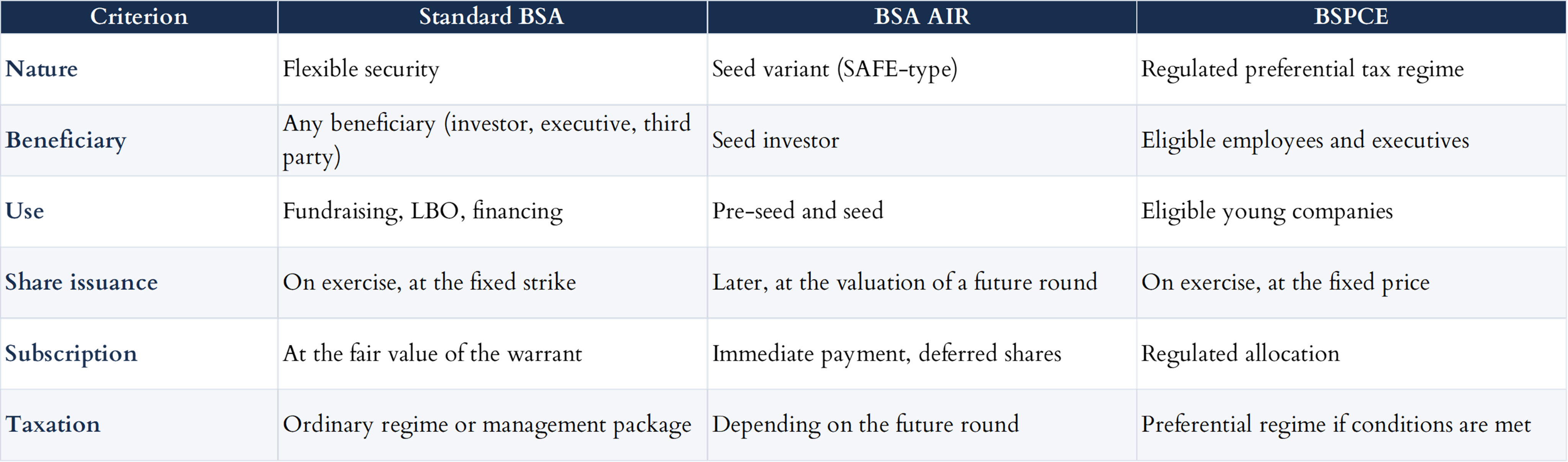
Concise comparison of the BSA, the BSA AIR and the BSPCE. Our dedicated publication details the BSPCE and the management package.
Who to turn to in order to issue and value your BSA
Three criteria should guide the choice. The first is the independence of the valuer: a BSA value enforceable against the taxman and co-investors is produced by a third party without conflicts of interest, not by the party with an interest in minimising or inflating it. The second is the mastery of option valuation: Black-Scholes, binomial tree and Monte-Carlo, with the correct treatment of dilution and volatility. The third is dual franco-Swiss competence, indispensable to articulate French securities law, Swiss conditional capital and the management package tax regimes of both countries.
Hectelion brings together these three qualities. An independent boutique firm, with dual franco-Swiss expertise and economic independence from traditional financial intermediaries, it values and structures BSA on operations between 2 and 500 MCHF, in fundraising as in LBO. Its fundraising and its startup valuation rely on a rigorous modelling, ready to be submitted to the taxman and to investors. Hectelion is not FINMA-authorised and does not act on listed-company operations.
Advantages: alignment, leverage and deferred dilution
The first advantage is the alignment of interests: the BSA directly ties its holder's gain to the performance of the company, which makes it an unmatched tool for incentive and retention. The second is leverage: with a measured outlay, the holder captures a large fraction of the upside, which allows an executive to be associated with the capital without asking for a fortune. The third is deferred dilution: the capital only opens at exercise, often years later and only if value has risen, which protects existing shareholders in the meantime.
To these benefits is added a great flexibility of structuring: parity, strike, maturity, exercise conditions and ratchet are modulated case by case, where a standard instrument would impose a rigid grid. Well designed, the BSA aligns financing, incentive and protection in a single security.
Limits: dilution, complexity and tax risk
The first limit is dilution over time: exercise creates new shares that dilute existing shareholders, an effect that must be anticipated in the capitalisation table. The second is complexity: valuing and documenting a BSA requires option modelling and careful legal drafting, far from a simple percentage. The third is tax risk: a poorly set strike, below fair value, exposes the holder to a requalification of the gain as salary, at a cost that can wipe out the interest of the operation.
To this is added a limit specific to advice: Hectelion acts as an independent valuer and structurer, and is not FINMA-authorised; the firm substitutes neither for the lawyer who drafts the terms and conditions of the warrants, nor for the tax adviser who secures the applicable regime. This division of roles is a strength: it guarantees a valuation produced by a third party whose profession it is, articulated with the legal and tax experts.
The 5 mistakes to avoid
Mistake 1: setting the strike without an independent valuation
Choosing an exercise price by intuition, without establishing the fair value of the underlying, exposes to the worst of tax risks. A strike below fair value creates a discount requalifiable as salary, and a strike without justification does not withstand an audit. The value of the strike is demonstrated by a multi-method valuation, never by a round figure set at random.
Mistake 2: confusing BSA, BSA AIR and BSPCE
These three instruments have different targets and regimes. Treating a BSA as a BSPCE, or the reverse, leads to eligibility and tax errors heavy with consequences. The BSA is a flexible container, the BSA AIR a seed tool, the BSPCE a regulated tax status. The choice must precede the drafting, not follow it.
Mistake 3: valuing the BSA on a single volatility
Applying Black-Scholes with a single volatility assumption gives false precision, because the volatility of an unlisted company is not observed. Without a Monte-Carlo simulation of the volatility, the value shown is indefensible as soon as an opponent tests its sensitivity. A range is worth more than a figure that is too neat.
Mistake 4: forgetting the dilution adjustment
A BSA is not an ordinary option: its exercise creates new shares, hence dilutes the capital. Applying the raw Black-Scholes formula, designed for an option on existing securities, overvalues the warrant. The dilution adjustment, a function of the number of warrants issued relative to the capital, is indispensable for a fair value.
Mistake 5: neglecting the 409A in the presence of American investors
As soon as a company counts investors or activity in the United States, Section 409A requires the strike to be set at fair market value, on pain of penalties for the beneficiary. Issuing BSA without a 409A valuation in this context runs a major tax risk, often discovered too late, during a sale due diligence.
Case 1: ratchet BSA in a fundraising of a French tech SME
A French technology SME raises a funding round. The share is valued at 100 EUR, on the basis of the last round and a multi-method valuation. An investor subscribes, alongside its shares, 10,000 BSA at parity, with a strike of 100 EUR and a four-year maturity, carrying an anti-dilution ratchet clause that adjusts its rights in the event of a later down round. With a risk-free rate of 3% and a retained volatility of 40%, the value of each warrant converges across the three methods: 35.3 EUR in Black-Scholes, 35.3 EUR by the binomial tree, 35.4 EUR in Monte-Carlo. The lot of 10,000 warrants is therefore worth around 353,000 EUR.
The Monte-Carlo applied to the volatility, drawn between 30% and 50%, places the value in a range of 30.6 to 39.9 EUR per warrant, with a mean of 35.3 EUR. This range is not a weakness, it is the truth of the instrument: it documents the uncertainty and secures the negotiation between the investor and the company. The ratchet, for its part, protects the investor from unfair dilution, provided it is valued and not merely mentioned. Without this valuation, the warrant would have been treated as a free accessory, at the risk of a disagreement and a reassessment.
Case 2: sweet equity in BSA in an LBO of a Swiss SME
A Swiss industrial SME is the object of an LBO led by its management team. To associate the managers with value creation, the structure provides for sweet equity structured in BSA. The share of the acquisition company is worth 50 CHF, the strike is set at parity at 50 CHF, the maturity at five years, in a context of a risk-free rate of 2% and a volatility of 35%. The value of each warrant comes to 17.0 CHF in Black-Scholes, confirmed at 17.0 CHF by the binomial tree and 16.9 CHF in Monte-Carlo. The managers subscribe their warrants at this fair value of 17.0 CHF, an essential condition to rule out any requalification of their exit gain as employment income.
The simulation of the volatility, between 25% and 45%, places the value in a range of 14.3 to 19.6 CHF, with a mean of 17.0 CHF. By subscribing at the documented fair value, and not at a symbolic price, the executives obtain strong leverage at exit while neutralising the risk of a requalified management package. The BSA here turns a measured outlay into a powerful incentive, on the sole condition of a rigorous valuation upstream. Consistency with the shareholders' agreement and its exit clauses completes the arrangement.
A word from the founder
« The BSA is a wonderful and dangerous tool at once. Wonderful because it aligns financing, incentive and protection in a single security. Dangerous because everything hinges on two figures, the strike and the volatility, that too many files set by intuition. »
« What I repeat to executives and funds is that the value of a BSA is demonstrated, it is not declared. A strike without an independent valuation is a reassessment waiting for its hour, often discovered during the sale due diligence. »
« And for an unlisted company, the only honest valuation goes through Monte-Carlo on the volatility. We do not give a figure, we give an assumed range. It is less comfortable, but it is what holds before the taxman and before an opponent. », Aristide Ruot, Founder and Managing Director of Hectelion SA.
FAQ: the 10 essential questions on the BSA
Introduction: what to keep in mind before the questions
The BSA is a flexible but technical instrument, whose value and taxation depend on precise parameters. The answers below clarify its nature, its valuation, the role of the strike and of the 409A, and the franco-Swiss traps to know before any issue.
Q1: What exactly is a BSA?
It is a security granting the right, not the obligation, to subscribe one or more new shares at a price set in advance, over a given period. Economically, it is a call option whose exercise creates new shares and dilutes the capital.
Q2: How is a BSA valued?
Through option models: Black-Scholes in closed form, the Cox-Ross-Rubinstein binomial tree for flexible cases, and Monte-Carlo to integrate the uncertainty of the volatility. Well conducted, the three methods converge towards the same central value.
Q3: How to set the exercise price, the strike?
By first establishing the fair value of the share through an independent valuation, then positioning the strike according to the objective, at parity, above or below. A strike below fair value creates a fiscally risky discount. The strike is demonstrated, it is not guessed.
Q4: Why is the strike so important?
Because it determines the value of the warrant, the price the holder must pay, the intensity of the incentive and the tax treatment of the exit gain. A mistake on the strike is paid in dispute or reassessment, often years later.
Q5: What is the 409A and does it concern me?
It is the American rule that requires the strike to be set at least at fair market value, established by an independent valuation. It concerns you as soon as you have investors or activity in the United States, and it illustrates a universal best practice.
Q6: What is the difference between a BSA and a BSPCE?
The BSA is a flexible container, grantable to any beneficiary and subscribed at its fair value. The BSPCE is a favourable tax regime strictly reserved for employees and executives of eligible young companies, subject to precise conditions.
Q7: What is a BSA AIR?
It is a seed variant inspired by the American SAFE: the investor pays today, the shares are issued later at the valuation of a future round, with a discount and a cap. Light and fast, it suits pre-seed and seed, not complex structures.
Q8: Does the BSA dilute the capital?
Yes, but in a deferred manner: dilution only occurs at the exercise of the warrants, often years later and only if value has risen. It must nonetheless be anticipated in the capitalisation table from the issue.
Q9: What is the taxation of a BSA?
It depends on the subscription conditions. Subscribed at its fair value, the gain in principle follows the capital gains regime. Subscribed with a discount, it exposes to a requalification as salary under the management package regime in France, or as a benefit assessable in money in Switzerland.
Q10: Who should value my BSA?
An independent valuer mastering option models and the treatment of dilution and volatility. Hectelion produces this valuation, enforceable against the taxman and investors, in complementarity with the lawyer and the tax adviser who carry the legal aspects.
Conclusion: the BSA, a precision tool that does not forgive approximation
The BSA is one of the most powerful instruments of the balance sheet top: it aligns interests, offers leverage and finances with deferred dilution, in fundraising as in LBO. But its very flexibility makes it a demanding tool, where everything hinges on two parameters, the strike and the volatility. A strike set by intuition, a single volatility, a forgotten dilution adjustment, and the warrant becomes a source of dispute or reassessment rather than a lever of value.
The right approach is methodical: establish the fair value of the underlying, set the strike according to a clear objective, value the warrant through Black-Scholes, the binomial tree and Monte-Carlo, and have it subscribed at the documented fair value. This is where the added value of an independent franco-Swiss valuer lies: turning a dangerous instrument into a precision tool, enforceable and defensible.
Summary of the article
The BSA, the share subscription warrant, is a security granting the right to subscribe new shares at a set price, the strike, over a given period. Economically an option, it serves fundraising, the LBO and financing, and differs from the BSA AIR, a seed tool, and from the BSPCE, a reserved tax regime. Its value is not declared through a percentage but computed through option models: Black-Scholes, the Cox-Ross-Rubinstein binomial tree, and Monte-Carlo applied to the volatility, which delivers a range rather than a misleading figure.
Two parameters dominate: the strike and the volatility. The strike must be set after an independent valuation of the underlying, then calibrated according to the objective; a strike below fair value creates a discount requalifiable as salary, in France under the management package regime, in Switzerland as a benefit assessable in money. The American 409A rule formalises this fair value requirement, and the dilution factor distinguishes the BSA from a simple option. The logic extends to taxation: without a documented fair value, the gain shifts towards income tax.
The cases of a ratchet BSA valued at 35.3 EUR per warrant in a French round and of a sweet equity valued at 17.0 CHF per warrant in a Swiss LBO show the way forward: establish the value of the underlying, set and demonstrate the strike, value through the three methods while adjusting for dilution, and subscribe at fair value. The BSA is a precision tool, to be structured with an independent adviser, not improvised.
Sources
- Aswath Damodaran (NYU Stern), valuation of warrants and options
- Autorité des Marchés Financiers (AMF), securities and corporate financing
- Cornell Law School (LII), Internal Revenue Code, Section 409A
- French Tax Bulletin (BOFiP), tax regime of management packages
- International Valuation Standards Council (IVSC), valuation of financial instruments
- Légifrance, French Commercial Code, article L.228-91 et seq.
- Swiss Confederation (Fedlex), Code of Obligations, conditional share capital (art. 653)
Author
Aristide Ruot, Ph.D.
Founder | Managing Director, Hectelion SA