
Family Business Transfer in Switzerland | Valuation, Financing & Tax
Family business transfer in Switzerland

Introduction: an operation at the crossroads of law, tax and finance
The family transfer of a business in Switzerland is one of the most complex and sensitive operations a business owner can undertake. It is not merely a financial transaction: it engages the continuity of a life’s work, family balances, the legal solidity of a structure, and the tax security of the transferor for years after the transfer.
It simultaneously mobilises corporate law, succession law, cantonal and federal taxation, financial engineering and family governance — within one of the most sophisticated legal frameworks in Europe. Poorly prepared, it exposes the transferor to tax reclassifications, family disputes and an inequitable valuation. Well structured, it optimises the net seller price, preserves governance and ensures a smooth transition for heir-successors.
According to Bpifrance Le Lab (2025), 70% of business owners considering a transfer more than one year away have not yet genuinely engaged in preparation. In Switzerland, this reality is compounded by the complexity of the Swiss legal framework — article 20a LIFD, art. 333 CO, hereditary reserves of the Civil Code — and by the diversity of cantonal tax regimes, where the same operation can have radically different consequences depending on whether the company is domiciled in Geneva, Zug or Berne.
This article presents the five modes of family transfer, available financing mechanisms in French-speaking and German-speaking Switzerland, cantonal donation taxation, tax rulings, the role of the lawyer and notary, the most frequent errors, and Hectelion’s positioning — with a detailed case study on a Vaud-based company.
Would you like to have your business valued, sell it, acquire a company or structure a family transfer?
Hectelion conducts all these engagements in France and Switzerland — valuation, disposal, acquisition, financial due diligence, financial structuring, holding, PPA.
→ Book a call — 30 minutes, confidential
Why family transfer in Switzerland is different
The Swiss framework presents four major specificities compared to France. First, the absence of capital gains tax for individuals renders the disposal of securities in principle exempt at federal level.
Second, cantonal tax diversity: corporate tax varies from 12% in Zug to 18% in Zurich. Third, the Swiss Code of Obligations (SR 220, CO) specifically governs share transfers, asset transfers and employee rights. Fourth, specifically Swiss financing mechanisms — FAE, Cautionnement romand, BG Mitte — with no direct French equivalent.
Key articles of the Code of Obligations
Art. 181 CO — Assumption of debt: joint liability of the transferor subsists for three years.
Art. 333 para. 1 CO — Automatic transfer of employment contracts.
Art. 333a CO — Obligation to inform and consult employees.
Art. 685b CO — Restriction on the transfer of registered shares in non-listed companies.
Art. 686 para. 1 CO — Maintenance of the share register.
Art. 697j CO — Obligation to disclose the beneficial owner upon crossing 25% capital threshold.
Art. 620ss CO — Corporation law applicable to majority share transfers.
Art. 629 CO — Incorporation of a SA: mandatory notarial deed.
Art. 777 CO — Incorporation of a Sàrl: authentic form required.
The five modes of family transfer
1. The intra-family sale (Share Deal or Asset Deal)
The sale to one or more heirs at market price is the most tax-neutral mode for the individual transferor. In the context of a business disposal process, capital gains on share disposals are in principle exempt in Switzerland. The Share Deal preserves legal continuity, avoids double taxation and limits administrative formalities. The Asset Deal is mandatory for sole traders; the five-year blocking period must be respected.
2. Donation and advance on inheritance
Donation is the gratuitous transfer of all or part of the shares. The advance on inheritance is imputed against the heir’s succession share (art. 626 CC). An independent business valuation is essential to determine the value of transferred securities and avoid any tax adjustment. These mechanisms can create imbalances between heirs — hereditary reserves (art. 470ss CC) — which must be anticipated through a succession agreement (art. 494 CC).
3. The vendor loan
The vendor loan is a financing arrangement in which the transferor lends to the successor. The FTA publishes annual circular letters on reference interest rates for CHF loans (FTA circular letter of 29 January 2026 — CHF rate 2026: 1.75%). If the rate deviates, the FTA may reclassify the difference as a taxable benefit in kind. The financial structuring of the vendor loan must be documented and defensible.
4. The family LBO (Leveraged Buy-Out)
The family LBO involves creating an acquisition holding company (NewCo) that acquires the target’s shares with leverage, repaid through dividends flowing up from the target. Two specific risks must be managed:
- The indirect partial liquidation (art. 20a LIFD): if the NewCo draws up target reserves to repay the acquisition loan, the FTA may reclassify the capital gain as taxable income. The tax ruling is the most effective protection.
- The net debt / EBITDA ratio: Swiss banks generally require a ratio below 3.5x to 4x. Rigorous financial due diligence and a solid business plan are prerequisites.

5. The family holding company
The family holding company centralises governance, optimises dividend taxation via the participation exemption (art. 69 LIFD), and organises the progressive transfer of capital to heirs. In Switzerland, Zug (12%), Schwyz and Glarus are the most attractive cantons. In French-speaking Switzerland, Vaud, Geneva (14%) and Fribourg remain competitive.
The role of the lawyer and notary
The lawyer: holding company articles (art. 685b CO); family shareholders’ agreement; transfer agreement and asset/liability warranties; vendor loan agreement; bank subordination agreements.
The notary: notarial deed of incorporation of the SA (art. 629 CO) or Sàrl (art. 777 CO); authentication of donation deeds; succession matters (art. 494 CC, art. 470ss CC).
Cantonal donation taxation
The valuation of securities at the date of donation is critical, which is why an independent business valuation is essential before any transaction.
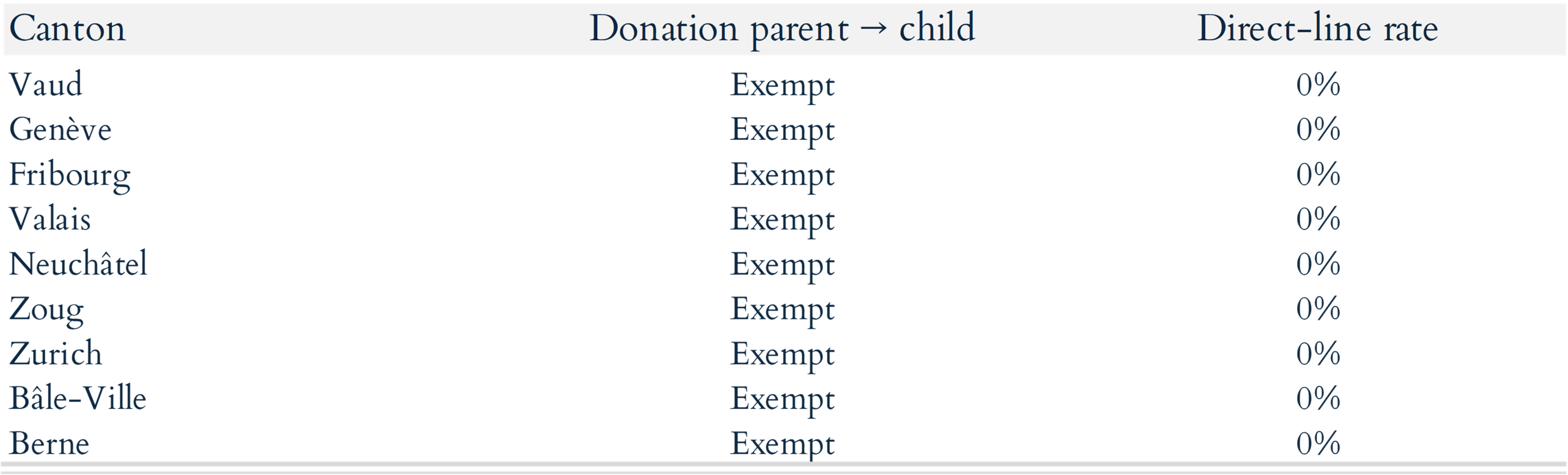
In the collateral line, donation rights may apply from 6% to 54% depending on kinship degree and canton. In Geneva, rights are only payable if the donor is domiciled in the canton (art. 12 LDE Geneva).
The tax ruling
A tax ruling is a binding advance agreement from the cantonal tax authorities or the Federal Tax Administration (FTA / ESTV). It is legally enforceable and the most powerful tax security instrument in a Swiss family transfer. The ruling secures:
- The qualification of the share disposal as an exempt capital gain
- The tax treatment of the vendor loan: interest rate, flows, absence of taxable benefit
- The valuation retained for the donation: FTA confirmation of market value
- The participation exemption applicable to the holding company
- The exclusion of indirect partial liquidation (art. 20a LIFD)
- The treatment of hidden reserves in case of prior conversion to a SA or Sàrl
The application must be filed before the transaction with a complete file including structure description, financial flows, business valuation and legal opinion. Processing time: 4 to 12 weeks.
Financing: FAE, Cautionnement romand and German-Swiss equivalents
Cautionnement romand provides guarantees up to CHF 1 million. Offices: FAE (Geneva), Cautionnement Vaud, CCF SA (Valais), COFAG (Fribourg). FAE covers CHF 1m to CHF 4m, guaranteeing 120% of the credit in case of default (source: fae-ge.ch). German-Swiss equivalents: BG Mitte (bg-mitte.ch) covers Central Switzerland; BG OST-SUD covers Zurich and Eastern Switzerland; Bürgschaftsgenossenschaft Nordwestschweiz covers Basel, Aargau and Solothurn. Cantonal Banks (ZKB, BLKB) have dedicated business acquisition programmes.
Why structure this operation with Hectelion
Family business transfer requires rigorous coordination across five disciplines: valuation, financial structuring, financial due diligence, governance and taxation.
1. Financial due diligence — an indispensable prerequisite
Before any business valuation, independent financial due diligence is essential. Hectelion carries out:
- Revenue rationalisation: recurrence, customer concentration, revenue quality. Critical point: estimating the revenue loss linked to the owner’s departure — which can represent 10% to 40% of revenue — and anticipating corrective measures (transition plans, client contractualisation).
- Normalised EBITDA: restatement of owner’s remuneration, non-recurring items, benefits in kind, lease costs, personal expenses.
- Normative working capital: historical analysis and determination for price negotiation.
- Cash and net debt restatement: non-operating assets/liabilities, excess cash, debt-like items (shareholder current accounts, pension commitments), off-balance-sheet commitments.
- Hidden or contingent liabilities: litigation, tax disputes, third-party guarantees.
An unnormalised EBITDA and poorly restated net debt can lead to a valuation gap of 20 to 40%. See our financial due diligence service.
2. The business plan — the cornerstone of the file
The business plan is required by banks, guarantee organisations and conditions the tax ruling. Hectelion prepares financial business plans as part of its financial structuring engagements: 5-year revenue assumptions including owner departure impact, debt service demonstration, capex integration, and base/pessimistic/optimistic scenarios.
3. Valuation methods applied
The valuation of the target is the founding act of any transfer. Hectelion deploys seven cross-referenced methods:
- Substantial value: assets at replacement cost. Basis of the practitioners’ method.
- Practitioners’ method: capitalised earnings (×2) + substantial value (×1), divided by 3. Reference for unlisted SMEs and Swiss tax rulings.
- Transaction multiples: EV/EBITDA multiples from comparable transactions, adjusted for illiquidity, size and control discounts.
- Listed comparables: listed company multiples with size and illiquidity discounts.
- Earnings yield / net income: capitalisation of normalised net income by a rate derived from the WACC.
- Earnings yield / normalised EBITDA: capitalisation of the average normalised EBITDA over the past 3 years divided by the WACC. Robust for moderate-growth SMEs and defensible before the FTA.
- DCF: discounting of future free cash flows at the WACC with terminal value. See our independent valuation reports.
4. Data room structuring
A well-structured data room accelerates bank and guarantee organisation decisions. It must cover:
- Legal (articles, share register, shareholders’ agreement, minutes, material contracts);
- Financial (audited accounts 3–5 years, tax returns, forecast);
- Tax (FTA correspondence, disputes, ruling);
- HR (employee list, key contracts, pension fund);
- Commercial (client list, concentration, owner-dependency);
- IP (trademarks, patents, licences); Real estate (leases, properties).
Hectelion assists with structuring and organisation of the data room.
5. Relationship with FAE, Cautionnement romand and banks
Hectelion prepares the financial file as part of its financial structuring engagements: 5-year business plan, debt repayment schedule, dividend flow-up analysis.
Common errors in a family transfer
- No independent valuation: price set informally, exposing the transferor to tax adjustment or heir challenges.
- No tax ruling: favourable treatment assumed without FTA confirmation, creating reclassification risk years later.
- Unnormalised EBITDA: owner’s narrative replaces accounting rigour.
- Vendor loan at non-FTA-compliant rate: may be reclassified as disguised donation or taxable benefit.
- Unanticipated owner-dependency: successor inherits a client portfolio tied to the founder without a transition plan.
- Inadequate data room: incomplete file extends the process by 3 to 6 months.
When to structure a family transfer in Switzerland?
3 to 5 years before: initiate the business valuation, clean up accounts, reduce owner-dependency, structure the family holding company.
18 to 36 months before: legal structuring, dialogue with banks and guarantee organisations, tax ruling application.
6 to 12 months before: financial due diligence, data room, finalisation of legal documents, signing of financing agreements.
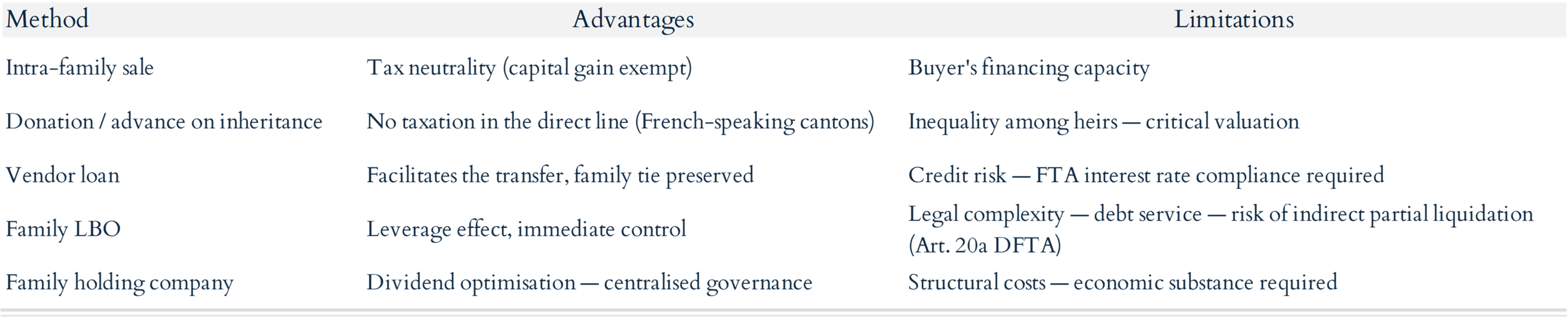
Advantages and limitations of each transfer mode
Glossary
Advance on inheritance: anticipated donation imputed against the heir’s succession share (art. 626 CC).
Normalised EBITDA: earnings restated for non-recurring items and owner-related distortions.
Indirect partial liquidation: tax reclassification (art. 20a LIFD) when successor draws up target reserves to repay acquisition loan.
Practitioners’ method: FTA-recognised method combining capitalised earnings (×2) and substantial value (×1), divided by 3.
Participation exemption: proportional corporate income tax reduction for a holding company holding ≥10% of a subsidiary (art. 69 LIFD).
Hereditary reserves: minimum succession portions reserved for legal heirs (art. 470ss CC).
Tax ruling: binding advance FTA agreement. Legally enforceable.
Substantial value: sum of operating assets at replacement cost, less liabilities.
Illustrative case study (fictitious data)
Company C SA, Canton of Vaud: Revenue CHF 12m | Normalised EBITDA CHF 2.1m | EV: CHF 15m | Net cash: CHF 1.5m | Equity Value: CHF 16.5m. Transferor: founder, 62. Successor: only son, 35.
- Incorporation of a SA holding (NewCo Vaud)
- Donation of 20% (CHF 3.3m) — exempt, Canton of Vaud
- Sale of 80% to NewCo for CHF 13.2m
- Financing: CHF 3m equity + CHF 6m bank debt (Cautionnement romand) + CHF 4.2m vendor loan at 1.75% (FTA 2026)
- Tax ruling filed with FTA
- Financial due diligence + valuation report (practitioners’ + DCF + multiples)
Net equity value: CHF 16.5m — CHF 3.3m donation + CHF 13.2m cash/vendor loan.
A word from the Managing Director
Family business transfer in Switzerland resembles no other operation. It simultaneously engages the valuation of a lifetime’s work, family solidarity and business continuity. This triptych demands a rigour that purely financial transactions do not always require.
What we systematically observe: family transfers conducted without independent valuation, without a tax ruling and without due diligence — because “it’s family, we trust each other”. It is precisely in this context of trust that documentation rigour matters most: it protects the transferor against tax reclassifications, the successor against post-closing surprises, and the family against succession disputes.
Our approach: a defensible valuation anchored in market data, rigorous due diligence on normalised EBITDA and net debt, a credible business plan — and a ruling file built before signing.
Aristide Ruot, Ph.D — Founder & Managing Director, Hectelion
FAQ — Family business transfer in Switzerland
Are donation rights payable in Switzerland on a family transfer?
In the vast majority of cantons, donations in the direct line are exempt. Rights may apply in the collateral line depending on the canton.
What is indirect partial liquidation and what is the risk?
Art. 20a LIFD: the FTA may reclassify the transferor’s capital gain as taxable income when the successor draws up target reserves to repay the acquisition loan. The tax ruling is the most effective protection.
Is a notary required to incorporate a SA holding company in Switzerland?
Yes — art. 629 CO for the SA, art. 777 CO for the Sàrl.
What is the average timeline for a well-structured family transfer?
18 to 36 months from decision to closing.
What is the practitioners’ method and does the FTA accept it?
Capitalised earnings (×2) + substantial value (×1), divided by 3. Systematically accepted in tax ruling contexts.
Share Deal vs Asset Deal?
Share Deal: disposal of company shares, capital gains exempt for individuals. Asset Deal: disposal of assets, generates corporate income tax. Share Deal almost always preferred in family transfers.
Can Hectelion assist if the company is domiciled in France?
Yes. We coordinate valuation, due diligence and structuring on both sides of the border. See business valuation: France vs Switzerland.
Would you like to have your business valued, sell it, acquire a company or structure a family transfer?
Hectelion conducts all these engagements in France and Switzerland — valuation, disposal, acquisition, financial due diligence, financial structuring, holding, PPA.
→ Book a call — 30 minutes, confidential
Conclusion: Family business transfer in Switzerland — an operation that cannot be improvised
Family transfer of a Swiss SME simultaneously mobilises the independent business valuation, financial due diligence, financial structuring of the holding and financing, the tax ruling with the FTA, and family governance framed by a lawyer and notary. The rigour of preparation determines long-term legal and tax security and the quality of the net seller price. At Hectelion, we support business owners across all financial and valuation components of their family transfers, in coordination with their lawyers, notaries and fiduciaries.
Contact us for an initial confidential discussion — 30 minutes, no commitment.
Sources
- Swiss Code of Obligations (SR 220 / CO) — art. 181, 333, 333a, 629, 685b, 686, 697j, 777 — admin.ch
- Swiss Civil Code (CC) — art. 470ss, 494, 626 — admin.ch
- Federal Act on Direct Federal Tax (LIFD / SR 642.11) — art. 20a, 69 — admin.ch
- Swiss Federal Tax Administration (FTA) — Circular letters on reference interest rates 2025 and 2026 — estv.admin.ch
- FAE — Fondation d’Aide aux Entreprises, Geneva — fae-ge.ch
- Cautionnement romand — cautionnement-romand.ch
- BG Mitte — bg-mitte.ch
- Raiffeisen Switzerland — raiffeisen.ch
- Bpifrance Le Lab — Business transfer preparation study, 2025
- In Extenso Finance / Epsilon Research — Panorama Régions & Transmission 2025, April 2026
Author
Aristide Ruot, Ph.D
Founder | Managing Director