
Valuation Multiples by Sector: EV/Revenue, EV/EBITDA, EV/EBIT, P/E and P/BV — France / Switzerland 2026
Valuation multiples by sector

Introduction: The multiple — a reflex for business owners, and its limits
A valuation multiple is a ratio that expresses a company’s value as a proportion of a financial indicator such as revenue, EBITDA, EBIT or net profit. Derived from comparable transactions or market data, it is applied to the target company to estimate its enterprise value or equity value quickly.
When a business owner first considers the value of their company, their first instinct is almost always the same: find the sector reference multiple, and apply it to their EBITDA. This approach is intuitive, fast, and widely used by M&A practitioners. It is an indispensable starting point in any valuation process.
A valuation multiple is a ratio that expresses a company’s value as a proportion of a reference financial indicator — revenue, EBITDA, EBIT or net profit. It is calculated from comparable transactions (disposals, acquisitions) or market data, then applied to the target company to estimate its enterprise value or equity value.
As Aswath Damodaran, professor at NYU Stern School of Business and a global reference in valuation, notes: “A multiple is a starting point, not an end point. It reflects market consensus at a given moment, but does not substitute for fundamental analysis.” (Damodaran, Investment Valuation, 3rd ed., Wiley, 2012).
The central issue is this: a raw sector multiple, derived from listed companies or mid-market transactions, can never be applied directly to an unlisted SME without rigorous adjustments. Size, liquidity, capital structure, owner-dependency and customer concentration — all factors requiring significant corrections to the raw multiple.
This article presents the six reference multiples used in valuation, their construction methodology, applicable discounts and premiums, sector multiple tables for France and Switzerland in 2026, variation factors within a given sector, and two detailed case studies.
Audit (due diligence) and value your business now
Upload your accounts: Acontos’ AI rebuilds your normalised EBITDA and applies your sector’s multiples. Launch the free simulator →
Origin and foundations of valuation multiples
Valuation multiples originate from American stock market practice in the 1950s–1970s, where financial analysts progressively developed standardised ratios to compare listed companies within the same sector.
The P/E ratio was among the first to be systematised, followed by the Price-to-Book Value in the 1960s–1970s, popularised notably by Benjamin Graham.
The surge of M&A transactions in the 1980s–1990s led practitioners to develop multiples specific to private transactions, foremost among them EV/EBITDA. This ratio, which relates enterprise value to EBITDA, has the advantage of neutralising differences in capital structure and depreciation policy between companies — two variables that vary significantly across countries and accounting choices.
In France, the use of multiples in mid-market transactions is regularly documented by the Argos Index® mid-market, published quarterly by Epsilon Research and Argos Wityu since 2006.
In Switzerland, practice aligns with European standards, with sector nuances linked to the Swiss industrial structure — predominance of precision engineering, medtech and financial services.
For further reading on valuation approaches: business valuation: approaches and methods — WACC — premiums and discounts in valuation — business valuation service.
Would you like to have your business or assets valued, sell, acquire, conduct financial due diligence or a PPA?
Hectelion conducts all these engagements in France and Switzerland — disposal, divorce, shareholder agreements, tax, assets, financial instruments or financial due diligence.
→ Book a call — 30 minutes, confidential
The six reference multiples in valuation
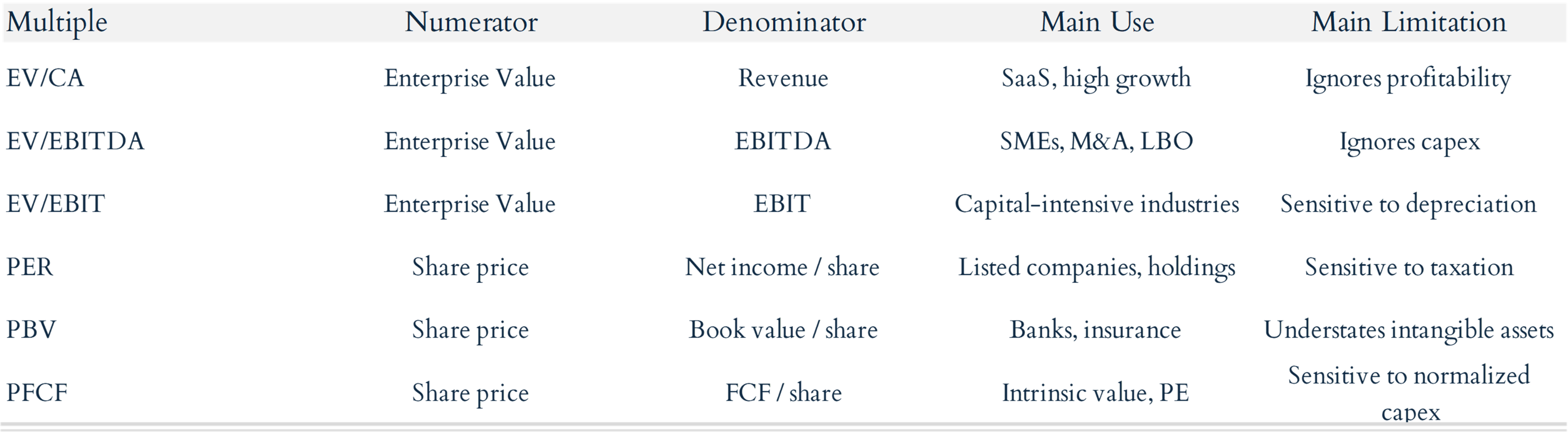
The six reference multiples used in business valuation are EV/Revenue, EV/EBITDA, EV/EBIT, P/E, P/BV and P/FCF. Enterprise value multiples compare the value of the whole business with revenue or operating profit, while equity multiples relate the shareholders’ stake to net profit, book value or free cash flow.
A — EV/Revenue (Enterprise Value / Revenue)
EV/Revenue relates enterprise value to revenue. It measures commercial traction independently of profitability, making it particularly useful for high-growth companies that have not yet generated significant operating profit.
It is the reference multiple for SaaS software publishers, scale-up startups and fast-growing companies. Its main limitation: it does not capture profitability — two companies with the same revenue can have very different valuations depending on their margins.
See our article on SaaS and software valuation.
B — EV/EBITDA
EV/EBITDA is the reference multiple in mid-market M&A transactions. It relates enterprise value to EBITDA — earnings before interest, taxes, depreciation and amortisation.
It neutralises differences in capital structure and depreciation policy between companies, making it a particularly suitable comparison tool for SMEs and mid-sized companies.
Its limitation: it does not reflect capital expenditure needs (capex).
See valuation approaches and methods.
C — EV/EBIT
EV/EBIT incorporates depreciation and amortisation in the denominator, unlike EV/EBITDA. It is more relevant for capital-intensive industries where depreciation represents a real economic cost (manufacturing, infrastructure, energy). The gap between EV/EBITDA and EV/EBIT reveals the sector’s capital intensity.
Its limitation: sensitive to depreciation policy choices, which vary across French, Swiss and IFRS accounting frameworks.
D — P/E (Price-Earnings Ratio)
The P/E ratio relates share price to earnings per share. It is the reference multiple on stock markets.
In M&A practice, it is less used than EV/EBITDA for unlisted SMEs, since net profit is sensitive to accounting policies, tax structure and exceptional items.
It remains relevant for holding companies and financial companies.
E — P/BV (Price-to-Book Value)
P/BV relates market value to the book value of equity.
It is the reference for sectors with high tangible asset intensity: banks, insurers, real estate companies. In Switzerland, P/BV is frequently used for the valuation of family holding companies.
F — P/FCF (Price-to-Free Cash Flow)
P/FCF relates share price to free cash flow per share. It is particularly used in private equity and long-term intrinsic valuations, as it incorporates capital expenditure needs that EV/EBITDA omits. Its limitation: highly sensitive to the normalised capex assumption and working capital variation.
Application context
Multiples are used in two distinct contexts: transaction comparables (similar private transactions) and listed comparables (listed companies in the same sector).
For an unlisted SME, transaction comparables are generally more relevant.
The prerequisite for any multiple application is EBITDA normalisation: adjustment of owner’s remuneration, restatement of lease costs, exclusion of non-recurring items and restatement of benefits in kind.
See our financial due diligence service and our article on WACC.
Methodology: building and applying a multiple
Building a multiple involves four steps: comparable selection (transactions over the past 24 to 36 months), EBITDA normalisation, application of the raw multiple, and adjustments (size discount, illiquidity discount, control discount depending on the transaction).
Further resources: business valuation: approaches and methods — size premium and WACC — Hectelion valuation service.
Get a first indicative estimate of your company’s value
Hectelion provides a free indicative valuation tool, based on French-Swiss market data.
→ Access the indicative valuation tool
Discounts and premiums applicable to multiples
Four adjustments apply before using a raw sector multiple on an unlisted SME: a discount for lack of marketability of 20% to 40%, a minority discount of 15% to 30%, a control discount or premium, and a holding discount on net asset value. Each reflects liquidity, governance or structure differences.
The raw application of a sector multiple to an unlisted SME is a frequent error.
Four adjustments are essential. For a detailed overview: premiums and discounts in business valuation.
A — Discount for Lack of Marketability (DLOM)
The illiquidity discount (DLOM) reflects the fact that an unlisted SME share cannot be sold instantly on an organised market.
Given that the average duration of an SME M&A process is 6 to 18 months, this capital lock-up justifies a significant discount.
It is quantified through empirical studies on restricted stocks or put option models. The observed range is 20% to 40% depending on size, sector and asset liquidity.
B — Minority discount
An investor acquiring a minority stake does not control strategic decisions, dividend policy, or management appointments.
The observed range is 15% to 30% depending on the rights attached to the securities and the contractual protection available — notably through a well-structured shareholders’ agreement.
C — Control discount (control premium)
The control premium is the additional price an acquirer accepts to pay in a transaction in order to obtain full or majority control of a company. It reflects observed behaviour in M&A transactions.
Applied as an adjustment to comparable transaction multiples, it constitutes a discount to be applied to the raw multiple derived from transactions including a change of control.
Observed control premiums range between 15% and 30%, with variations depending on the sector, target size and expected synergies. Source: BM&A, analysis of 620 European public offers (2025): 20% to 30%.
D — Holding discount (NAV discount)
A holding company is generally valued at a discount to the sum of its underlying asset values (NAV — Net Asset Value).
This discount reflects structural costs, lack of transparency and reduced liquidity of participations. The observed range is 10% to 30%.
See our article on holding company structuring in Switzerland.

Sector multiple tables — France / Switzerland 2026
The ranges below are derived from cross-referencing several recognised public sources. They cover transactions involving unlisted SMEs and mid-sized companies (enterprise value between €2m and €150m / CHF). They are indicative benchmarks — every multiple must be adjusted for the specific risk profile, size and characteristics of the company being valued.

Factors driving multiple variation within a sector
The sector multiple defines only a reference range. A company’s position within that range depends on six main factors:
- the revenue recurrence (ARR, long-term contracts),
- organic growth (>20%/year generates a premium),
- owner-dependency (primary discount factor),
- customer concentration (>30% with one customer = discount),
- size (effect of size premium and CSRP), and barriers to entry.
French-Swiss nuances
Swiss companies in precision engineering, watchmaking and medtech consistently command multiples above European medians, while the French mid-market has faced multiple pressure since 2025. The corporate tax differential, around 25% in France versus roughly 15% in Switzerland, also affects the net price a seller actually receives.
The Swiss market has specific characteristics that directly influence observed transaction multiples. Precision engineering, watchmaking and medtech consistently show multiples above European medians.
In France, the mid-market has been under multiple pressure since 2025 in sectors exposed to US tariffs and in distribution. The tax rate differential — average corporate tax France 25% vs Switzerland ≈15% — influences the net seller price.
See business valuation: France vs Switzerland.
Advantages and limitations of multiples
Multiples offer three major advantages: speed, readability and market anchoring. Their limitations are equally real: they do not capture future growth, are sensitive to restatements, suffer from scarce comparables in the SME segment and expose to the risk of mechanical application without adjustment.
Case studies
Case 1 — B2B SaaS SME, Île-de-France (fictitious data)
Company A SAS: Revenue €4,200k | Normalised EBITDA €1,100k | Growth +28% | ARR €3,800k | Churn 8% | Net financial debt: +€5,000k.
Sector median EV/EBITDA multiple (SaaS): x14.
Gross enterprise value: 1,100 × 14 = €15,400k.
EV/Revenue check: 15,400 / 4,200 = x3.7 — consistent with the x3 to x8 range.
Illiquidity discount −20%.
Equity Value = EV − NFD = (15,400 + 5,000) × −20% ≈ €16,320k.
This valuation constitutes a negotiation starting point, which must be cross-checked with a DCF model.
Case 2 — Swiss industrial mid-sized company, Canton of Vaud (fictitious data)
Company B SA: Revenue CHF 18,000k | Normalised EBITDA CHF 3,200k | EBIT CHF 2,100k | Net financial debt: (CHF 2,000k) (net cash) | Majority disposal (85%).
Sector EV/EBITDA multiple (Swiss precision engineering): x7.5. Gross enterprise value: 3,200 × 7.5 = CHF 24,000k.
EV/EBIT check: 24,000 / 2,100 = x11.4 — consistent with the x7 to x12 range.
Application of control discount 25%: Adjusted EV = 24,000 × 75% = CHF 18,000k.
Equity Value for 85% = (18,000 − (−2,000)) × 85% = ≈CHF 17,000k.
Swiss corporate tax ≈15% vs France 25% improves the net seller price by 8 to 10% relative to an equivalent French transaction.
A word from the Managing Director
The multiple is the common language of M&A transactions. It is the tool every acquirer masters, every CFO understands, and that structures the bulk of mid-market negotiations in France and Switzerland.
What we regularly observe at Hectelion: business owners who arrive at negotiations with a raw sector multiple, without having anticipated the illiquidity discount, the size adjustment or the owner-dependency that the acquirer will systematically apply. The gap between the market multiple and the multiple effectively paid can represent 20 to 40% of the initial valuation. This is not a negotiation — it is a methodological reality.
Our approach is always the same: produce a defensible valuation, anchored in the most recent market data and documented in its adjustments, rather than a flattering valuation that collapses at the first counter-offer.
Aristide Ruot, Ph.D — Founder & Managing Director, Hectelion
Audit (due diligence) and value your business now
Upload your accounts: Acontos’ AI rebuilds your normalised EBITDA and applies your sector’s multiples. Launch the free simulator →
FAQ — Frequently asked questions on valuation multiples
What is the average EV/EBITDA multiple for an SME in France in 2026?
The median multiple for unlisted European SMEs and mid-sized companies was 8.3x EBITDA in Q4 2025, according to the Argos Index® mid-market (Epsilon Research / Argos Wityu, February 2026).
For smaller French SMEs (EBITDA below €2m), the average multiple is around 5 to 6x according to Dealsuite.
These figures must be adjusted for sector, size and specific risk profile.
What is the difference between EV/EBITDA and EV/Revenue?
EV/EBITDA measures enterprise value as a proportion of operating profitability — the reference multiple for profitable companies. EV/Revenue measures value as a proportion of revenue — used for high-growth companies not yet profitable, particularly SaaS.
Why is my multiple lower than the listed sector multiple?
Listed multiples incorporate a liquidity premium and a size premium.
For an unlisted SME, the illiquidity discount (20% to 40%) and the size discount mechanically reduce the applicable multiple.
This is a normal and well-documented phenomenon.
What is the illiquidity discount and how is it estimated?
The DLOM reflects the inability to immediately sell an unlisted SME share.
Range: 20% to 40%. Methods: restricted stocks (Duff & Phelps / Kroll) and put option models (Longstaff, Chaffe).
See premiums and discounts in valuation.
Are multiples different in France and Switzerland?
Yes, with significant sector nuances.
Switzerland shows higher multiples for precision engineering, medtech and financial services.
The tax rate differential (25% France vs ≈15% Switzerland) and Swiss franc appreciation also influence cross-border valuations.
See business valuation: France vs Switzerland.
How does Hectelion use multiples in its valuation engagements?
Multiples are one of the three approaches systematically deployed — alongside DCF and net asset value — in our independent valuation engagements.
They are adjusted, documented and subjected to a cross-method consistency test.
Would you like to have your business or assets valued, sell, acquire, conduct financial due diligence or a PPA?
Hectelion conducts all these engagements in France and Switzerland — disposal, divorce, shareholder agreements, tax, assets, financial instruments or financial due diligence.
→ Book a call — 30 minutes, confidential
Conclusion: Valuation multiples — a reference tool, not a formula
Valuation multiples — EV/Revenue, EV/EBITDA, EV/EBIT, P/E, P/BV, P/FCF — are indispensable tools in any SME and mid-market valuation process.
But they are never applied mechanically: EBITDA normalisation, illiquidity and size discounts, control discounts and French-Swiss sector specificities condition the quality and defensibility of the result.
At Hectelion, multiples are systematically cross-checked with a DCF and a net asset value approach.
Contact us for an initial confidential discussion.
Author
Aristide Ruot, Ph.D
Founder | Managing Director