
How to Sell, Transfer, or Divest a Business: Steps and Process of a Sell-Side M&A Transaction
The Essential Steps to Sell a Business

Introduction: Understanding Business Transfer Mechanisms
The sale of a business represents one of the most structurally significant strategic decisions in the life of an executive and their shareholders. Whether driven by a desire for succession, a market opportunity, or a value creation strategy, the sale of a company is generally part of a broader reflection — patrimonial, strategic, and financial — aimed at optimizing the economic value created by the business throughout its development.
In an economic context characterized by the intensification of Mergers & Acquisitions (M&A) activity and the growing challenges of business transmission, particularly in European economies, these transactions play a central role in the continuity of the entrepreneurial fabric, the reshaping of markets, and the efficient reallocation of capital within the economy.
From this perspective, a business sale can be defined as the operation by which one or more shareholders transfer all or part of the shares or assets of a company to a buyer. This transaction can take various legal and financial forms depending on the chosen structure — notably a share deal or an asset deal — each carrying distinct implications in terms of taxation, legal framework, and finance.
In the context of M&A transactions, it is also common to distinguish between sell-side transactions, where a financial advisor assists the seller in preparing, organizing, and conducting the sale process, and buy-side transactions, where the acquirer is supported in identifying, strategically analyzing, and acquiring a target company. In both cases, these operations follow a structured and sequential process comprising several key phases, from the strategic preparation of the transaction through to the final negotiation of acquisition contracts and the closing of the deal.
As Joshua Rosenbaum and Joshua Pearl, specialists in corporate finance and market transactions, remind us, M&A transactions rely on structured processes designed to efficiently bring together sellers and buyers and to secure the terms of the transaction. (Rosenbaum, Joshua & Pearl, Joshua (2013). Investment Banking: Valuation, Leveraged Buyouts, and Mergers & Acquisitions. Hoboken: John Wiley & Sons.)
In the same vein, Patrick A. Gaughan emphasizes that "M&A transactions represent one of the major strategic instruments enabling companies to restructure, enhance their competitiveness, and create value for their shareholders." (Gaughan, Patrick A. (2018). Mergers, Acquisitions, and Corporate Restructurings. 7th Edition. Hoboken: John Wiley & Sons.)
This raises a central question for executives, founders, and shareholders considering the sale of their company: how can the sale of a business be effectively structured and organized to optimize its valuation, secure the transaction, ensure the continuity of the business after the sale, and support the executive through a smooth transition — without weakening the entrepreneurial momentum or the human dynamics that often constitute one of the company's most valuable assets?
In practice, the success of a sale process rests on thorough preparation, appropriate financial structuring, and the implementation of a competitive process enabling the identification and selection of the most relevant buyers given the company's strategic positioning and the shareholders' objectives.
With this in mind, this article proposes a structured analysis of the main dimensions of a business sale in the context of a sell-side M&A process. It begins by examining the motivations that can lead to the sale or transfer of a company, as well as the various forms of business succession that exist. It then explores the key participants in a transaction and the types of buyers likely to engage in the process. Finally, it details the steps of the business sale process, the key structural principles for securing a transaction, and illustrates these mechanisms through a practical case study of a sale in an M&A context.
What Is a Business Sale, Transfer, or Succession?
A business sale, transfer, or succession refers to the operation by which one or more shareholders decide to transfer all or part of the ownership of a company to a new buyer. This transaction may arise for strategic, patrimonial, personal, or economic reasons and often represents a major milestone in a company's trajectory.
In practice, a business sale generally corresponds to the sale of the company's shares (equity stakes or partnership interests) held by historical shareholders. In some cases, the transaction may also take the form of an asset sale, when the buyer wishes to acquire only specific elements of the company's assets, such as business activities, contracts, trademarks, or equipment.
Beyond the purely legal transaction, the sale of a business is part of a structured strategic process, aimed at organizing the meeting between seller and buyer under the best possible conditions — both in terms of valuation and transaction security.
According to Joshua Rosenbaum and Joshua Pearl, specialists in corporate finance, M&A transactions constitute a central mechanism for capital reallocation and enable companies to adjust their strategic and financial structure in a constantly evolving economic environment. (Rosenbaum, Joshua & Pearl, Joshua (2013). Investment Banking: Valuation, Leveraged Buyouts, and Mergers & Acquisitions. Hoboken: John Wiley & Sons.)
Sale, Transfer, and Succession: Related but Distinct Concepts
In common usage, the terms sale, transfer, and succession are often used interchangeably. However, these concepts can cover slightly different realities depending on the context.
A business sale generally refers to the transaction by which a shareholder transfers their shares to a buyer in exchange for a price, with the primary objective being the transfer of ownership to a new investor.
A business transfer is a broader term, encompassing all mechanisms that allow the control or ownership of a company to be transferred — whether through a sale, a donation, a family succession, or a capital restructuring.
Business succession, meanwhile, often carries a more patrimonial or intergenerational dimension. It may notably occur in the context of a family inheritance, an employee buyout, or a handover between executives.
What Is a Business Sale Process (M&A Sell-Side)?
The sale of a business is not limited to the signing of a sale agreement between a seller and a buyer. In the majority of professional transactions, it is embedded in a structured M&A process aimed at bringing the company to market and identifying the most relevant buyers.
In this context, the term sell-side process is generally used when the transaction is organized from the seller's perspective and managed by a financial advisor, such as an investment bank or a specialized M&A firm.
The primary objectives of a sell-side process are to:
- Prepare the company for sale
- Identify and approach potential buyers
- Organize a competitive process among investors
- Optimize the company's valuation
- Legally and financially secure the transaction
This process typically relies on several structured steps, including the preparation of transaction documentation, the marketing phase with potential buyers, the conduct of due diligence, and the final negotiation of acquisition agreements.
As Patrick A. Gaughan highlights, M&A transactions require rigorous preparation and methodical structuring in order to maximize transaction value and reduce associated risks. (Gaughan, Patrick A. (2018). Mergers, Acquisitions, and Corporate Restructurings. 7th Edition. Hoboken: John Wiley & Sons.)
Why Sell, Transfer, or Divest a Business?
The decision to sell, transfer, or divest a business rarely stems from a single factor. In practice, it most often reflects a combination of strategic, economic, patrimonial, and personal motivations specific to the executives and shareholders involved. After several years — sometimes decades — dedicated to building a company, the question of transferring ownership and governance naturally arises in the entrepreneurial journey.
In many cases, a business sale occurs at a pivotal moment in its lifecycle, when shareholders wish to organize their exit, prepare for management succession, or allow the company to enter a new phase of development under the impetus of a strategic or financial acquirer. Business succession thus constitutes both an economic and a human process, involving patrimonial, family, and organizational considerations.
According to the European Commission, hundreds of thousands of businesses are affected each year by succession issues, notably due to the aging of founder-executives and the evolution of family structures. (European Commission – Business Transfers and SME Continuity)
In practice, several situations can lead an executive or shareholders to consider selling or transferring their business.
Retirement of the Founder-Executive
One of the most common reasons for a business sale is the retirement of the founder-executive. Having devoted a large part of their professional life to creating and developing the company, the executive may wish to organize a gradual withdrawal from operations while ensuring business continuity.
In this context, a sale allows for proactive management succession planning and guarantees the sustainability of the business beyond the founder's departure.
Absence of Family Succession
In many family businesses, passing ownership to the founder's children has historically been the preferred solution. However, it is not uncommon for the next generation to decline to take over the business — whether due to a different career path or a lack of interest in managing the company.
In such situations, a sale to an external buyer can preserve the company, the jobs, and the expertise developed over the years.
The Executive's Desire to Step Back
Running a business involves a significant burden of responsibility, both operationally and strategically. After years of intense activity, some executives may feel the need to hand over leadership in order to pursue other professional, entrepreneurial, or personal projects.
A business sale can then serve as a stepping stone toward a new phase of life.
Enabling the Company to Reach a New Development Stage
In some cases, executives choose to sell their business in order to allow it to enter a new growth phase. The arrival of a strategic acquirer or financial investor can bring additional resources, access to new markets, or greater investment capacity.
This strategy may be particularly relevant when the company reaches a development level requiring financial or organizational resources beyond what the historical shareholders can provide.
Reducing the Burden of Executive Responsibilities
Running a business involves numerous responsibilities — people management, financial oversight, regulatory compliance, and strategic direction. Over time, these responsibilities can become particularly heavy to bear, especially in uncertain economic contexts.
A business sale can then provide a means of passing these responsibilities on to a new shareholder or management team.
Realizing the Economic Value Created
After years of growth and investment, shareholders may wish to crystallize the economic value of their business. A sale transaction allows the theoretical value of the company to be converted into liquidity, securing the shareholders' wealth.
In some transactions, the buyer may also be willing to pay a control premium, reflecting the strategic or commercial synergies they anticipate.
Pursuing a New Life or Entrepreneurial Project
For some executives, selling a business marks a personal transition. After years spent building and developing their company, they may wish to launch a new entrepreneurial venture, move into investment activities, or simply change their lifestyle.
A business sale can free up time and financial resources to explore new opportunities.
When the Business Becomes a Constraint
Finally, in some situations, running a business can gradually become a burden for the executive. Regulatory constraints, competitive pressures, or economic difficulties can transform an initially motivating entrepreneurial journey into a source of stress or fatigue.
In this context, a sale can preserve the value created while ensuring business continuity under the responsibility of a new shareholder.
Types of Business Sales, Transfers, and Buyouts (LBO, MBO, MBI, BIMBO, OBO & FBO)
A business sale or transfer can take different forms depending on the nature of the acquirer, the financial structuring of the transaction, and the objectives pursued by shareholders and executives. In the practice of M&A transactions, several buyout structures have gradually developed to address the various situations encountered in business successions — notably in the context of entrepreneurial inheritance, capital restructuring, or governance transitions.
In academic corporate finance literature, these transactions are generally analyzed through the lens of buyout transactions — i.e., operations involving the acquisition of control of a company by a group of investors or executives, often partially financed by debt. These buyout structures have been the subject of extensive analysis in works dedicated to M&A and private equity.
Beyond the academic perspective, however, these structures also correspond to widely used practices among investment banks, private equity funds, and M&A advisors in structuring business succession transactions.
M&A professionals distinguish between several forms of buyout depending on the identity of the acquirer and the post-transaction capital structure.
Leveraged Buyout (LBO)
The Leveraged Buyout (LBO) is one of the most well-known buyout structures in business succession transactions. In this type of deal, the acquisition of the target company is largely financed by debt, which will be repaid using the cash flows generated by the business after the transaction.
The structure typically involves the creation of an acquisition holding company, which takes on the acquisition debt and holds the shares of the target. The dividends paid by the business are then used to progressively repay the debt incurred during the transaction.
LBO transactions are frequently conducted by private equity funds specializing in growth capital or in the context of family business successions.
Management Buyout (MBO)
A Management Buyout (MBO) refers to a transaction in which the existing management team acquires the business. The incumbent managers thus become shareholders of the company they run, often with the support of financial investors or a private equity fund.
This type of transaction is particularly common in SMEs when the founder-executive wishes to hand over the business while ensuring management continuity. The MBO makes it possible to maintain governance stability and preserve key competencies within the organization.
Management Buy-In (MBI)
A Management Buy-In (MBI) refers to a transaction in which an external management team acquires control of the company and takes over its operational leadership.
Unlike the MBO, where incumbent managers buy out the business, the MBI involves the arrival of new management responsible for steering the company's future development. This type of succession typically occurs when the company does not have an internal team ready to take over from the outgoing executive.
Buy-In Management Buyout (BIMBO)
The Buy-In Management Buyout (BIMBO) is a hybrid structure combining characteristics of both the MBO and the MBI. In this type of transaction, the business is acquired jointly by part of the existing management team and new external executives.
This configuration allows the internal experience and company knowledge held by incumbent managers to be combined with the complementary skills brought by the incoming executives.
Owner Buyout (OBO)
An Owner Buyout (OBO) refers to a transaction in which the owner-executive sells part of their shares to a financial investor while retaining a significant stake in the business.
This structure allows the executive to secure part of their personal wealth while remaining involved in the company's future development. The transaction is often supported by an investment fund that provides financial resources and strategic support to accelerate the company's growth.
Family Buyout (FBO)
A Family Buyout (FBO) refers to a business succession carried out within the family circle. In this case, the company is taken over by one or more family members of the founder-executive.
This form of succession has historically been very common in family businesses. It preserves continuity of ownership and maintains the entrepreneurial culture developed within the company.
Full Share Sale to a New Buyer (Trade Sale)
Beyond specific buyout structures such as LBOs, MBOs, or MBIs, the most common form of business sale consists of a direct sale of all shares held by shareholders to a new buyer. In M&A practice, this is generally referred to as a share deal or a trade sale.
In this type of transaction, the buyer — whether a strategic industrial group, a financial investor, or an individual entrepreneur — acquires all or part of the company's shares. Ownership and control are thus transferred to the new shareholder, while the company generally continues its operations under its existing legal structure.
This form of sale is particularly common when the company is acquired by a strategic player in the same sector, seeking to achieve industrial, commercial, or technological synergies. It may also occur when a financial investor wishes to take control of a company in order to accelerate its development.
A full share sale may concern all shares held by the founder or historical shareholders, but it may also take the form of a majority or minority stake sale, particularly when the executive wishes to retain a residual stake and remain involved in the company's future development.
Asset Sale (Asset Deal)
Beyond a share deal, some M&A transactions take the form of an asset sale, also referred to as an asset deal. In this type of transaction, the buyer does not acquire the shares of the target company, but instead directly acquires all or part of the company's underlying assets.
The transferred assets may include various elements of the company's property, such as equipment, inventory, commercial contracts, intellectual property rights, trademarks, licenses, customer databases, or other intangible assets related to the business. The transaction may cover the company's entire operations or only a specific business unit.
Unlike a share deal, in which the company's legal identity remains unchanged, an asset sale involves a selective transfer of the economic elements constituting the business — allowing the buyer to acquire only the assets deemed strategic. This structure may be preferred when the buyer wishes to limit exposure to certain historical liabilities, such as legal, tax, or employment-related risks associated with the seller.
In M&A, asset sales are frequently observed in corporate restructuring, carve-out operations, or strategic group reorganizations, when certain activities are sold independently from the overall legal structure.
However, this type of transaction also carries specific legal and tax implications. Each transferred asset generally requires a separate contractual transfer or novation, which can make the transaction more complex to structure than a share deal.
Academic and professional corporate finance literature highlights that the choice between a share deal and an asset deal constitutes one of the key structural decisions in designing an M&A transaction, each structure carrying distinct implications in terms of taxation, liability transfer, and operational continuity.
Partial Capital Sale (Minority or Majority Stake)
In some M&A transactions, the deal does not necessarily involve the entirety of the company's capital. In practice, shareholders often choose to sell only part of their shares, resulting in a partial capital sale.
In this type of transaction, the buyer enters the company's capital by acquiring a minority or majority stake, while historical shareholders — often the founder or management team — retain a residual interest in the business. This structure allows for a gradual transition of ownership while maintaining continuity in governance and operational management.
A majority stake sale generally refers to a transaction in which the buyer takes control of the company by acquiring more than 50% of voting rights. In this configuration, the new shareholder becomes the reference shareholder and holds strategic decision-making power. Historical shareholders may nonetheless retain a minority stake to remain involved in the company's future development.
Conversely, a minority stake sale occurs when the investor acquires a limited stake in the company without taking control. This type of transaction is particularly common in growth capital or development capital operations, when executives wish to fund business growth while retaining the majority of the capital and operational leadership.
These transactions often serve to align the interests of executives and investors. The retention of a significant stake by historical shareholders can be an important trust signal for investors and help preserve the company's entrepreneurial momentum.
Transactions involving a partial capital sale are common in private equity transactions, particularly when investment funds wish to support a company's growth while leveraging the expertise and commitment of the incumbent management team.
Summary Table of Business Sale and Succession Structures
Business sales, transfers, and buyouts can take various forms depending on the transaction structure, the identity of the acquirer, and the objectives pursued by shareholders.

Common Mistakes to Avoid in a Business Sale
A business sale is a complex process involving financial, legal, strategic, and human dimensions. In M&A practice, however, certain mistakes can undermine the transaction, reduce the company's valuation, or jeopardize the success of the process. Insufficient preparation, poor structuring of the sale process, or poorly managed negotiations can have significant consequences on the outcome of the transaction.
Underestimating the Preparation Phase
One of the most common mistakes is launching a sale process without adequate preparation. A poorly prepared company may raise concerns among potential investors and lead to a heightened perception of risk.
In M&A practice, insufficient preparation can manifest as incomplete or imprecise documentation, a poorly structured data room, inconsistent or insufficiently detailed financial information, and the absence of a clearly articulated strategic vision.
The quality of the preparation phase is one of the determining factors in the success of a sale transaction.
Negotiating with a Limited Number of Buyers
Another frequent mistake is entering into exclusive discussions with a single investor at the outset of the process. In professional M&A practice, putting multiple buyers in competition is a key lever for optimizing the financial and contractual terms of the transaction.
A competitive process increases competitive pressure among investors, improves the valuation offered for the company, and strengthens the seller's negotiating position. Conversely, negotiating with a single buyer can significantly reduce the seller's bargaining power.
Overestimating the Company's Value
In some situations, shareholders may have a perception of their company's value that differs significantly from market reality. This can lead to a gap between the seller's expectations and the proposals made by investors.
In M&A transactions, a company's valuation is generally based on several financial approaches, including discounted cash flow (DCF) analysis, comparable company multiples, and comparable transaction multiples. A realistic valuation of the business is therefore a key element in engaging constructive discussions with investors.
Overlooking the Human Dimension of the Transaction
A business sale is not solely a financial transaction — it also carries significant human dimensions, particularly for the founder-executive and the company's teams.
In some transactions, a lack of alignment between the executive and the future buyer on strategic vision or company culture can undermine post-acquisition integration. In practice, investors pay close attention to the quality of the relationship with management and to the continuity of the leadership team.
Underestimating the Legal Complexity of the Transaction
Some companies underestimate the legal complexity of a sale transaction. The drafting and negotiation of the sale agreement (Share Purchase Agreement – SPA) typically involves in-depth discussions on representations and warranties, price adjustment mechanisms, conditions precedent, and seller liability clauses. These elements can have a significant impact on the risks borne by the parties after the transaction.
Not Engaging a Specialized M&A Advisor
One of the most frequently observed mistakes in business sale transactions is when executives or shareholders attempt to conduct the sale process alone, without the support of a specialized M&A advisor.
An M&A transaction is a highly structured process requiring financial, legal, strategic, and negotiation expertise. Preparing transaction documentation, identifying potential buyers, organizing a competitive process, managing due diligence, and negotiating contractual terms all require specific expertise and a thorough understanding of market practices.
In M&A practice, the involvement of a financial advisor — such as an investment bank or a specialized M&A firm — enables the structuring and management of the sale process, the identification and approach of relevant potential buyers, the creation of a competitive dynamic among investors, the optimization of the company's valuation, and the securing of financial and contractual transaction terms.
Engaging an experienced advisor also allows the executive to remain focused on the operational management of the business during the sale process, while benefiting from a trusted representative to defend their interests in negotiations with investors.
At Hectelion, we regularly support executives, founders, and shareholders in their sale, succession, and capital restructuring transactions, in Switzerland, France, and more broadly across Western Europe. Our approach consists of structuring transactions rigorously while taking into account the strategic, financial, and human dimensions specific to each business.
"Personally, I generally recommend that business executives seek the support of independent specialized M&A firms. Like the companies they advise, these firms are themselves entrepreneurially driven. Unlike certain highly institutional organizations — such as major investment banks or international consulting firms — independent M&A firms often share a closer affinity with executives and entrepreneurs.
This natural alignment of interests between independent firms and the companies they advise generally fosters a relationship of trust, grounded in a concrete understanding of entrepreneurial challenges and a pragmatic approach to transactions.
In M&A practice, the quality of preparation and advisory support is therefore one of the key factors that transforms a simple intention to sell into a successful transaction."
What Is the Average Duration of a Business Sale or Transfer Process?
In M&A practice, the duration of a complete business sale process can vary considerably depending on several factors, including the size of the company, the complexity of the business, the number of investors involved in the process, and any applicable regulatory constraints.
In the SME and mid-market segment, a structured sell-side process typically extends over a period of nine to fifteen months, from the initial preparation phase through to the effective closing of the transaction.
This timeframe generally includes:
- 2 to 3 months of transaction preparation
- 1 to 3 months of marketing phase and receipt of indicative offers
- 1 to 2 months of in-depth due diligence
- 2 to 4 months of final negotiation, legal documentation drafting, and transaction closing
However, some transactions may require longer timelines, particularly when the deal involves multiple jurisdictions, specific regulatory approvals, or prior restructuring of the company's perimeter.
In M&A practice, the success of a transaction therefore depends not only on the quality of preparation and structuring, but also on the parties' ability to effectively manage the transaction timeline.
Key Steps in a Business Sale Transaction
A business sale is not limited to the signing of a sale agreement between a seller and a buyer. In M&A practice, the transaction is embedded in a structured and sequential process, aimed at bringing the company to market, identifying the most relevant buyers, and maximizing the terms of the transaction.
This process, commonly referred to as the sell-side process, is generally managed by an M&A advisor and unfolds across several successive phases that structure interactions between the seller and potential investors.
In professional M&A practice, this process is generally broken down into four main phases:
- The preparation and marketing phase
- The market phase and receipt of non-binding indicative offers (NBO / LOI)
- The due diligence phase
- The final negotiation and closing phase
Phase 1: Preparation and Marketing
The first step in a sale process consists of preparing the company for the transaction and structuring all information to be shared with potential investors. This phase is essential, as it allows shareholders to align on the objectives of the transaction, define its parameters, and structure the documentation to be used during the marketing phase.
Depending on the complexity of the transaction and the company's level of preparation, this phase typically lasts between two and three months.
In M&A practice, this preparation phase generally includes:
- Defining the strategic rationale for the transaction
- Defining the transaction perimeter (full sale, partial sale, or carve-out)
- Setting up regular meetings with shareholders and executives to manage the process
- Collecting and organizing company information
- Conducting a strategic analysis of the business and its market positioning
- Preparing financial and operational information
- Conducting a preliminary valuation of the company
- Structuring the transaction documentation
This phase also involves preparing the documents to be used when marketing the company to potential buyers. In M&A practice, several key documents are typically produced at this stage:
- A process timeline
- An anonymous teaser presenting the main characteristics of the business
- An Information Memorandum (IM) detailing the company's business, strategy, and financial performance
- A Non-Disclosure Agreement (NDA) for interested investors
- A data room containing the documents required for company analysis
- A process letter governing the sale process
- A framework for evaluating indicative offers (NBO / LOI)
- A long list and short list of potential investors
- A financial factbook summarizing the company's key economic and financial indicators
The objective of this phase is to present the company clearly, in a structured and compelling manner, in order to attract potential buyers and effectively prepare for the marketing phase.
Phase 2: Marketing Phase and Receipt of Non-Binding Indicative Offers (NBO / LOI)
The second step of the sale process corresponds to the marketing phase, during which the company is presented to potential buyers identified during the preparation phase. The objective is to generate interest from strategic or financial investors and to organize a competitive process that optimizes the terms of the transaction.
In M&A practice, this phase typically begins with the sending of an anonymous teaser to a targeted list of potential buyers. Investors expressing interest are then invited to sign a Non-Disclosure Agreement (NDA) in order to access more detailed information about the company.
Once the NDA is signed, investors generally receive the Information Memorandum (IM) and the process letter, which outlines all the information required to prepare and submit a non-binding indicative offer (NBO) or Letter of Intent (LOI). They may also receive a simplified financial factbook summarizing the key figures presented in the IM.
At the same time, potential investors may be invited to meet the management team in the context of a management meeting or expert session. In practice, a meeting of one to two hours is generally sufficient to allow buyers to ask initial questions and engage directly with management. This step must nonetheless remain carefully managed to provide relevant information without disclosing overly sensitive details at this stage.
Interested investors are then invited to submit a non-binding indicative offer (NBO, Indicative Offer / IO, or Letter of Intent / LOI).
These preliminary offers allow the seller and their advisors to gauge market interest in the company and compare the various proposals received. An indicative offer typically includes:
- An indicative valuation of the company
- An envisaged transaction structure (full sale, partial sale, LBO, etc.)
- Key investment assumptions
- An indicative transaction timeline
- Principal transaction conditions
At the end of this phase, the seller and their advisors generally select a limited number of buyers — typically two to four investors — to continue the process in the subsequent due diligence phase.
In M&A practice, this marketing phase typically spans one to three months, depending on the number of investors approached and the complexity of the transaction.
Phase 3: Due Diligence
The third step of the sale process corresponds to the due diligence phase, during which pre-selected buyers conduct an in-depth analysis of the company. This phase typically follows the receipt and analysis of non-binding indicative offers (NBO / LOI) and the selection of a limited number of investors authorized to continue the process.
The objective of due diligence is to allow potential buyers to verify the information provided during the marketing phase, more precisely assess the risks associated with the transaction, and confirm their interest in acquiring the company.
In M&A practice, selected investors are granted full access to the data room, which contains all documents required for a detailed analysis of the business.
Due diligence may cover several dimensions of the company, including:
- Financial due diligence — covering economic performance analysis, cost structure, cash generation, and growth prospects
- Legal due diligence — examining contracts, corporate structure, potential disputes, and contractual commitments
- Tax due diligence — identifying potential tax risks and the tax implications of the transaction
- Operational due diligence — covering the company's organization, industrial or commercial processes, and internal systems
- Commercial and strategic due diligence — analyzing the company's market positioning, client portfolio strength, and development prospects
During this phase, investors may also organize additional exchanges with the management team, notably through Q&A sessions or deeper working meetings. These exchanges allow buyers to better understand the company's operations, strategy, and growth prospects.
The due diligence phase also leads to the preparation of a binding offer by the remaining investors, specifying the final financial terms and principal contractual modalities envisaged for the transaction.
In M&A practice, the due diligence phase typically extends over four to eight weeks, depending on the complexity of the business and the scope of the analyses conducted.
This step constitutes a key moment in the sale process, as it serves to secure the transaction, identify potential risks, and prepare for the final negotiations between the seller and the selected buyer.
Phase 4: Final Negotiation, Signing, and Closing
Based on the binding offers received, the selling shareholders and their advisors generally continue discussions with several investors simultaneously, in order to maintain a competitive dynamic among potential buyers.
In M&A practice, this approach enables a form of competitive auction, in which investors progressively improve their proposals — both in terms of valuation and contractual conditions.
The analysis of offers therefore does not rest solely on the proposed valuation. Selling shareholders must also arbitrate between several parameters, including:
- The price proposed for the company
- The transaction structure
- Financing arrangements
- The level of warranties requested from the seller
- Price adjustment mechanisms
- Any conditions precedent
In this context, the final decision often results from a trade-off between the proposed price and the contractual conditions associated with the transaction — with some investors offering a higher valuation while others present more secure execution conditions.
It is generally only at an advanced stage of the process that the selling shareholders may decide to enter into exclusive negotiations with the investor presenting the most attractive offer, in order to finalize the contractual documentation and proceed to the signing of the sale agreement.
In M&A practice, the final price determination often relies on pricing-at-closing mechanisms, which allow the sale price to be adjusted or secured between the signing date and the effective completion of the transaction.
The most commonly used mechanisms include:
- The Locked Box mechanism, in which the transaction price is fixed based on a historical reference financial position. The seller commits not to extract value from the company between the reference date and completion, except for contractually agreed exceptions.
- The Completion Accounts (or Closing Accounts) mechanism, in which the transaction price is adjusted after completion based on the company's actual financial position at closing — notably in terms of net debt and working capital levels.
These mechanisms serve to secure the transaction and ensure a balanced allocation of risk between the seller and the buyer.
All of these elements are formalized in the sale agreement — generally referred to as a Share Purchase Agreement (SPA) in a share deal, or an Asset Purchase Agreement (APA) in an asset deal.
In M&A practice, the finalization of the transaction generally unfolds in two distinct steps:
- Signing — the execution of the legal agreements
- Closing — the moment at which all conditions precedent are satisfied and the effective transfer of ownership of the business takes place
Depending on the complexity of the transaction, this final phase can extend over several weeks, or even several months when specific regulatory approvals or conditions must be met.
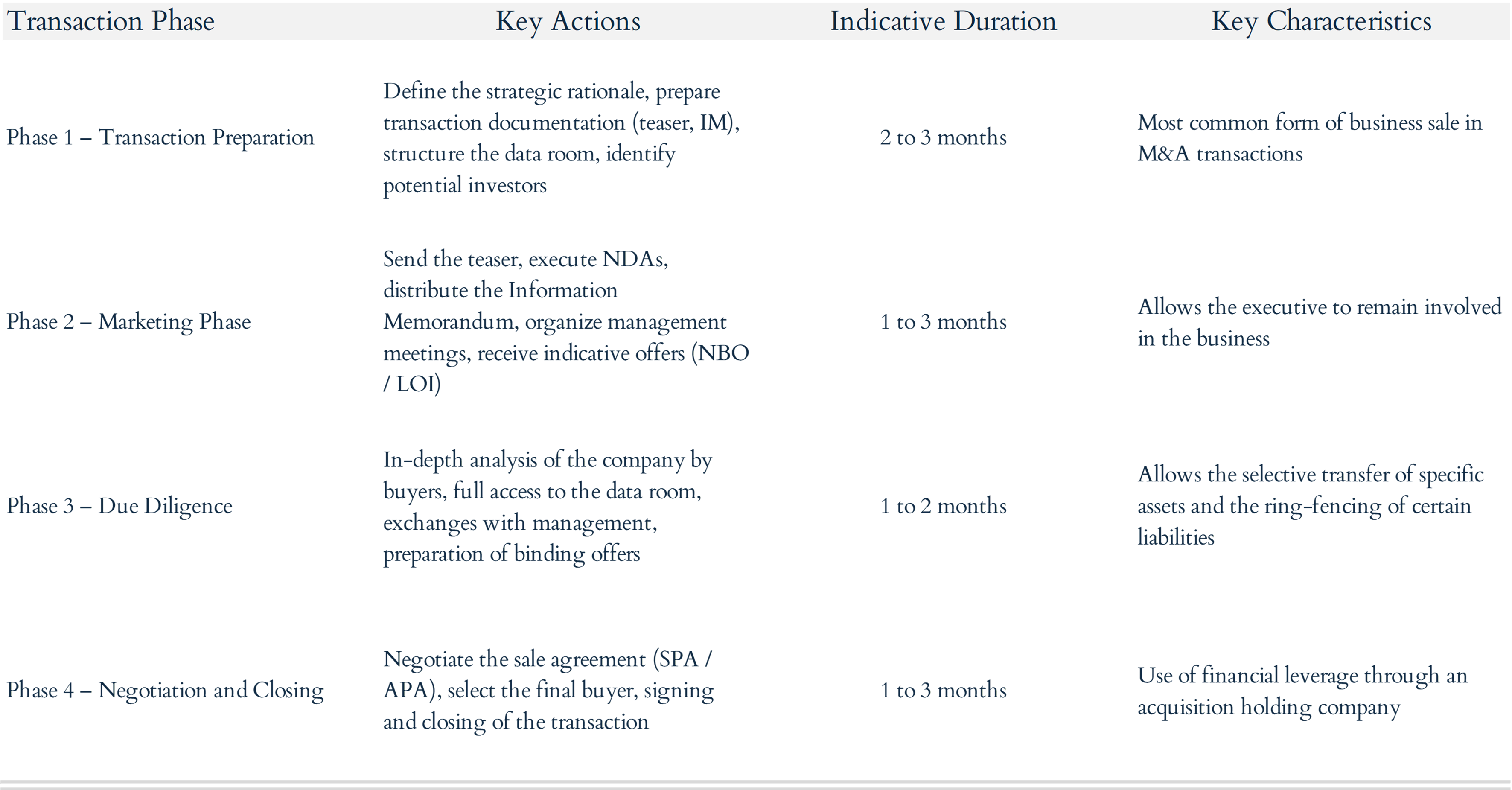
Synthetic Overview of a Business Sale Transaction
A business sale is generally embedded in a structured and sequential process, organized around several successive steps designed to identify potential buyers, structure the transaction, and secure the terms of the deal.
In M&A sell-side practice, the process can be summarized as follows:
Phase 1 – Transaction Preparation
- Define the strategic rationale for the transaction
- Define the transaction perimeter
- Collect and analyze financial and operational information
- Prepare transaction documentation (teaser, IM, factbook, process letter, NDA, data room)
- Establish the list of potential investors
- Set up the transaction timeline
Phase 2 – Marketing Phase
- Send the teaser to targeted investors
- Execute Non-Disclosure Agreements (NDAs)
- Distribute the Information Memorandum and process letter
- Organize management meetings
- Receive non-binding indicative offers (NBO / LOI)
Phase 3 – Due Diligence
- Grant full access to the data room
- Conduct financial, legal, and operational analyses
- Organize additional exchanges with management
- Receive binding offers
Phase 4 – Negotiation and Transaction Closing
- Negotiate financial and contractual terms
- Arbitrate between offers received
- Draft and negotiate the sale agreement (SPA / APA)
- Signing and closing of the transaction
Depending on the complexity of the transaction and the number of investors involved, the entire process typically extends over a period of six to twelve months.
Indicative Transaction Timeline
CEO Message
"The sale of a business represents an important milestone in the life of an entrepreneur. Behind the financial and legal considerations, a transaction of this nature often represents the culmination of several years — sometimes several decades — of commitment, hard work, and entrepreneurial development.
For many founder-executives, the succession of their business is not simply a financial transaction. It is also part of a broader reflection aimed at ensuring business continuity, preserving the teams, and safeguarding the entrepreneurial project built over time.
In this context, the choice of the buyer takes on particular importance. Beyond the price proposed, executives often pay close attention to the future shareholder's strategic vision, their capacity to continue developing the business, and their human compatibility with the existing teams.
At Hectelion, we believe that a business sale is not simply about organizing a transaction. The firm accompanies executives, founders, shareholders, and businesses through a strategic transition — helping them take the next step in their development.
Our approach is built on a simple conviction: a successful sale must combine financial rigor, discretion, technical expertise, and a human understanding of the specific challenges faced by each executive.
Beyond structuring the transaction, our role is therefore to support entrepreneurs through a key milestone in their journey — ensuring that the company's identity is preserved, the quality of relationships between parties is maintained, and the conditions for a smooth succession are in place."
Conclusion: The Keys to a Successful Business Sale
The sale or succession of a business represents a major strategic milestone in the life of an executive and their shareholders. Far beyond a simple financial transaction, it often represents a defining step in a company's lifecycle — marking the transition of an entrepreneurial project built over the years toward a new phase of development.
As explored throughout this article, a business sale rests on a structured process, generally organized around several successive phases: transaction preparation, marketing phase, due diligence, and final negotiation. Each of these steps plays a determining role in the success of the transaction and requires rigorous preparation as well as close coordination between executives, shareholders, and their advisors.
The success of a business sale rests notably on several key factors: the quality of company preparation, the structuring of the sale process, the identification of relevant buyers, and the ability to create a competitive environment that optimizes the financial and contractual terms of the transaction.
However, beyond financial and legal considerations, the succession of a business remains a profoundly human decision. For the founder-executive, it often involves passing on an entrepreneurial project, a team, and a vision built over the years to a new shareholder capable of ensuring their continuity and development.
When properly prepared and supported, a business sale can thus represent a natural transition in a company's trajectory — both valorizing the work accomplished by historical shareholders and opening a new growth phase for the business.
Looking to build expertise in Mergers & Acquisitions?
Hectelion offers M&A training programs combining theoretical foundations, practical methodologies, and real-life transaction case studies.
👉 Learn more about the program
Author
Aristide Ruot, Ph.D
Founder | Managing Director

.avif)
.jpg)


