
Purchase Price Allocation (PPA): Definition, Method and Considerations in France and Switzerland
PPA | Definition, valuation methods and WARA

Introduction: PPA — A Post-Acquisition Imperative Too Often Underestimated
Every business acquisition generates, in the weeks following closing, a structuring accounting obligation: allocating the acquisition price between the identifiable assets acquired, the liabilities assumed and the residual goodwill.
This process — the Purchase Price Allocation, or PPA — is required by IFRS 3 and US GAAP ASC 805 for entities subject to these standards, and constitutes an essential best practice for all companies wishing to faithfully reflect the economic substance of an acquisition in their financial statements.
Yet PPA is one of the most frequently underestimated post-closing obligations. Many acquirers discover, months after signing, that the price they paid incorporates significant intangible assets — customer relationships, brands, technologies, contracts — that should have been identified, valued separately and amortised over their useful life.
The absence of rigorous PPA results in overstated goodwill, poorly calibrated amortisation and financial reporting that fails to reflect the economic substance of the transaction.
As the IASB states in the basis for conclusions of IFRS 3: “The objective of accounting for a business combination is to provide information that is relevant about the assets acquired, the liabilities assumed and the consideration transferred, so that users of financial statements can evaluate the nature and financial effects of the transaction.”
The question that CFOs, auditors and M&A advisers invariably ask is the same: how to exhaustively identify the intangible assets acquired, value them in a defensible manner, and produce a report that withstands scrutiny from the external auditor, tax authorities and, where applicable, a counter-expert?
This article provides a structured and operational answer to that question.
We will cover the origins and regulatory framework, the definition and components, the application contexts, the five-step methodology, the structure of a typical PPA engagement and report, Franco-Swiss considerations, common errors, pre-deal PPA, advantages and limitations, and two quantified case studies.
Origins and Foundations of Purchase Price Allocation
PPA finds its foundations in the evolution of international accounting standards at the turn of the 2000s. Previously, business combinations could be accounted for using the pooling of interests method, which allowed the recognition of goodwill and acquired intangible assets to be avoided.
This method was progressively abandoned in favour of the acquisition method, requiring complete allocation of the price paid.
IFRS 3 Business Combinations was published in March 2004, then revised in January 2008 in convergence with US GAAP ASC 805.
In France, CRC Regulation 99-02 and the ANC guidelines govern business combinations for consolidated accounts. In Switzerland, Swiss GAAP FER 30 applies to groups not using IFRS.
Both frameworks present notable differences from IFRS 3, particularly on the treatment of goodwill.
For further reading on the valuation methods used in this context: business valuation approaches and methods — WARA: definition, calculation and PPA — intangible asset valuation service.
Would you like to have your business, its assets or financial instruments valued, sell it, conduct a financial due diligence or a PPA ?
Hectelion handles all these operations in France and Switzerland — business sale, divorce, shareholders agreement, taxation, assets, financial instruments a financial due diligence or a PPA.
→ Book a call — 30 minutes, confidential
Definition: What Is Purchase Price Allocation?
Purchase Price Allocation is the accounting and financial process by which the acquisition price of a business is distributed between the identifiable assets acquired, the liabilities assumed and the residual goodwill, at the acquisition date.
Acquisition Price = Fair Value of Net Identifiable Assets Acquired + Goodwill
Goodwill = Acquisition Price − (Identifiable Assets at Fair Value − Liabilities Assumed at Fair Value)
The fair value of net identifiable assets includes all tangible assets (fixed assets, inventories, receivables), identifiable intangible assets (brands, customer relationships, technologies, contracts) and liabilities assumed (financial debt, provisions, tax liabilities).
Goodwill represents the residual — the portion of the acquisition price exceeding the fair value of net identifiable assets.
It typically reflects the value of the company’s reputation, human capital, expected synergies and any competitive advantage not individually identifiable.
Distinction Between Goodwill and Badwill
When the fair value of net identifiable assets exceeds the acquisition price, the result is badwill (negative goodwill). This situation — relatively rare — may arise from a distressed acquisition or a forced sale. Under IFRS 3, badwill is immediately recognised in profit or loss.
Identifiable Intangible Assets vs Residual Goodwill
An intangible asset is identifiable if it meets one of two criteria defined by IFRS 3: the separability criterion (the asset can be separated from the entity and sold, transferred, licensed, rented or exchanged) or the contractual-legal criterion (the asset arises from contractual or legal rights). Further reading: brand valuation — patent valuation — know-how valuation.

Application Context: Who Is Concerned and Within What Timeframe?
PPA is mandatory for any entity applying IFRS or US GAAP in the context of a business combination.
IFRS 3 provides for a measurement period of a maximum of 12 months from the acquisition date, during which the acquirer may adjust the provisional amounts recognised.
After this deadline, any correction must be recognised through profit or loss.
In practice, PPA concerns three categories of entities:
- listed groups or bond issuers subject to IFRS (legal obligation);
- subsidiaries of international groups whose parent applies IFRS or US GAAP (obligation by consolidation);
- unlisted SMEs and mid-caps making acquisitions (recommended even in the absence of legal obligation, for financial reporting quality, tax management and preparation for a future sale).
The link with financial due diligence is direct: a well-conducted due diligence anticipates identifiable intangible assets and facilitates post-closing PPA.
See also our mergers and acquisitions service.
Methodology: The Five Steps of PPA
Step 1 — Identification of Identifiable Intangible Assets
Exhaustive identification of intangible assets in the acquired entity meeting IFRS 3 identifiability criteria: contracts, customer lists, brand portfolios, proprietary technologies, licences, databases, non-compete agreements.

Step 2 — Valuation of Each Identified Asset
Three families of methods are used depending on the nature of the asset.
The Relief from Royalty method (RfR) is the reference for brands, patents and technologies:
Value = Σ (Revenue × Royalty Rate × (1 − Tax)) / (1 + WACC)^n.
The MEEM method (Multi-Period Excess Earnings) is the reference for customer relationships.
The Cost Approach applies to internally developed software and codified know-how.
Further reading: patent valuation — software and SaaS valuation — intangible asset valuation service.

Step 3 — WARA (Weighted Average Return on Assets)
WARA is the central consistency test of any PPA. It verifies that the implicit return rates attributed to each asset are consistent with the acquirer’s WACC:
WARA = Σ (Asset value i / Total value) × Return rate i. WARA should be equal to or slightly above WACC.
Further reading: WARA: definition and calculation — WACC.

Step 4 — Calculation of Residual Goodwill
Goodwill is calculated as the residual between the acquisition price and the fair value of net identifiable assets allocated.
Under IFRS, it is subject to a mandatory annual impairment test under IAS 36: comparison between the carrying amount of the cash-generating unit (CGU) and its recoverable amount.
See business valuation: approaches and methods.
Step 5 — Documentation and Report
The PPA must be documented in a formalised report produced by an independent expert.
This report is the supporting document presented to the external auditor and, where applicable, tax authorities.
Its content is detailed in the following chapter.
Engagement Structure and PPA Report Organisation
A — Stakeholders
The acquirer (CFO) mandates the expert and provides the data — SPA, financial statements, business plan.
The external auditor (statutory auditor in France, réviseur in Switzerland) validates the PPA report as part of consolidated accounts certification.
The independent valuation expert (Hectelion) conducts the engagement, identifies the assets, values each component, calculates the WARA and produces the report.
The target’s finance team provides operational data: customer lists, attrition rates, royalties charged.
B — The Seven Phases of a PPA Engagement

C — What a PPA Report Must Contain
1. Cover page and engagement context — identification of parties, acquisition date, expert mandate, independence declaration.
2. Transaction description — price, legal structure, first consolidation date, contingent consideration (earn-out).
3. Target presentation — business, economic model, key financial data.
4. Regulatory framework — IFRS 3, Swiss GAAP FER 30, fair value principles.
5. Intangible asset inventory — exhaustive list with identifiability justification.
6. Valuation sheet per asset — method, key assumptions, cash flow table, value, sensitivity analysis.
7. WARA calculation and consistency test.
8. Final allocation table. 9. Independence declaration.
10. Appendices — sources, models, sensitivity tables, expert’s CV.
D — Duration and Cost
For an SME (enterprise value between €5M and €50M/CHF), a rigorous engagement generally falls between €/CHF 10,000 and 30,000 depending on the number of assets identified, data availability and sector complexity.
ook a call for a confidential initial discussion.
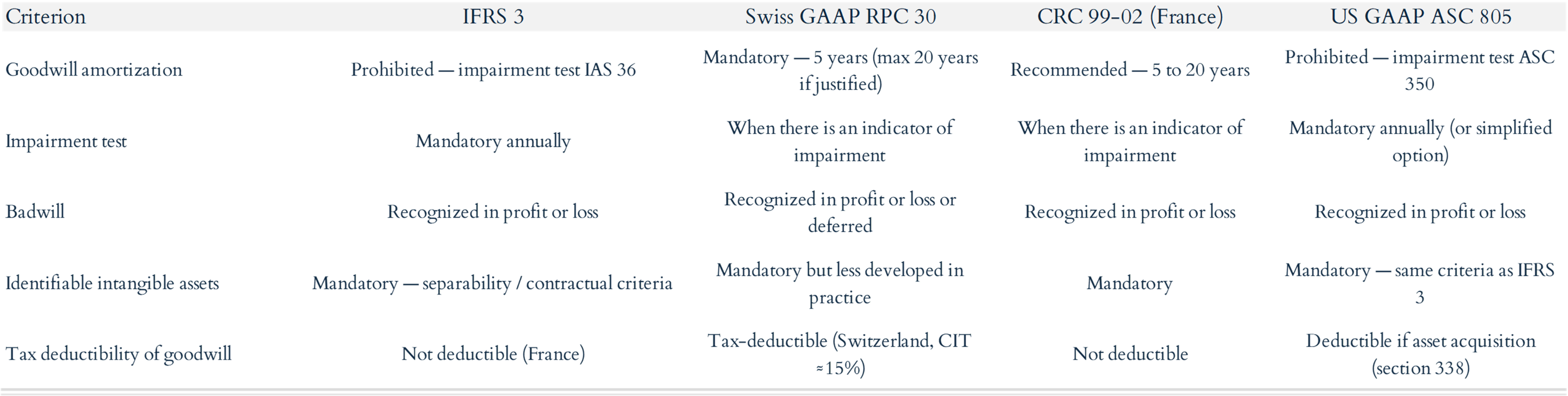
Franco-Swiss Considerations: Differences in Goodwill Treatment
The treatment of goodwill is the main divergence between the applicable frameworks.
These differences have direct implications for amortisation policy and post-acquisition tax management.
See business valuation: France vs Switzerland — holding companies in Switzerland.
Common Errors in a PPA
1. Omission of identifiable intangible assets. Customer relationships, proprietary technologies and non-compete agreements are regularly overlooked. Their value is absorbed into overstated goodwill.
2. Double counting between intangible assets and goodwill. Some PPAs value an intangible asset while retaining in goodwill elements that should be excluded from it. This double counting distorts the WARA.
3. WARA inconsistent with WACC. A WARA materially below WACC signals undervaluation of intangible assets or overvaluation of tangible assets. See WACC — size premium.
4. Poorly calibrated customer attrition rate. In the MEEM method, the attrition rate is the most sensitive variable. It must be calibrated on the target’s actual historical data.
5. Measurement period not respected. The PPA must be finalised within 12 months of the acquisition date. After this deadline, any correction flows through profit or loss.
6. Absence of sensitivity analysis. A report without sensitivity analysis on key assumptions cannot withstand serious challenge.
PPA: a post-deal exercise by construction
The Purchase Price Allocation is, by construction, a post-deal exercise. It follows directly from closing and consists in reflecting in the accounts, at the acquisition date, what has been legally and economically acquired. The obligation is triggered only from the point of control — as defined under IFRS 10 — and therefore cannot materially exist beforehand.
IFRS 3 frames this sequencing precisely through the concept of the measurement period: the acquirer has a maximum window of twelve months from the acquisition date to finalise the allocation of the price paid between identifiable assets acquired, liabilities assumed and residual goodwill. Beyond this deadline, any subsequent adjustment must be recognised through profit or loss, with the consequences this entails for the readability of the consolidated accounts and the scrutiny applied by the external auditor. US GAAP ASC 805 applies an equivalent principle, with a comparable measurement period.
This post-deal qualification is not a semantic nuance: it shapes both the acquirer's responsibilities — sole custodian of the allocation obligation from the point of control — and the temporality of the exercise. Identification of intangible assets, fair value measurement, WARA consistency test and formalisation of the report must all be conducted within the window opened by closing.
Pre-deal PPA — also referred to as indicative PPA or shadow PPA — does not call this framework into question. It is a complementary professional practice: performing, ahead of closing and based on data room information, a simulation of the allocation that will effectively be carried out once the transaction has completed. This approach does not substitute for the formal post-closing PPA; it prepares for it, by informing price negotiation and the modelling of the acquisition's return profile.
Pre-Deal PPA: Anticipating the Accounting Impact Before Closing
Pre-deal PPA involves conducting an indicative PPA before closing, based on information available in the data room.
It pursues three objectives:
- anticipating the accounting impact (calibrating amortisation forecasts in acquisition models),
- informing price negotiation (the value of identifiable intangibles directly affects residual goodwill),
- accelerating post-closing (starting the formal engagement immediately after closing, reducing the risk of exceeding the 12-month measurement period).
See M&A acquisition process — Locked-box vs Completion Accounts.
Advantages and Limitations of PPA
What PPA Delivers in Practice
Financial transparency: post-acquisition financial statements faithfully reflect the economic substance of the transaction.
Amortisation optimisation: each intangible asset is amortised over its own useful life.
Tax protection: in Switzerland, goodwill amortisation generates a tax shield; in France, documentation protects against fiscal recharacterisation.
Preparation for a future sale: a well-documented acquisition facilitates due diligence in a subsequent sale.
Limitations to Be Aware Of
PPA rests on assumptions involving a degree of subjectivity — royalty rates, attrition rates, useful lives.
The annual goodwill impairment test may lead to subsequent corrections if performance disappoints.
See premiums and discounts in valuation.
Examples and Case Studies
Case 1 — Acquisition of a SaaS Technology SME (fictitious names)
Company A SAS, B2B SaaS publisher, Île-de-France.
Revenue: €4.2M.
Normalised EBITDA: €1.1M.
Acquisition price: €10M.
Acquirer WACC: 11.0%.
Net book assets at acquisition date: €1.2M.
Identified intangible assets: proprietary technology (SaaS platform), customer relationships (ARR €3.8M, attrition 8%), commercial brand.

Case 2 — Acquisition of a Swiss Services Company (fictitious names)
Company B Sàrl, engineering consulting, canton of Zurich.
Revenue: CHF 6.8M.
EBITDA: CHF 1.4M.
Acquisition price: CHF 9M.
Acquirer WACC: 10.5%.
Net book assets: CHF 2.1M.
Identified intangible assets: customer portfolio (recurring contracts, renewal rate 85%), codified technical know-how, non-compete agreement signed with founders (5 years).

A Word from the Managing Director
Purchase Price Allocation is one of the most demanding engagements we conduct at Hectelion — and one of those with the most directly financial stakes for our clients.
What we regularly observe: acquirers who have paid a price reflecting the real value of significant intangible assets — a recognised brand, a recurring customer portfolio, proprietary technology — but have not commissioned a rigorous PPA.
The result: overstated goodwill, unidentified intangible assets, poorly calibrated amortisation.
Our approach is systematic: start from the economic analysis of the target — understand where the value paid actually comes from — before entering the modelling phase. An acquirer never pays solely for accounting assets.
They pay for future cash flows generated by specific assets. PPA must reflect that reality.
Pre-deal PPA is, in our view, the most underutilised practice in mid-market acquisition processes.
Conducting an indicative PPA before closing allows the acquirer to integrate the accounting impact into the return model, inform price negotiation and accelerate post-closing.
Aristide Ruot, Ph.D — Founder & Managing Director, Hectelion
FAQ — Frequently Asked Questions on Purchase Price Allocation
What is Purchase Price Allocation (PPA) in M&A?
PPA is the accounting process by which the acquisition price is distributed between net identifiable assets acquired and residual goodwill.
It is required by IFRS 3 and US GAAP ASC 805 and constitutes best practice for all acquisitions.
See business valuation: approaches and methods.
In what cases is PPA mandatory?
It is mandatory for any entity applying IFRS or US GAAP in the context of a business combination. For SMEs and mid-caps not subject to IFRS, it is recommended in all significant acquisitions.
See our mergers and acquisitions service.
What is the difference between goodwill and identifiable intangible assets?
Identifiable intangible assets meet the separability or contractual-legal criteria.
They are valued separately and amortised over their useful life. Goodwill is the residual, not amortised under IFRS, subject to the annual IAS 36 test.
Resources: brand — patent — know-how.
How is goodwill calculated in a PPA?
Goodwill = Acquisition price − Fair value of net identifiable assets acquired. Net identifiable assets include tangible assets at fair value, identifiable intangible assets valued separately and liabilities assumed at fair value.
What is the difference between IFRS 3 and Swiss GAAP FER 30 on goodwill?
Under Swiss GAAP FER 30, two alternative treatments are available at the group's option:
(i) capitalisation and planned amortisation over its useful life (20 years maximum, 5 years where the useful life cannot be reliably determined), which generates a tax shield (average Swiss corporate income tax ≈ 15%);
or (ii) direct offset against equity at the acquisition date, with disclosure in the notes of the effects of a theoretical capitalisation.
How much does a PPA engagement cost at Hectelion?
Between €/CHF 10,000 and 30,000 for an SME (EV between €5M and €50M/CHF).
Book a call for a tailored quote.
Conclusion: Purchase Price Allocation — A Tool of Rigour in the Service of Value Creation
PPA is not an accounting formality.
It is a rigorous analytical exercise that reflects the economic substance of an acquisition, identifies the real value of assets acquired and calibrates post-closing amortisation policy.
At Hectelion, an independent advisory firm active in France and Switzerland, we conduct PPA engagements across all contexts — SME and mid-cap acquisitions, carve-outs, Franco-Swiss cross-border transactions, pre-deal PPA.
Our expertise covers all intangible assets: brands, patents, software, know-how.
Contact us for a confidential initial discussion.
Author
Aristide Ruot, Ph.D
Founder | Managing Director