
How to Acquire a Company: Steps and Process of a Buy-Side M&A Transaction
The essential steps to acquiring a business

Introduction: Understanding the Mechanisms of Business Acquisition
The acquisition of a business is one of the most structurally significant strategic decisions in the trajectory of an executive, an industrial group, or a financial investor. Whether driven by external growth ambitions, a sector consolidation strategy, or a value creation opportunity, the purchase of a company is generally part of a broader strategic, financial, and organisational reflection aimed at strengthening the acquirer's competitive positioning and accelerating its development.
In an economic environment characterised by intensifying M&A activity and the constant search for growth drivers, buy-side transactions play a central role in market restructuring, synergy creation, and the efficient reallocation of capital within the economy.
A business acquisition can be defined as the transaction by which an acquirer — whether an industrial group, an investment fund, or an entrepreneur — takes total or partial control of a target company, by acquiring all or part of its shares or assets. This transaction can take various legal and financial forms depending on the structure chosen, with distinct implications in terms of taxation, legal framework, and operational continuity.
In M&A practice, buy-side transactions are those in which a financial adviser supports the acquirer in identifying, analysing, and executing the acquisition — as opposed to sell-side transactions, where the seller is assisted in preparing and managing the disposal process. In both cases, these operations follow a structured, sequential process comprising several key phases, from defining the acquisition strategy through to final contract negotiation and deal closing.
As Joshua Rosenbaum and Joshua Pearl note, M&A transactions are built on rigorous processes designed to efficiently bring acquirers and targets together, secure transaction terms, and maximise value creation for all parties. (Rosenbaum, Joshua & Pearl, Joshua (2013). Investment Banking: Valuation, Leveraged Buyouts, and Mergers & Acquisitions. Hoboken: John Wiley & Sons.)
McKinsey & Company similarly emphasises that acquisitions are among the most powerful growth levers available to companies, provided they are correctly prepared, structured, and integrated. (McKinsey & Company (2010). Merger Management Compendium.)
This raises a central question for executives, industrial groups, and investors considering a business acquisition: how can one effectively identify, analyse, and acquire a target company so as to optimise its strategic value, secure the transaction, and ensure a successful integration — without destabilising the organisation or undermining the expected value creation?
In practice, the success of an acquisition depends on a clearly defined strategy, rigorous target selection, thorough risk analysis, and a financing structure suited to the objectives pursued.
With this in mind, this article provides a structured analysis of the main dimensions of a buy-side M&A acquisition process. It first examines the motivations that may lead to an acquisition and the different forms transactions can take. It then reviews the key players involved and target selection criteria. Finally, it details the steps of the acquisition process, the structural principles for securing a transaction, and the key success factors for post-acquisition integration.
What Is a Business Acquisition in the Context of a Buy-Side M&A Process?
A business acquisition is the transaction by which an acquirer takes total or partial control of a target company, by acquiring all or part of its shares or assets. This transaction may be driven by strategic, financial, or operational considerations and frequently represents a major milestone in a company's development trajectory.
In M&A practice, the process is referred to as buy-side when the transaction is organised from the acquirer's perspective and managed — where applicable — by a specialist financial adviser. The primary objective is to identify the most relevant targets, structure the analysis and negotiation of the transaction, and maximise value creation for the acquirer.
According to Aswath Damodaran, Professor of Finance at the Stern School of Business at New York University and a globally recognised authority in business valuation, acquisitions only create value when they are grounded in a sound strategic rationale, a rigorous assessment of the target, and a carefully planned post-acquisition integration. (Damodaran, Aswath (2012). Investment Valuation: Tools and Techniques for Determining the Value of Any Asset. 3rd Edition. Hoboken: John Wiley & Sons.)
Why Acquire a Business? The Motivations Behind a Buy-Side Transaction
The decision to acquire a business rarely stems from a single factor. In practice, it is most often driven by a combination of strategic, financial, and operational motivations specific to each acquirer. Several broad rationales may lead an industrial group, an investment fund, or an entrepreneur to pursue an acquisition.
Accelerating External Growth
Acquisition is one of the most direct levers for accelerating a company's growth. Rather than organically developing new capabilities — which requires time, resources, and execution risk — the acquirer can choose to acquire a company that already possesses the competencies, assets, or market positions it is seeking.
This external growth logic is particularly common in highly competitive sectors where speed of development constitutes a decisive competitive advantage.
Realising Strategic or Operational Synergies
One of the primary drivers of an acquisition lies in the ability to create synergies between the acquirer and the target company. These synergies may be commercial — expanding the customer base, accessing new geographic markets — operational — sharing support functions, optimising procurement — or financial — improving cost structure, tax optimisation.
McKinsey & Company notes in this regard that synergies are among the main factors justifying the control premiums observed in M&A transactions, and that their effective realisation largely conditions value creation post-acquisition. (McKinsey & Company (2010). Merger Management Compendium.)
Consolidating a Market Position
In certain sectors, acquisitions are part of a sector consolidation logic. The acquirer then seeks to strengthen its dominant position in a market, reduce competitive pressure, or reach a critical scale enabling cost optimisation and improved competitiveness.
This type of transaction is particularly common in fragmented sectors, where a player has the opportunity to become the reference consolidator of its market.
Acquiring Technologies, Competencies, or Strategic Assets
In an economic environment characterised by rapid technological transformation, many acquisitions are motivated by the desire to acquire proprietary technologies, patents, specific know-how, or high-value teams.
This type of transaction — sometimes referred to as an acqui-hire when it primarily targets human talent — is particularly prevalent in technology, healthcare, and knowledge-intensive service sectors.
Diversifying Activities or Revenue Streams
Some acquirers seek to diversify their portfolio of activities to reduce their exposure to a specific sector or market. Acquiring a company operating in a complementary sector or new geographic area can help reduce earnings volatility and improve the resilience of the overall group.
Making a Financial Investment
For private equity funds and financial investors, acquiring a business is primarily driven by a financial value creation logic. The objective is to acquire a company at an attractive price, improve its operational and financial performance, and then realise the value created upon a subsequent disposal.
As Ludovic Phalippou, Professor at the Saïd Business School at the University of Oxford, notes, private equity funds generate value by combining financial leverage, operational improvement of acquired companies, and synergy creation within their portfolio. (Phalippou, Ludovic (2017). Private Equity Laid Bare. CreateSpace Independent Publishing Platform.)
The Different Types of Business Acquisition
In M&A practice, acquisitions can take various forms depending on the nature of the transaction, the level of control sought, and the objectives pursued by the acquirer.
Full Acquisition (Share Deal)
A full acquisition corresponds to the acquisition of the entire share capital of a target company. The acquirer acquires all shares held by the existing shareholders and becomes the sole shareholder of the company. This form of acquisition is the most common in M&A transactions, particularly when the acquirer wishes to fully consolidate the target into its group perimeter.
Majority Acquisition
In some transactions, the acquirer takes control of the target by acquiring a majority stake — generally above 50% of voting rights — without necessarily buying out the entire share capital. This structure allows the acquirer to hold strategic decision-making power while leaving historical shareholders with a residual minority interest.
Minority Acquisition (Equity Stake)
A minority acquisition occurs when the investor acquires a limited stake in the target's share capital without taking operational control. This type of transaction is common in growth capital strategies or when the acquirer wishes to establish a strategic partnership before considering a future takeover.
Asset Acquisition (Asset Deal)
In some transactions, the acquirer does not purchase the shares of the target company but directly acquires all or part of its assets — equipment, contracts, brands, patents, customer databases. This structure is often preferred when the acquirer wishes to limit its exposure to the target's historical liabilities, or when the transaction concerns a specific business division.
Merger
A merger is a specific form of combination between two companies, in which the entities concerned are brought together within a single legal structure. Unlike a traditional acquisition, a merger generally implies the combination of assets, liabilities, and teams from both companies into a common entity.
Key Players in an Acquisition Transaction
An acquisition transaction mobilises a range of players with complementary expertise, whose effective coordination largely determines the smooth progress of the transaction.
The Buy-Side Financial Adviser (M&A Boutique or Investment Bank)
In managing an acquisition process, the buy-side financial adviser plays a central and structuring role. Its involvement extends far beyond target identification or administrative coordination of the transaction — it acts as the acquirer's strategic partner at every stage of the process, from defining the investment thesis through to deal closing.
In M&A practice, the buy-side financial adviser supports the acquirer across all dimensions of the transaction.
On the strategic level, it contributes to defining acquisition criteria, building the investment thesis, and identifying the most relevant targets in light of the objectives pursued. On the financial level, it conducts or coordinates target valuation work, analyses the financing conditions of the transaction, and structures the pricing mechanisms. On the operational level, it manages the process as a whole — approaching targets, managing NDAs, coordinating due diligence, organising management exchanges — while maintaining effective deal momentum. Finally, on the contractual level, it assists the acquirer in negotiating the financial terms and conditions of the acquisition agreement, defending its interests at every stage of discussions.
Choosing the Adviser: A Strategic Decision in Itself
The choice of financial adviser is itself a strategic decision for the acquirer. In practice, two broad categories of players fulfil this role: large international investment banks and independent specialist M&A boutiques.
Large investment banks and international audit firms have significant resources, a global presence, and established reputations. They primarily intervene on large-scale transactions involving listed groups or top-tier investment funds.
However, for executives, founders, and investors engaged in mid-market or business transfer transactions, independent specialist M&A boutiques offer specific advantages worth highlighting. Unlike large institutional structures — whose organisation is often pyramidal, standardised, and removed from entrepreneurial realities — independent boutiques share with their clients a common entrepreneurial culture built on proximity, agility, and alignment of interests.
This distinction is fundamental in the context of an acquisition. An entrepreneur-acquirer — whether an executive making their first external acquisition or a family group in a consolidation phase — has different needs from an institutional investment fund with dedicated internal teams. Above all, they need a partner capable of understanding their challenges, adapting to their constraints, and guiding them with discernment through a transaction that often commits a significant part of their wealth or their group's strategy.
Hectelion: An Independent Boutique Serving Acquirers and Entrepreneurs
Founded in French-speaking Switzerland and active in France and Western Europe, Hectelion is an independent advisory firm specialising in mergers and acquisitions, business valuation, intangible assets, financial instruments, financial due diligence, and financial structuring. With over ten years of expertise and more than 150 transactions analysed, the firm advises executives, investors, and entrepreneurs in their growth, transfer, and financing projects.
What fundamentally distinguishes Hectelion from large institutional M&A advisers is its entrepreneurial positioning. The firm is itself an independent structure, founded and led by professionals who share with their clients a common culture of risk-taking, decision-making, and long-term value creation. This natural proximity to entrepreneurs generates an alignment of interests that large investment banks or international audit firms — structured around institutional logic and standardised processes — cannot replicate in the same way.
In the context of buy-side transactions, Hectelion intervenes across all dimensions of the transaction:
In terms of valuation, the firm conducts independent valuations based on methods recognised under international standards — DCF, comparable listed companies, comparable transactions, yield value, practitioners' method, net book value/substantive value — taking into account sector-specific characteristics, control premiums, and the specific features of each target company. These workstreams provide the acquirer with an objective, documented view of the target's value, independent of the optimistic projections sometimes presented by the seller.
In terms of financial due diligence, Hectelion conducts in-depth analyses covering earnings quality, cost structure, normalised cash generation, and the target's financial risks — enabling the acquirer to base its investment decision on solid, verified foundations.
In terms of financial structuring, the firm assists acquirers in modelling and optimising the financing structure of the transaction — equity, senior debt, mezzanine, vendor loan, earn-out — with the aim of maximising investment returns while managing the associated risk.
In terms of M&A process management, Hectelion coordinates all stages of the acquisition — target identification, approach, negotiation, due diligence, contractual documentation — drawing on a proven methodology and an in-depth knowledge of market practices in France, Switzerland, and Western Europe.
Finally, on post-acquisition integration, the firm supports its clients in defining the integration plan, monitoring synergy realisation, and managing the organisational and cultural challenges associated with the acquisition — a dimension that is often underestimated but critical for long-term value creation.
“We do not simply advise — we commit alongside our clients as true transaction partners. Our independence is our strength: it allows us to defend the acquirer’s interests with objectivity, without conflicts of interest and without institutional agenda. In an acquisition process, where every decision commits significant resources and long-term strategic stakes, this independence is not a detail — it is a fundamental guarantee.”
Aristide Ruot, PhD — Founder & Chief Executive Officer, Hectelion
Legal Advisers
Lawyers specialising in corporate and commercial law are involved in the legal analysis of the target, the drafting and negotiation of the acquisition agreement (Share Purchase Agreement – SPA, or Asset Purchase Agreement – APA), and the legal structuring of the transaction.
Financial Experts (Financial Due Diligence)
Specialist firms — generally audit, advisory, or transaction services firms — conduct financial, tax, and operational due diligence to enable the acquirer to analyse the target company in depth and identify the key risks associated with the transaction.
In many M&A transactions, this work is entrusted to external firms mandated by investors to produce an independent analysis of the company’s financial and operational situation.
“At Hectelion, we have chosen to offer an integrated transaction approach. In addition to strategic advisory and process management, the firm is able to directly conduct certain financial and transactional analyses, particularly in the context of financial due diligence, business valuation, or financial risk analysis related to the transaction.”
Strategy Consultants
In certain transactions, strategy consulting firms may be mandated to analyse the market, the target’s competitive positioning, and potential synergies with an acquirer.
“At Hectelion, this dimension is directly integrated into our transaction advisory. The firm intervenes at the intersection of strategic thinking, financial structuring, and transaction execution, providing executives and shareholders with a unified, coherent, execution-oriented approach.”
Financial Institutions
When the acquisition is partially debt-financed — particularly in LBO transactions — banks or debt funds are involved in structuring and arranging the financing of the transaction.
Share Deal vs Asset Deal: Comparative Overview
The choice between a share transfer (share deal) and an asset transfer (asset deal) is one of the most structuring decisions in designing an M&A transaction. Each structure has distinct implications in terms of taxation, liability transfer, legal complexity, and operational continuity, which must be carefully analysed by the acquirer and its advisers.

Key Steps in a Business Acquisition Process (M&A Buy-Side)
In M&A practice, a structured acquisition process generally breaks down into four successive phases:
1. The strategy and target identification phase
2. The approach and preliminary analysis phase
3. The due diligence and valuation phase
4. The final negotiation and closing phase
Phase 1: Defining the Acquisition Strategy and Identifying Targets
The first step in an acquisition process is to clearly define the acquirer’s external growth strategy and to identify the most relevant targets in light of its objectives. This phase forms the foundation of the entire acquisition process and directly determines the relevance and quality of subsequent transactions.
In M&A practice, this phase generally includes several preliminary workstreams.
Defining Acquisition Criteria
The acquirer begins by defining the strategic and financial criteria guiding its target search. These may relate to the industry sector, geographic area, company size, profitability level, growth profile, or competitive positioning of the target.
Building the Investment Thesis
In parallel, the acquirer and its advisers develop an investment thesis detailing the strategic rationale of the acquisition, anticipated synergies, and the expected value of the transaction. This thesis serves as the guiding thread throughout the entire acquisition process.
Target Identification and Prioritisation
Based on the defined criteria, a list of potential targets is established — generally structured as a long list followed by a short list — ranked by the degree of strategic alignment between each company and the acquirer’s objectives.
Preliminary Target Analysis
Each identified target is subject to a preliminary analysis to assess its market positioning, publicly available financial performance, and potential for value creation for the acquirer.
Phase 2: Approaching the Target and Preliminary Analysis
Once the priority targets have been identified, the acquirer initiates a structured approach aimed at establishing first contact and assessing the feasibility of the transaction.
Initial Contact with the Target
The approach to the target may be made directly by the acquirer or through a financial adviser acting as intermediary to preserve confidentiality and discreetly assess the target’s interest in a potential transaction.
Signing a Confidentiality Agreement (NDA)
Once the target expresses interest in the transaction, the parties generally sign a Non-Disclosure Agreement (NDA) to govern information exchanges and protect sensitive data shared during preliminary discussions.
Preliminary Analysis of the Target
Based on the initial information received, the acquirer and its advisers conduct a preliminary analysis of the target company, covering its strategic positioning, financial performance, organisational structure, preliminary financial valuation, and development prospects. This analysis enables the acquirer to confirm or reassess its interest in the target and refine its investment thesis.
Management Meeting
In the vast majority of transactions, an initial meeting between the acquirer and the target’s management team is organised to allow the parties to discuss directly the strategy, development prospects, and terms of a potential transaction. This meeting plays an important role in assessing the human and cultural compatibility between the two organisations.
Submission of a Non-Binding Indicative Offer (NBO / LOI)
At the end of this preliminary analysis phase, the acquirer may submit a non-binding indicative offer (Non-Binding Offer – NBO or Letter of Intent – LOI), specifying the envisaged valuation, transaction structure, and main terms of the transaction. This offer constitutes a formal signal of interest, enabling discussions to progress towards the due diligence phase.
Phase 3: Due Diligence and Target Valuation
The due diligence phase is the central stage of the acquisition process. It enables the acquirer to conduct a thorough and comprehensive analysis of the target company, to verify information provided during previous phases, identify potential risks, and base its acquisition decision on solid, documented foundations.
In M&A practice, due diligence generally covers several complementary areas.
Financial Due Diligence
Financial due diligence aims to analyse in detail the target’s economic and financial performance — revenue, profitability, cost structure, cash generation, debt level — and to validate the financial projections presented by the seller. It also enables the identification of any accounting adjustments and corrections required for an accurate valuation of the company.
Legal Due Diligence
Legal due diligence covers the analysis of the target’s legal structure, its commercial and employment contracts, any ongoing litigation, its intellectual property, and its contractual commitments. Its objective is to identify legal risks that could affect the transaction or the value of the company.
Tax Due Diligence
Tax due diligence enables an analysis of the target’s tax situation, identification of potential tax risks, and assessment of the tax implications of the transaction for the acquirer. It is particularly important in cross-border transactions, where applicable tax rules can vary significantly across jurisdictions.
Operational Due Diligence
Operational due diligence focuses on the target’s internal organisation, its industrial or commercial processes, the quality of its IT systems, and the robustness of its human resources. It enables the acquirer to assess the operational capability of the target and identify any investment requirements post-acquisition.
Commercial and Strategic Due Diligence
Commercial due diligence aims to analyse the target’s positioning in its market, the strength of its customer portfolio, the quality of its supplier relationships, and its development prospects. It enables an assessment of the sustainability of the target’s business model and validation of the growth assumptions embedded in the valuation.
Target Valuation
In parallel with due diligence work, the acquirer and its financial advisers generally conduct a thorough valuation of the target to estimate its economic value and determine the price level that may be proposed in the context of the acquisition.
In M&A practice, this valuation typically relies on several complementary financial approaches:
- Discounted Cash Flow (DCF) analysis, which estimates the intrinsic value of the company by discounting projected future cash flows at a rate reflecting the weighted average cost of capital (WACC).
- Listed comparable companies analysis (Trading Comparables), which values the target by reference to valuation multiples observed for comparable listed companies operating in the same sector.
- Comparable transaction analysis (Transaction Comparables), which estimates the company’s value by reference to multiples observed in recent transactions involving comparable companies.
- The yield value method, which estimates the value of a company based on its future or historical earnings capacity, by capitalising or discounting expected results.
- The asset-based approach, grounded in net book value (NBV), adjusted net book value (ANBV), or substantive value, to assess the value of the company’s asset base.
- The practitioners’ method, widely used in certain valuation contexts in Switzerland, which generally combines several approaches — notably asset-based and yield-based — to arrive at a more balanced estimate of company value.
As Aswath Damodaran emphasises, no valuation method is universally superior to others: the quality of a valuation depends above all on the relevance of the assumptions made and the consistency of the analysis with the specific characteristics of the company being valued. (Damodaran, Aswath (2012). Investment Valuation: Tools and Techniques for Determining the Value of Any Asset. 3rd Edition. Hoboken: John Wiley & Sons.)
Phase 4: Final Negotiation, Signing, and Closing
Based on the results of the due diligence and the valuation conducted, the acquirer enters the final negotiation phase with the seller, aimed at definitively establishing the financial and contractual terms of the transaction.
Submission of a Binding Offer
At the conclusion of the due diligence phase, the acquirer submits a binding offer specifying the final price proposed for the acquisition, the transaction structure, and the main contractual terms envisaged. This offer marks the starting point of final negotiations between acquirer and seller.
Negotiating the Acquisition Agreement (SPA / APA)
Negotiating the acquisition agreement is one of the most technical and delicate stages of the process. In M&A practice, the acquisition agreement — generally referred to as a Share Purchase Agreement (SPA) in the case of a share sale, or an Asset Purchase Agreement (APA) in the case of an asset sale — governs all terms of the transaction.
Key negotiation points typically include:
- Price and adjustment mechanisms — notably via a Locked Box or Completion Accounts mechanism
- Representations and warranties provided by the seller regarding the condition of the target company
- Acquirer protection mechanisms — indemnification clauses, liability guarantees, escrow accounts
- Conditions precedent — competition authority approval, shareholder approval, waiver of change of control clauses
- Post-closing commitments — non-compete clauses, management transition obligations, earn-out
Pricing Mechanisms
In M&A practice, the final determination of price often relies on mechanisms designed to adjust or secure the transaction price between the signing date and effective completion of the transaction.
The Locked Box mechanism fixes the price on the basis of a historical financial reference date, while the Completion Accounts mechanism provides for a price adjustment after closing based on the company’s actual financial position at the completion date.
Signing and Closing
In M&A practice, the finalisation of a transaction generally takes place in two distinct stages:
- Signing, corresponding to the execution of the final legal agreements
- Closing, the moment at which all conditions precedent have been satisfied and effective transfer of ownership of the company takes place
Depending on the complexity of the transaction, the period between signing and closing may range from a few days to several months, particularly when the transaction is subject to regulatory or competition authority approval.
Financing a Business Acquisition: Structures and Mechanisms
Financing is one of the most structuring dimensions of an acquisition transaction. Beyond target valuation and contractual negotiation, the acquirer’s ability to arrange appropriate financing directly determines the feasibility of the transaction and its expected return on investment.
In M&A practice, several financing sources may be mobilised, either individually or in combination, depending on the acquirer’s profile, the size of the transaction, and the target’s financial characteristics.
Equity
Equity financing corresponds to the capital contribution made directly by the acquirer — whether an industrial group, an investment fund, or an individual entrepreneur. It constitutes the most secure component of the financing, as it does not generate repayment obligations and creates no recurring financial charge for the acquired company.
In transactions conducted by private equity funds, the equity component of total acquisition financing typically represents between 30% and 50% of the acquisition price, with the remainder financed through debt.
Senior Debt
Senior debt is the priority debt component of an acquisition’s financing structure. It is generally arranged by banks and is characterised by priority repayment in the event of financial difficulties.
In LBO transactions, senior debt typically represents between 40% and 60% of the acquisition price and is repaid from the cash flows generated by the acquired company. Its maturity is generally between five and seven years.
Mezzanine Debt
Mezzanine debt occupies an intermediate position in the financing structure, between equity and senior debt. It carries a higher risk than senior debt — as it is repaid after senior debt in the event of default — and offers correspondingly higher returns for lenders.
Mezzanine debt can take various forms, including subordinated bonds, participating loans, or convertible instruments. It is particularly used in mid-sized LBO transactions where senior bank financing is insufficient to cover the full acquisition price.
Vendor Loan
A vendor loan corresponds to a mechanism whereby the seller agrees to defer payment of part of the sale price. Concretely, the seller grants a loan to the acquirer, who repays this fraction of the sale price over a defined period after closing.
This mechanism is commonly used in mid-market transactions, particularly when the acquirer wishes to limit its initial equity contribution or when bank financing does not cover the full acquisition price. It also signals the seller’s confidence in the company’s ability to generate the cash flows needed for repayment.
Earn-Out
An earn-out is a conditional price supplement mechanism, whereby part of the acquisition price is paid to the seller after closing, contingent on the achievement of pre-defined performance targets — generally revenue, EBITDA, or net income targets over a period of one to three years following the transaction.
This mechanism helps bridge the valuation gap between buyer and seller when the parties disagree on the target’s future development prospects. It does, however, carry risks of post-closing disputes, particularly when the calculation terms are insufficiently precise or when the acquirer has significant influence over the results taken into account.
Earn-out mechanisms are increasingly common in mid-market transactions, representing a price component in a significant proportion of transactions in this segment.
Summary Table: Financing Structures

Target Valuation: Methods and Sector Benchmarks
Valuing a target company is one of the most technical and consequential steps in an acquisition process. Beyond the financial methods classically used — DCF, listed comparables, comparable transactions — M&A practice also relies on sector market benchmarks enabling rapid contextualisation of a valuation.
Discounted Cash Flow (DCF) Analysis
The DCF method estimates the intrinsic value of a company by discounting projected future cash flows at a rate reflecting the weighted average cost of capital (WACC). This approach is particularly suited to companies with sufficient visibility on future cash flows and a stable financial track record.
Its main limitation lies in its sensitivity to the assumptions made — particularly the discount rate and long-term growth rate — which can cause the resulting value to vary significantly.
The Yield Value Method
In addition to DCF and market multiple approaches, some company valuations may also draw on the yield value method, particularly used in certain financial expertise contexts, SME valuations, or certain valuation practices in continental Europe.
This method estimates the economic value of a company based on its normalised earnings capacity, generally determined from the average results observed over several recent financial years.
In practice, the yield value may be estimated by:
- Capitalising the average EBITDA observed over the past two or three years, divided by a capitalisation rate or the weighted average cost of capital (WACC)
- Capitalising the average normalised net income, also divided by an appropriate capitalisation rate
In certain valuation contexts, particularly in Switzerland, these results may be compared to a normative capitalisation rate published by the Swiss Tax Conference (STC). This rate constitutes a standardised reference used in certain tax and asset valuation workstreams, independently of the specific risk profile of the company being valued.
Listed Comparable Companies (Trading Comparables)
This method values the target by reference to the valuation multiples observed for a sample of comparable listed companies — generally expressed as multiples of EBITDA, EBIT, or revenue. It has the advantage of being based on objective, real-time market data.
Comparable Transactions (Transaction Comparables)
The comparable transactions method values the target by reference to multiples observed in recent transactions involving companies with a similar profile. It generally incorporates a control premium reflecting the strategic value of acquiring control of a company.
Asset-Based Approach (NBV, Substantive Value, ANBV)
Some valuations may also incorporate an asset-based approach, which assesses the company’s value based on its net asset value. This approach generally draws on several indicators:
- Net Book Value (NBV) / Substantive Value: the value of shareholders’ equity as recorded in the company’s balance sheet
- Adjusted Net Book Value (ANBV): restating balance sheet assets and liabilities to reflect their true economic value
The asset-based approach is particularly relevant in specific situations, notably when the company holds significant assets — such as real estate, industrial, or financial assets — or when the business has limited profitability but rests on a substantial economic asset base.
In M&A practice, this method is generally used alongside cash flow and market multiple approaches to provide a more complete picture of the company’s economic value.
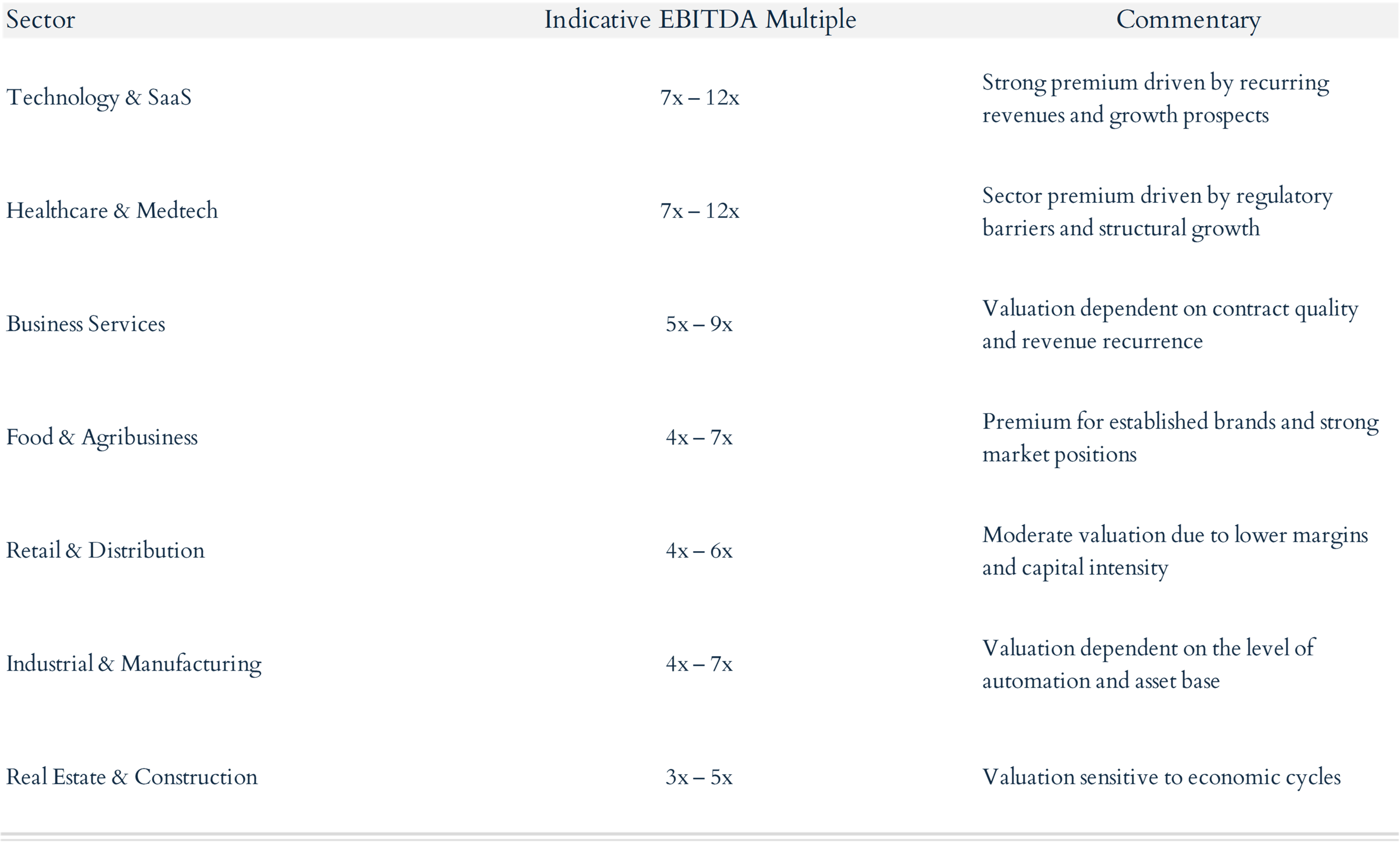
Sector Benchmarks: Indicative EBITDA Multiples
In M&A practice, EBITDA multiples are the most commonly used valuation reference. By way of indication, the multiple ranges observed in mid-market transactions in Europe vary significantly by sector.
Managing Confidentiality in an Acquisition Process
In M&A practice, confidentiality is a major strategic concern for both the acquirer and the target company. An information leak during the process can have significant consequences — disrupting teams, alarming clients and suppliers, triggering competitor reactions, or even destabilising the transaction itself.
Risks Associated with Information Leaks
The risks of confidentiality breaches in an M&A process are multiple. They may result from inadequately controlled exchanges with stakeholders, overly wide circulation of transaction documents, indiscretions within the teams involved, or inadvertent signals perceptible to third parties — including employees, clients, or competitors.
In some situations, the mere rumour of an ongoing acquisition may be sufficient to destabilise the target’s teams, weaken key commercial relationships, or attract the attention of competitors who may formulate competing offers.
The Central Role of the Confidentiality Agreement (NDA)
The Non-Disclosure Agreement (NDA) is the primary legal instrument governing information exchanges between acquirer and target. It defines the scope of protected information, the parties’ obligations, those authorised to access confidential information, and the penalties applicable in the event of a breach.
In M&A practice, the NDA is generally signed at the very beginning of the process, before any significant documents concerning the target are shared. Its drafting warrants particular care, especially with regard to the precise definition of confidential information, the duration of the confidentiality obligation, and non-solicitation clauses for employees.
Secure Data Room Management
The virtual data room is the centralised space in which all documents relating to the target company are made available to authorised acquirers. Secure management involves strict access rights controls — with differentiated authorisation levels by user profile — monitoring of document consultations, and full traceability of downloaded files.
Specialist virtual data room platforms — such as Intralinks, Datasite, or Firmex — offer advanced access rights management, document watermarking, and activity reporting features, enabling precise control over the circulation of sensitive information.
Internal Communication and Team Management
One of the most delicate challenges in managing confidentiality concerns internal communication within the organisations involved in the transaction. In most cases, the circle of those informed of the process is deliberately limited to senior management and key members of the transaction team, to reduce the risk of leaks.
The decision to progressively expand the circle of those informed — particularly during the operational due diligence phase — must be made with discernment, taking into account the sensitivity of the information being shared and the risks associated with each stage of the process.
Specifics of Cross-Border M&A Transactions
In an economic environment marked by the internationalisation of markets and increasing capital mobility, a growing number of acquisitions involve parties located in different countries. These cross-border transactions present important specificities that the acquirer must anticipate and manage to ensure the smooth progress of the transaction.
In the context of Hectelion — active in Switzerland, France, and more broadly in Western Europe — these issues are particularly prevalent, as a large number of the transactions the firm advises on involve parties in different jurisdictions.
Cultural and Managerial Differences
One of the first challenges in a cross-border acquisition lies in managing cultural differences between acquirer and target. These may relate to management practices, communication styles, decision-making processes, or team expectations regarding governance and leadership.
The academic literature on international management consistently highlights that cultural differences are among the main sources of difficulty in cross-border post-acquisition integrations. Geert Hofstede, whose work on cultural dimensions is a reference in intercultural management, notes that ignorance of cultural differences is one of the primary factors behind the failure of international mergers and acquisitions. (Hofstede, Geert (2001). Culture’s Consequences: Comparing Values, Behaviors, Institutions and Organizations Across Nations. 2nd Edition. Thousand Oaks: Sage Publications.)
Regulatory and Legal Constraints
Cross-border acquisitions generally involve a plurality of legal and regulatory frameworks applicable to the transaction. Depending on the countries involved and the size of the transaction, it may be subject to competition authority approval — European Commission, national authorities — as well as sector-specific regulations in sensitive areas such as defence, telecommunications, or financial services.
In Europe, the EC Merger Regulation subjects concentration operations exceeding certain revenue thresholds to prior authorisation, which can significantly extend the timeline for completing the transaction.
International Tax Considerations
The tax structuring of a cross-border acquisition is one of the most complex dimensions of this type of transaction. Tax implications vary significantly depending on the countries involved, particularly with regard to the taxation of capital gains on disposals, withholding taxes on dividends and interest, transfer pricing between entities within the same group, and rules on the deductibility of interest charges related to acquisition financing.
In the specific context of transactions involving Switzerland — whose tax regime has particularly attractive characteristics for holding structures — thorough tax analysis is essential to optimise the structuring of the transaction and anticipate the tax implications in each jurisdiction concerned.
Foreign Exchange Considerations
When a cross-border acquisition involves different currencies — for example, a euro-denominated acquisition financed in Swiss francs — the acquirer is exposed to foreign exchange risk that may affect the effective cost of the transaction and the return on investment. This risk must be identified and managed from the structuring phase, using appropriate hedging instruments.
Best Practices in Cross-Border Acquisitions
Given these specific challenges, acquirers engaged in cross-border transactions are well advised to rely on advisers with local expertise in each jurisdiction concerned — lawyers, tax advisers, and financial advisers — and to anticipate the additional delays associated with applicable regulatory procedures.
Post-Acquisition Integration: A Critical Success Factor Often Underestimated
While the success of an acquisition depends largely on the quality of the selection, analysis, and negotiation process, effective value creation ultimately rests on the acquirer’s ability to successfully integrate the acquired company into its organisation.
Yet the academic and professional literature on M&A consistently highlights that post-acquisition integration is one of the most complex and consequential phases of a merger and acquisition transaction.
According to McKinsey & Company, approximately 70% of acquisitions fail to create the expected value, primarily due to difficulties encountered during the post-acquisition integration phase. (McKinsey & Company (2010). Merger Management Compendium.)
In practice, a successful integration rests on several key factors.
Anticipating Integration Planning
The highest-performing acquirers begin planning the integration during the due diligence phase, without waiting for the closing of the transaction. This anticipation enables the identification of the main integration workstreams, the definition of responsibilities, and the preparation of teams for change.
Managing the Human Factor
Integrating an acquired company inevitably involves organisational and cultural changes that may generate resistance within teams. The quality of communication, management of key talent, and consideration of cultural dimensions are determining factors in the success of the integration.
Monitoring Synergy Realisation
Post-acquisition value creation depends largely on the effective realisation of the synergies identified during the due diligence phase. Establishing precise monitoring indicators and a dedicated governance structure enables tracking of synergy realisation and adjustment of the integration plan based on observed results.
Preserving the Entrepreneurial Culture
In acquisitions of SMEs or companies with a strong entrepreneurial culture, preserving the identity and dynamism of the acquired company is often a key success factor. An overly rapid or directive integration can undermine the organisational balance and compromise the retention of key talent.
Mistakes to Avoid in an Acquisition Process
In M&A practice, certain recurring mistakes can undermine an acquisition, reduce value creation, or compromise integration success.
Acquiring Without a Clearly Defined Strategy
One of the most common mistakes is to engage in an acquisition without a clearly defined strategy. An opportunistic acquisition, not grounded in a solid strategic rationale, carries a high risk of value destruction. Bain & Company notes in this regard that the most value-creating acquisitions are those that form part of a coherent, pre-defined external growth strategy. (Bain & Company (2022). Global M&A Report. Boston: Bain & Company.)
Overpaying for the Target
Overvaluing the target company is one of the primary risks of an acquisition. In a competitive process, the pressure to win the transaction can lead the acquirer to offer a valuation above the target’s intrinsic value, reducing the investment’s expected return.
Underestimating Risks Identified in Due Diligence
Some acquirers may be tempted to downplay risks identified during due diligence, particularly when the transaction is strategically attractive. This mistake can prove particularly costly if the underestimated risks materialise after closing.
Neglecting the Integration Phase
As noted above, post-acquisition integration is one of the most decisive stages in value creation from an acquisition. Insufficient preparation or poor execution of integration can rapidly undermine the expected synergies and destabilise the dynamics of the acquired company.
Not Engaging a Specialist Adviser
Like sell-side transactions, buy-side transactions require specific expertise in financial structuring, valuation, negotiation, and risk management. Engaging an experienced financial adviser provides the acquirer with an objective view of the transaction, optimises the terms of the acquisition, and secures the entire process.
How Long Does a Business Acquisition Process Typically Take?
In M&A practice, the duration of a complete acquisition process can vary significantly depending on several factors — the size and complexity of the target, the number of parties involved, regulatory constraints, and the degree of process competitiveness.
In the SME and mid-market segment, a structured buy-side process generally spans between six and twelve months, from the initial strategy definition phase through to effective closing of the transaction.
This duration typically includes:
- 1 to 2 months for strategy definition and target identification
- 1 to 2 months for target approach and preliminary analysis
- 1 to 2 months for in-depth due diligence
- 2 to 4 months for final negotiation, legal documentation drafting, and transaction completion
However, some transactions may require longer timelines, particularly when the transaction involves multiple jurisdictions, specific regulatory approvals, or preliminary restructuring of the target’s perimeter.
CEO Message
“A business acquisition is far more than a financial transaction. For an executive or investor, it represents a major strategic commitment, embodying a vision of development and an ambition for long-term value creation.
In this context, the quality of preparation and advisory support plays a decisive role. An acquisition that is poorly prepared, built on overly optimistic assumptions or insufficient due diligence, can rapidly become a source of operational and financial difficulties.
Conversely, an acquisition that is correctly structured — anchored in a clear strategy, supported by rigorous analysis, and accompanied by experienced advisers — can constitute a particularly powerful development lever, enabling the acquirer to accelerate growth, strengthen competitive positioning, and create lasting value.
At Hectelion, we regularly advise executives, industrial groups, and investors in their acquisition transactions, in Switzerland, France, and more broadly in Western Europe. Our approach rests on a simple conviction: a successful acquisition does not come down to signing a contract — it is built, step by step, on the basis of rigorous strategy, thorough analysis, and controlled execution.”
Conclusion: The Keys to a Successful Acquisition
The acquisition of a business is a major strategic transaction, whose success rests on a combination of analytical rigour, financial mastery, and human discernment.
As we have seen throughout this article, a structured acquisition process is built around four successive phases — strategy definition and target identification, approach and preliminary analysis, due diligence and valuation, final negotiation and closing — each playing a decisive role in securing the transaction and creating value for the acquirer.
Beyond the process itself, the success of an acquisition depends on several key factors: clarity of acquisition strategy, rigour in target analysis, discipline in valuation and negotiation, and — above all — the quality of post-acquisition integration, which ultimately determines the effective realisation of synergies and the expected value creation.
Finally, as in any M&A transaction, the human dimension occupies a central place. Cultural compatibility between acquirer and target, the quality of relationships with management, and the ability to preserve the entrepreneurial dynamics of the acquired company are factors every bit as decisive as the financial terms of the transaction.
When correctly prepared and supported, an acquisition can thus constitute a particularly powerful transformation lever, enabling the acquirer to take a new step in its strategic development and create lasting value for all its stakeholders.
Looking to build expertise in Mergers & Acquisitions?
Hectelion offers M&A training programs combining theoretical foundations, practical methodologies, and real-life transaction case studies.
👉 Learn more about the program
Author
Aristide Ruot, Ph.D
Founder | Managing Director


.jpg)


