SAFE vs BSA-AIR: Which Instrument for a Seed Fundraising Round?
SAFE or BSA-AIR for a seed fundraising round? A full legal comparison: cap, discount, conversion mechanics, MFN clause, and 2 verified worked cases.

Introduction: why an American SAFE is never signed as-is in France
A French startup negotiating its first seed round almost always receives, at some point, a term sheet mentioning a SAFE. The investor, often used to American practice, proposes the standard Y Combinator document. The problem is simple: this document has no recognised legal existence under French law, and a French joint-stock company cannot issue it as-is.
The SAFE (Simple Agreement for Future Equity) is a contract under American law created by the accelerator Y Combinator in 2013, which gives the investor the right to receive future shares with no debt, no interest and no maturity. The BSA-AIR (Bon de Souscription d'Actions, Accord d'Investissement Rapide, roughly "share subscription warrant, fast investment agreement") is its French equivalent, built on an instrument that French company law genuinely recognises: the share subscription warrant.
"Joint-stock companies may issue securities giving access to capital.", French Commercial Code, art. L. 228-91.
Three tensions make this choice of instrument decisive in 2026. First, more and more foreign funds and business angels familiar with the SAFE invest in French startups without always knowing the local legal wrapper to use instead. Second, law firms specialised in startup law report widely inconsistent discount and valuation cap practices from one BSA-AIR to another, for lack of a common reference. Third, a poorly anticipated conversion at the next round can dilute founders far more than expected, since the SAFE and the BSA-AIR follow subtly different calculation mechanics. This article details the legal nature of each instrument, their origin, the reasons for choosing one over the other, the conversion mechanics step by step, a comparative table of clauses, the situations that call for each instrument, the professionals to involve, their respective advantages and limitations, the most frequent mistakes, two verified worked cases, and a ten-question FAQ.
Secure your next seed fundraising round
Before choosing between a SAFE, a BSA-AIR or any other convertible instrument, a 30-minute conversation with Hectelion helps frame the structuring of your round, anticipate dilution at the next round, and choose the legal wrapper suited to your company and to your investors, whether French or foreign.
Acontos: estimate your company's value online for free
Before going into detail, Hectelion has developed Acontos, an online audit, due diligence and business valuation tool, powered by Anthropic's Claude Sonnet 5 artificial intelligence and calibrated on Hectelion's methodology. From your accounts, it produces a first estimate of the value of your shares within minutes, free of charge and without retaining any document. Launch the valuation simulator to get an order of magnitude, then keep reading to understand what drives it.
Definition: what is a SAFE and what is a BSA-AIR?
A SAFE is a simple bilateral contract, signed between the company and the investor, under which the latter pays an amount today in exchange for the right to receive shares upon a defined future event, most often the next qualifying financing round. It carries no interest, has no repayment maturity, and is not debt in the accounting sense. The most common version since 2018, the post-money SAFE, calculates the percentage of capital guaranteed to the investor directly by relating their investment to the post-money valuation cap, independent of the number of other convertible instruments issued in parallel.
The BSA-AIR (French SAFE equivalent) replicates this same economics, but through a different legal vehicle: a share subscription warrant carrying a deliberately symbolic issue premium, which entitles the holder to subscribe for new shares at a later financing round, under a valuation cap and a discount set in advance. Unlike the SAFE, the BSA-AIR is a security within the meaning of the French Commercial Code, issued by an extraordinary general meeting, and not a simple contract signed between the parties.
Origin: from the 2013 American contract to the French subscription warrant
Y Combinator published the first SAFE in 2013, to replace convertible notes seen as too cumbersome for American seed rounds: no interest rate to negotiate, no repayment maturity to track, a document of a few pages signed within days. The 2018 revised version, the post-money SAFE, corrected a flaw of the original version, which calculated the investor's dilution before the option pool was enlarged, making their actual percentage unpredictable.
French law does not recognise the SAFE as such: a joint-stock company cannot commit to issuing future shares through a simple contract, outside the framework of securities giving access to capital provided for by the Commercial Code. The BSA-AIR is said to have been designed as early as 2013 by the law firm SB avocats and the investment company The Family to transpose the SAFE's economics into this French legal framework, by building it on the share subscription warrant, an instrument that article L. 228-91 of the Commercial Code expressly authorises.
Why choose a SAFE or a BSA-AIR over a classic priced round
First, speed: a SAFE or a BSA-AIR is negotiated and signed within days, against several weeks for a classic priced round, which requires a contributions auditor, a full shareholders' agreement and a line-by-line negotiation of the bylaws. Second, avoiding a prematurely fixed valuation: at seed stage, setting a precise price per share is often arbitrary; the cap and the discount defer this discussion to the next round, once the company has more data, a trade-off we detail in our comparison of pre-money vs post-money valuation. Third, lower cost: the legal fees for a SAFE or a BSA-AIR remain well below those of a classic capital increase. Fourth, accounting neutrality: neither instrument appears as debt on the balance sheet, unlike a convertible bond. Fifth, investor familiarity: an American fund will prefer an instrument that replicates the economics of a SAFE it already knows, while a French business angel will be more comfortable with a BSA-AIR whose legal mechanics are recognised by their own advisor.
How the conversion of a SAFE or a BSA-AIR is built
The conversion mechanics follow a five-step methodology, whether for a SAFE or a BSA-AIR, with one important calculation difference between the two depending on the type of cap used.
Step one: the company's extraordinary general meeting authorises the issuance of the BSA-AIR and waives the existing shareholders' preferential subscription right in favour of the named investors, in accordance with articles L. 228-92 and L. 225-132 to L. 225-141 of the Commercial Code; an American SAFE, by contrast, is signed through a simple bilateral contract, with no equivalent corporate formalism.
Step two: the parties set the amount invested, the valuation cap, the discount and, where applicable, a valuation floor protecting the founders in case of a difficult round.
Step three: a triggering event occurs, most often a qualifying financing round exceeding a minimum amount agreed in advance, but sometimes also a change of control, an IPO or a dissolution.
Step four: the conversion price is calculated. For a classic pre-money cap, this price is the lower of two figures: the cap price, obtained by dividing the valuation cap by the number of shares outstanding before the round, and the round price reduced by the discount. For an American-style post-money cap, the guaranteed percentage of capital is derived directly from the investment relative to the cap, independent of the number of shares outstanding.
Step five: new shares are issued to the investor at the conversion price retained, together with the shares of the new round, and the shareholder register is updated.
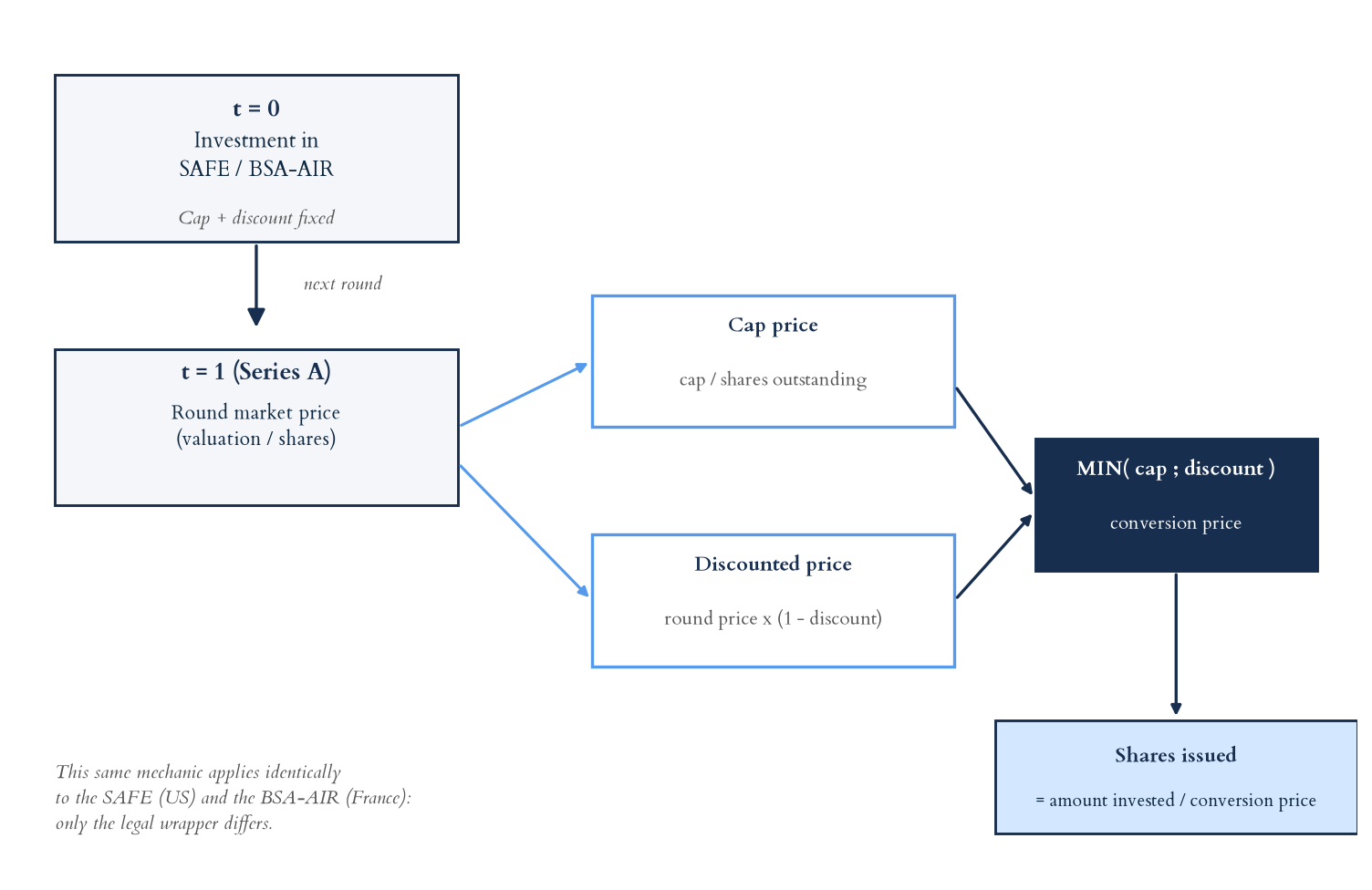
Conversion always retains the price most favourable to the investor between the price derived from the valuation cap and the price derived from the discount: this diagram applies identically to an American SAFE and a French BSA-AIR, only the legal wrapper differs between the two instruments.
This conversion mechanics answers a single question: how many shares does the investor receive, deterministically, once the triggering event has occurred.
It does not answer a separate question, that of the fair value of the BSA-AIR itself, at a date prior to its conversion, for example for accounting valuation purposes, a secondary sale of the warrant before the qualifying round, or a valuation certificate requested by a statutory auditor.
A BSA-AIR is indeed, legally, a share subscription warrant, hence an option, and as such falls under financial instrument valuation, using capital-market models, exactly as detailed in our article on BSA valuation and structuring: Black-Scholes with a Galai-Schneller-type dilution correction factor, the CRR binomial tree, or a Monte Carlo simulation depending on the complexity of the underlying.
This is the same mathematical toolkit used to allocate equity value across share classes, detailed in our article on the OPM and the illiquidity discount. The Excel calculator accompanying this article models only the deterministic conversion mechanics above, not the BSA-AIR's optional fair value.
Comparative table of clauses: cap, discount, MFN, pro-rata and dissolution
| Clause | SAFE (Y Combinator) | BSA-AIR |
|---|---|---|
| Legal nature | Simple bilateral contract, American law (Delaware) | Security (share subscription warrant), French Commercial Code |
| Issuance formalism | Bilateral signature, no meeting required | Extraordinary general meeting, waiver of preferential subscription rights, statutory auditor's report |
| Valuation cap | Most often post-money since 2018 | Most often pre-money, based on shares outstanding before the round |
| Discount | Generally 10 to 20% | Generally 15 to 25%, sometimes none |
| Valuation floor | Rare, outside specific negotiation | Frequent, to protect founders from excessive dilution in a difficult round |
| MFN clause | Exists in a dedicated version, automatically aligns with more favourable terms of a later SAFE | Rarely included by default, to be explicitly negotiated if desired |
| Pro-rata rights | Generally outside the SAFE itself, via a separate side letter | Rarely standardised, to be negotiated case by case |
| Dissolution event | Right to priority repayment from remaining assets, ahead of common shareholders | No repayment right by default: risk of total loss if no qualifying round ever occurs |
Hectelion table, based on Y Combinator's public templates and French market practice as reported by specialised law firms (see Sources). Discount percentages vary widely from one instrument to another: always verify the actual negotiated terms rather than relying on a market average.
When to use a SAFE or a BSA-AIR
Using one of these two instruments is relevant when a startup needs funds quickly, before having sufficient financial data to justify a precise valuation, typically during the early development phases of a startup, between seed stage and a first structured pre-money valuation round. It is also relevant when an investor wants to commit quickly without waiting for the full close of a priced round. The choice between a SAFE and a BSA-AIR then depends essentially on the nationality of the issuing company: a French company can only use a BSA-AIR, or an equivalent instrument recognised by French law, regardless of the investor's nationality.
Who to involve to structure a SAFE or a BSA-AIR
Three profiles must be involved together. A lawyer specialised in corporate law and fundraising drafts or adapts the issuance agreement and secures the waiver of preferential subscription rights. An accountant or statutory auditor prepares the special report required by the extraordinary general meeting. A valuation advisor, as part of financial structuring, helps calibrate the valuation cap and the discount consistently with the company's actual trajectory, to avoid a cap set too low, which would excessively dilute the founders, or too high, which would fail to interest investors. Hectelion supports French and Swiss startups in this calibration, as part of a structured fundraising engagement, whose usual advisory fees are detailed in a dedicated article.
Advantages: speed, simplicity and accounting neutrality
The SAFE and the BSA-AIR share three structural advantages for a seed-stage startup:
- Execution speed: a few days of negotiation against several weeks for a classic priced round.
- Documentary simplicity: a contract or warrant of a few pages rather than a full shareholders' agreement.
- Accounting neutrality: neither the SAFE nor the BSA-AIR sits on the balance sheet as interest-bearing debt, unlike a classic convertible bond.
Limitations: deferred dilution, uncertainty and risk of total loss
These same instruments carry four limitations to anticipate before using them:
- Deferred and sometimes underestimated dilution: several BSA-AIR or SAFE instruments stacked on different terms can convert simultaneously at the next round, with a cumulative effect rarely modelled in advance.
- Uncertainty over the founders' final valuation: neither the cap nor the discount guarantees a precise conversion price before the qualifying round actually occurs.
- No repayment right by default, specific to the BSA-AIR: if no qualifying round ever occurs, the investor can lose their entire investment with no recourse, a situation that an American SAFE at least partially addresses through a priority repayment clause in case of dissolution.
- Absence of a dedicated tax regime, often overlooked: the gain realised by the investor is not taxed either at signature or at conversion, but only when they later sell the resulting shares, under the standard regime for capital gains on the disposal of securities, by default under the 30% flat tax (12.8% income tax and 17.2% social contributions), with an optional election for the progressive scale if more favourable. The tax authorities have not yet clearly ruled on whether a BSA-AIR investment qualifies for the Madelin or IR-PME tax reductions, a point to check case by case before subscribing.
An American SAFE, conversely, has by construction no French tax regime at all since it is not recognised as a French-law instrument: a French investor who nonetheless signs an unadapted SAFE would face even greater tax uncertainty than with a BSA-AIR.
The 5 mistakes to avoid with a SAFE or a BSA-AIR
Mistake 1: stacking several instruments on different terms without modelling them together
Issuing a first BSA-AIR at a €2,000,000 cap, then a second at €3,000,000 a few months later, seems harmless taken separately, but their simultaneous conversion at the next round can dilute founders well beyond what each instrument suggested in isolation. A pro forma capitalisation table, including every instrument outstanding, must be built before any new issuance.
Mistake 2: confusing a pre-money cap with a post-money cap
A pre-money cap is divided by the shares outstanding before the next round; an American-style post-money cap directly guarantees a percentage of capital, with the instrument itself included in its own calculation base. The two conventions produce very different dilution outcomes for the same headline cap figure, and confusing them during negotiation means accepting poorly understood terms.
Mistake 3: omitting the waiver of preferential subscription rights
A BSA-AIR reserved for named investors requires the extraordinary general meeting to explicitly waive the existing shareholders' preferential subscription rights, in accordance with articles L. 225-132 to L. 225-141 of the Commercial Code. Omitting this formality exposes the issuance to a later challenge by an excluded minority shareholder.
Mistake 4: setting a valuation cap without analysing the actual trajectory
A cap set by rule of thumb, simply mirroring what a neighbouring startup supposedly negotiated, ignores the company's own financial trajectory: recognised startup valuation methods can substantiate it instead. A cap set too low excessively dilutes the founders at conversion; a cap set too high can discourage investors who feel insufficiently rewarded for the risk taken at seed stage.
Mistake 5: signing an American SAFE for a French company without adapting it
A Y Combinator SAFE document, signed as-is by a French joint-stock company, does not produce the intended legal effects: it is not a security recognised by the Commercial Code and does not validly bind the company to issue future shares. Any SAFE proposal received from a foreign investor must be re-translated into a BSA-AIR by a French lawyer before signature.
Case 1: a €300,000 BSA-AIR from French business angels
A French startup specialised in predictive maintenance solutions raises funds from a group of business angels through a BSA-AIR, under the following parameters:
- Common shares outstanding before the issuance: 800,000
- Amount raised in BSA-AIR: €300,000
- Pre-money valuation cap: €3,000,000, determined by a prior business valuation
- Discount: 20%
Eight months later, the company closes a qualifying Series A round, with the following parameters:
- Amount raised in the Series A: €1,500,000
- Pre-money valuation of the round: €5,000,000
The price per share of this round, for the new investors, is calculated simply: €5,000,000 divided by the 800,000 shares outstanding, i.e. €6.25 per share.
The BSA-AIR must convert at the price most favourable to the investor between two calculations. The price derived from the valuation cap: €3,000,000 divided by the same 800,000 shares outstanding, i.e. €3.75 per share. The price derived from the discount: €6.25 reduced by 20%, i.e. €5.00 per share. The valuation cap gives the lower price here, hence the one most favourable to the investor: it is the one that applies.
The business angels therefore receive €300,000 divided by €3.75, i.e. 80,000 new shares. The Series A investors receive €1,500,000 divided by €6.25, i.e. 240,000 new shares. The post-round share capital stands at 800,000 plus 80,000 plus 240,000, i.e. 1,120,000 shares.
The business angels thus hold 80,000 shares out of 1,120,000, i.e. 7.14% of the capital, for a €300,000 investment whose immediate value, at the Series A round price, amounts to 80,000 shares multiplied by €6.25, i.e. €500,000: an unrealised gain of €200,000 generated mechanically by the valuation cap mechanism, with no further negotiation needed at the time of conversion.
Case 2: a SAFE-like instrument for a US fund investing in a French startup
A French medical diagnostics startup negotiates with a US seed fund, familiar with the post-money SAFE and reluctant to depart from that logic. The company's lawyers structure a BSA-AIR whose economic terms exactly replicate an American post-money SAFE, under the following parameters:
- Amount invested: €460,000
- Post-money valuation cap: €9,200,000, equivalent to $10,000,000 at an illustrative exchange rate of €0.92 per dollar
- Discount: none
- Fully diluted shares outside this instrument: 950,000
The post-money cap principle directly guarantees the fund's percentage of capital, independent of the number of shares outstanding or of other convertible instruments issued in parallel: €460,000 divided by €9,200,000, i.e. 5.00% of the fully diluted capital, acquired at the very moment of signature.
For the investor to hold exactly 5.00% once their BSA-AIR has converted, the number of shares to allot is calculated by solving: shares to allot, divided by the sum of the 950,000 existing shares and those same shares to allot, must equal 5.00%. Solving this equation gives 50,000 new shares, for a total of 1,000,000 shares, indeed 50,000 out of 1,000,000, i.e. 5.00%.
A year later, the company raises a qualifying Series A round, with the following parameters:
- Amount raised in the Series A: €3,000,000
- Pre-money valuation of the round: €12,000,000
The price per share of this round is calculated on the already-converted capital base: €12,000,000 divided by the 1,000,000 shares outstanding, i.e. €12.00 per share. The new investors receive €3,000,000 divided by €12.00, i.e. 250,000 new shares. The post-round share capital stands at 1,000,000 plus 250,000, i.e. 1,250,000 shares.
The American fund, which held 5.00% right after its BSA-AIR converted, now holds only 50,000 shares out of 1,250,000, i.e. 4.00%, once the Series A is completed. The post-money cap guarantees an exact percentage at the precise moment of conversion, but offers no protection against the ordinary dilution generated by subsequent financing rounds: a nuance that many investors, even those familiar with the American SAFE, underestimate when they first encounter its French equivalent.
Word from the CEO
"I have seen founders accept a valuation cap without measuring its actual effect on their dilution, simply because the figure looked flattering at the time. A cap is never negotiated on its own: it is negotiated together with the number of shares outstanding and the anticipated trajectory of the next round."
"The costliest confusion I encounter by far is between an American SAFE and its French equivalent. These are not two names for the same thing: they are two different legal instruments, and only the second one validly binds a French company."
"Our role at Hectelion is not to draft the contract, it is to verify that the cap and the discount reflect a defensible valuation, so that the future conversion surprises no one around the table."
Aristide Ruot, Ph.D.
Founder | Chief Executive Officer, Hectelion SA
FAQ: the 10 essential questions on the SAFE and the BSA-AIR
Introduction: what to know before the questions
The questions below come up systematically during French-Swiss seed rounds and clarify the points most often confused between the American SAFE and the French BSA-AIR.
Q1: is a SAFE signed by a French company valid?
No, not as-is. A French joint-stock company can only issue securities recognised by the Commercial Code, including the share subscription warrant that underlies the BSA-AIR. An American SAFE signed without adaptation does not validly bind the company to issue future shares.
Q2: can a Swiss company use a SAFE or a BSA-AIR?
Swiss law has its own seed financing instruments, distinct from both the American SAFE and the French BSA-AIR; a Swiss company should structure its own instrument compliant with Swiss company law rather than directly importing either one.
Q3: what discount is customary for a BSA-AIR?
Market practice reported by specialised law firms places the discount most often between 15 and 25%, with some BSA-AIR carrying none at all, the investor relying solely on the valuation cap.
Q4: do a pre-money cap and a post-money cap give the same result?
No. A pre-money cap is divided by the shares outstanding before the next round, while a post-money cap directly guarantees a percentage of capital, including the instrument itself in its own calculation. The two conventions produce different dilution outcomes for the same headline cap figure.
Q5: can a BSA-AIR never convert?
Yes, if no triggering event, most often a qualifying financing round, ever occurs. The investor then remains the holder of an unexercised warrant, with no repayment right by default.
Q6: who must approve the issuance of a BSA-AIR?
The shareholders' extraordinary general meeting, which must also waive the existing shareholders' preferential subscription rights in favour of the named investors, based on the board's report and the statutory auditor's special report.
Q7: does the BSA-AIR appear on the balance sheet as debt?
No. Neither the SAFE nor the BSA-AIR constitutes interest-bearing debt; they are treated as quasi-equity pending conversion, unlike a classic convertible bond.
Q8: can several BSA-AIR be stacked on different terms?
Legally yes, but it is risky without prior modelling: their simultaneous conversion at the same qualifying round can generate a cumulative dilution effect far greater than each instrument suggested in isolation.
Q9: does the MFN clause exist in a BSA-AIR?
It is not included by default in French practice, unlike certain dedicated versions of the American SAFE; it must be explicitly negotiated and drafted if the parties want it.
Q10: how do you choose between a SAFE and a BSA-AIR?
The choice depends above all on the issuing company's nationality: a French company uses a BSA-AIR, regardless of the investor's nationality, who must then be informed that the intended economics remain comparable to a SAFE even though the legal vehicle differs.
Estimate your company's value with Acontos, Hectelion's online simulator
To extend this reading with a concrete figure, Hectelion provides Acontos, its online audit, due diligence and business valuation tool. Powered by Anthropic's Claude Sonnet 5 artificial intelligence and calibrated on Hectelion's methodology, it reads your accounts, normalises EBITDA, applies real sector multiples and rebuilds a net debt bridge to estimate the value of your shares within minutes, a useful benchmark before setting the valuation cap of a SAFE or a BSA-AIR. Launch the valuation simulator for free: the tool is confidential, retains no document and does not replace a formal valuation, but it gives a reliable first order of magnitude before discussing it with our team.
Conclusion: the same economic goal, two incompatible legal wrappers
The SAFE and the BSA-AIR pursue the same goal: letting a startup raise funds quickly, without locking in its valuation before having enough data to justify it. But this economic kinship should never obscure their difference in legal nature: one is an American-law contract, the other a French-law security, issued under a corporate formalism that the American contract entirely ignores.
For a French company, the question is therefore never whether to choose between the SAFE and the BSA-AIR, but how to correctly translate, for a foreign investor used to the former, the economic terms they expect to find in the latter: valuation cap, discount, and where applicable a floor and an MFN clause. It is this translation, more than the instrument itself, that determines the legal soundness of the round.
For founders, vigilance should focus mainly on the conversion mechanics: a pre-money cap and a post-money cap do not dilute in the same way, several instruments stacked on different terms sometimes convert simultaneously with a cumulative effect, and the absence of a repayment right by default in the BSA-AIR exposes the investor to a total loss if no qualifying round ever occurs.
Article summary
The SAFE, created by Y Combinator in 2013 and revised in 2018, is a bilateral American-law contract giving the right to future shares with no debt and no maturity. The BSA-AIR replicates its economics under French law, through a share subscription warrant carrying a symbolic issue premium, issued by an extraordinary general meeting that waives the existing shareholders' preferential subscription rights.
Both instruments share the same economic mechanisms, a valuation cap and a discount, but under different calculation conventions, pre-money for the classic BSA-AIR, most often post-money for the American SAFE since 2018, which produces different dilution outcomes for the same headline figure.
The two worked cases in this article illustrate this mechanics: a €300,000 BSA-AIR converted at the cap price gives 7.14% of the capital and an immediate unrealised gain of €200,000; a €460,000 SAFE-like instrument, structured as a BSA-AIR for a US fund, guarantees 5.00% at conversion but is diluted to 4.00% as soon as the next round closes.
For a French company, the choice is never between the two instruments themselves, but in correctly translating the economic terms of a SAFE into a BSA-AIR, with the support of a specialised lawyer, an accountant and a valuation advisor who calibrates the valuation cap on a defensible basis.
Sources
- Code de commerce (French Commercial Code), articles L. 228-91 and L. 228-92 on the issuance of securities giving access to capital
- Copeps, BSA-AIR treated as quasi-equity, on the absence of a specific tax regime and the Madelin/IR-PME uncertainty
- Hayot Expertise, BSA AIR: advantages, risks and 2026 taxation for founders
- Maddyness, BSA AIR, the financing tool born to face the crisis, op-ed by David Smadja and Florent Artaud
- SeedLegals, BSA AIR guide for startups
- Swim Legal, BSA AIR: how it works, advantages and points of attention for equity investors
- Y Combinator, standard post-money SAFE template, 2018 version
Author
Aristide Ruot, Ph.D.
Founder | Chief Executive Officer, Hectelion SA