BSPCE vs BSA vs stock options: which instrument to incentivize executives and employees?
Three instruments, three tax regimes, three eligible populations.

Introduction: BSPCE vs BSA vs stock options, which instrument should align executives and employees with the capital?
Three acronyms describe three legally distinct instruments for giving an executive or employee a stake in a company's value creation, and confusing one with another leads to very different tax consequences. The BSPCE, the BSA and classic stock options share the same principle, a future right to subscribe shares at a price fixed in advance, but they are not open to the same companies, do not benefit from the same tax regime, and do not answer the same needs.
The BSPCE is reserved by law to young companies, under precise conditions of age and ownership set by the French tax authorities. Classic stock options remain open to any company limited by shares, whatever its age. The BSA, finally, mainly serves as a building block of management packages in leveraged deals, with a tax treatment now framed by precise case law from the French Conseil d'État.
"The capital must be held directly and continuously to the extent of at least 15% by individuals.", French Directorate General of Public Finances, Bulletin officiel des finances publiques, BOI-RSA-ES-20-40-10, on BSPCE eligibility conditions.
Three factors make this choice particularly structural in 2026. First, lowering the individual-ownership threshold from 25% to 15%, effective for warrants granted since 1 January 2026, widens the pool of companies able to issue BSPCE. Second, the Conseil d'État's July 2021 case law clarified, and in some respects tightened, the risk of BSA management-package gains being reclassified as salary. Third, the spread of international fundraising multiplies situations where the BSPCE, reserved to French or European tax residents, is simply unavailable for certain beneficiaries.
This article covers the definition, origin and eligibility conditions of these three instruments, explains how each is taxed, then illustrates these concepts with two worked cases, a BSPCE grant in France and a stock option grant in Switzerland, before answering the ten questions most frequently asked on the topic.
- BSPCE: a warrant reserved to young French or European companies, with a favourable flat tax of 12.8% if the beneficiary has more than three years of tenure.
- Classic stock options: options open to any company limited by shares, with no age limit, but a less favourable tax regime than the BSPCE.
- BSA: a share subscription warrant used in LBO management packages, whose gain can be reclassified as salary under the Conseil d'État's case law.
- Vesting: the gradual acquisition of rights over time, a mechanism common to all three instruments to retain the beneficiary over the long run.
Secure the structuring of your employee ownership plan
Before choosing between BSPCE, BSA and stock options, talk to Hectelion's teams about the instrument best suited to your company and your beneficiaries. Book a first 30-minute call to discuss your company's age, your beneficiaries' tax residence and the context of the deal, a funding round, an LBO or organic growth.
Acontos: estimate the value of your company online for free
Before setting the exercise price of a BSPCE, a BSA or a stock option, you first need a reliable order of magnitude for the value of the company. Hectelion has developed Acontos, an online audit, due diligence and business valuation tool, powered by Anthropic's Claude Sonnet 5 artificial intelligence and calibrated on Hectelion's methodology. Based on your accounts, it produces a first estimate of the value of your shares within minutes, free of charge and without retaining any document. Launch the valuation simulator to get an order of magnitude, then keep reading to understand what drives it.
Definition: what is a BSPCE, a BSA and a classic stock option?
All three instruments grant a right to subscribe new shares at a price fixed at the time of grant, generally equal to the share's value at that date, for a potential gain equal to the gap between the future value and that exercise price. Their difference lies in who can issue them, who can receive them, and how the final gain is taxed.
Quick definition: the BSPCE in one sentence
A BSPCE is a warrant reserved to companies less than fifteen years old, unlisted or with a market capitalisation below €150 million, whose disposal gain benefits from a favourable flat tax.
Quick definition: classic stock options in one sentence
Stock options are subscription or purchase options open to any company limited by shares, with no age condition, but whose exercise gain is in principle taxed as salary.
Quick definition: the BSA in one sentence
A BSA is a share subscription warrant with no favourable tax regime of its own, widely used as a management package building block in leveraged deals, whose gain can be reclassified as salary depending on the circumstances of its grant.
Origin: where do the BSPCE, the BSA and stock options come from?
Classic stock options are the oldest of the three schemes, codified in French law as early as the 1970s and now governed by articles L.225-177 et seq. of the Commercial Code, which set out authorisation by the extraordinary general meeting, within a maximum period of thirty-eight months, and the setting of the subscription price using objective valuation methods for unlisted companies.
The BSPCE was created by the 1998 Finance Act to solve a specific problem: classic stock options, taxed more heavily and more rigid to implement, did not let young French technology companies compete with the salary packages offered by their American rivals. The BSA, finally, never benefited from a specific legal or tax regime for employees; it was private equity practice that gradually diverted it from its original purpose, a financing instrument, into a tool for aligning executives' interests in leveraged deals, which is why its tax treatment had to be clarified after the fact by case law rather than by statute.
BSPCE vs stock options vs BSA: who can benefit and which company can issue them?
The BSPCE is subject to the strictest eligibility conditions: according to the Bulletin officiel des finances publiques, the issuing company must have been registered for less than fifteen years, be unlisted or show a market capitalisation below €150 million, and have its capital held directly and continuously to the extent of at least 15% by individuals, a threshold lowered from 25% to 15% by the 2026 Finance Act for warrants granted since 1 January 2026. Only companies limited by shares can issue them, excluding SARLs, and beneficiaries must be employees or certain officers of the issuing company or its subsidiaries.
Classic stock options are subject to none of these age or capitalisation restrictions: any company limited by shares, listed or not, whatever its age, can issue them to its employees, authorisation being given by the extraordinary general meeting for a maximum of thirty-eight months. The BSA, for its part, is subject to no eligibility condition of its own: it is an ordinary security within the meaning of article L.228-91 of the Commercial Code, which any company limited by shares can issue, which explains its popularity in management package structures where beneficiaries are not always employees in the strict sense.
BSPCE vs BSA vs stock options: how is each one taxed?
The BSPCE benefits from the most favourable regime of the three: according to the BOFiP, the gain on disposal of shares subscribed by exercising the warrants is taxed at a flat rate of 12.8% when the beneficiary has worked in the company for at least three years at the disposal date, a rate raised to 30% when that three-year period is not met, with no option for progressive income tax rates in that second case.
Classic stock options follow a markedly less favourable regime: the gain realised on exercise is in principle taxed as salary, at progressive income tax rates, and the issuing company must pay a specific 30% employer contribution, set out in article L.137-13 of the Social Security Code, against a full exemption from employer contribution for the BSPCE.
The BSA benefits from no favourable tax regime of its own, and its treatment was clarified by three rulings of the Conseil d'État of 13 July 2021 (n°435452, n°437498 and n°428506), which distinguish three taxable moments: an acquisition benefit if the warrant was subscribed below its real value, taxed as salary for the year of acquisition; an exercise gain, in principle taxed as salary if it mainly stems from the functions performed; and a gain on disposal of the warrant itself, in principle taxed as a capital gain on securities under article 150-0 A of the CGI, unless that gain must be regarded as consideration for the person's role as officer or employee rather than as an investor, in which case it is reclassified as salary.
A fourth instrument often rounds out this landscape without entering the core comparison of this article: the free share grant (AGA) directly allocates shares with no subscription price to pay, and shares with stock options the same 30% employer contribution under article L.137-13 of the Social Security Code, whereas the BSPCE is fully exempt from it. Some SMEs and mid-caps that have never distributed dividends are nonetheless exempt, subject to size conditions.
Net comparison: how much of the gain actually reaches the beneficiary?
Beyond the headline rate, two further levies almost always apply: the 17.2% social levies that complete income tax on a gain taxed as a capital gain, and the 9.7% CSG/CRDS that is added to progressive income tax on a gain taxed as salary. The table below situates, illustratively and excluding special cases, the overall rate actually borne by the beneficiary depending on the instrument and the applicable regime.
| Instrument | Applicable regime | Illustrative overall rate |
|---|---|---|
| BSPCE, more than 3 years' tenure | 12.8% income tax + 17.2% social levies | about 30% |
| BSPCE, less than 3 years' tenure | 30% income tax + 17.2% social levies | about 47% |
| BSA, gain not reclassified (capital gain, art. 150-0 A) | 12.8% income tax + 17.2% social levies (flat tax) | about 30% |
| Classic stock options, or BSA reclassified as salary | Progressive rates (up to 45%) + 9.7% CSG/CRDS | up to about 55% |
Illustrative rates, excluding the exceptional high-income contribution and the beneficiary's personal circumstances. The BSA's reclassification risk, described above, therefore shifts its overall rate from 30% to about 55%, which makes it the central tax issue of this instrument.
Why choose an employee ownership instrument over cash compensation?
- An employee ownership instrument aligns the beneficiary's interest with the company's long-term value creation, rather than a single year's isolated performance.
- It lets a young company offer an attractive package without immediately burdening its cash position, unlike an equivalent cash bonus.
- It retains the beneficiary over time through vesting, the gradual acquisition of rights that makes most of the gain conditional on an extended presence.
- For the BSPCE specifically, the flat 12.8% tax beyond three years of tenure makes the net gain significantly higher than an equivalent cash payment taxed at progressive rates.
- For an LBO investor, a BSA management package aligns the buyout manager's interest with the exit gain, without immediately diluting the cash available for the deal itself.
How do you structure a BSPCE, BSA or stock option plan?
- Check the company's eligibility upfront, age and ownership threshold for the BSPCE, authorisation by the extraordinary general meeting for stock options.
- Determine the list of eligible beneficiaries, taking tax residence into account for the BSPCE, which in practice requires activity and taxation in France or the European Union.
- Have the share's fair value at the grant date assessed through an objective method, a condition for the scheme's tax safety and an explicit requirement of the Commercial Code for unlisted companies.
- Set the exercise price at that fair value level, a lower price revealing a benefit immediately taxable as salary under the case law applicable to BSAs.
- Define the vesting period and, where relevant, a cliff clause, which delays the acquisition of the first rights to prevent a quick departure from triggering a disproportionate gain.
- Document the whole scheme, the auditors' report, the valuation method used, to prepare for a later tax audit.
When should you prefer the BSPCE, the BSA or classic stock options?
| Criterion | BSPCE | Stock options | BSA |
|---|---|---|---|
| Eligible company | Under 15 years old, unlisted or under €150M | Any company limited by shares, no age limit | Any company limited by shares, no age limit |
| Typical beneficiary | Employee or officer, FR or EU tax resident | Employee, regardless of tax residence | LBO buyout manager, not necessarily an employee |
| Tax on the gain | 12.8% (30% if under 3 years' tenure) | Progressive rates, salary regime | Capital gain or salary depending on circumstances (Conseil d'État, 2021) |
| Typical context | Startup raising funds | Any company, including listed or international | LBO management package |
The three instruments can coexist within the same company, aimed at different populations of beneficiaries depending on their eligibility and the context of the deal.
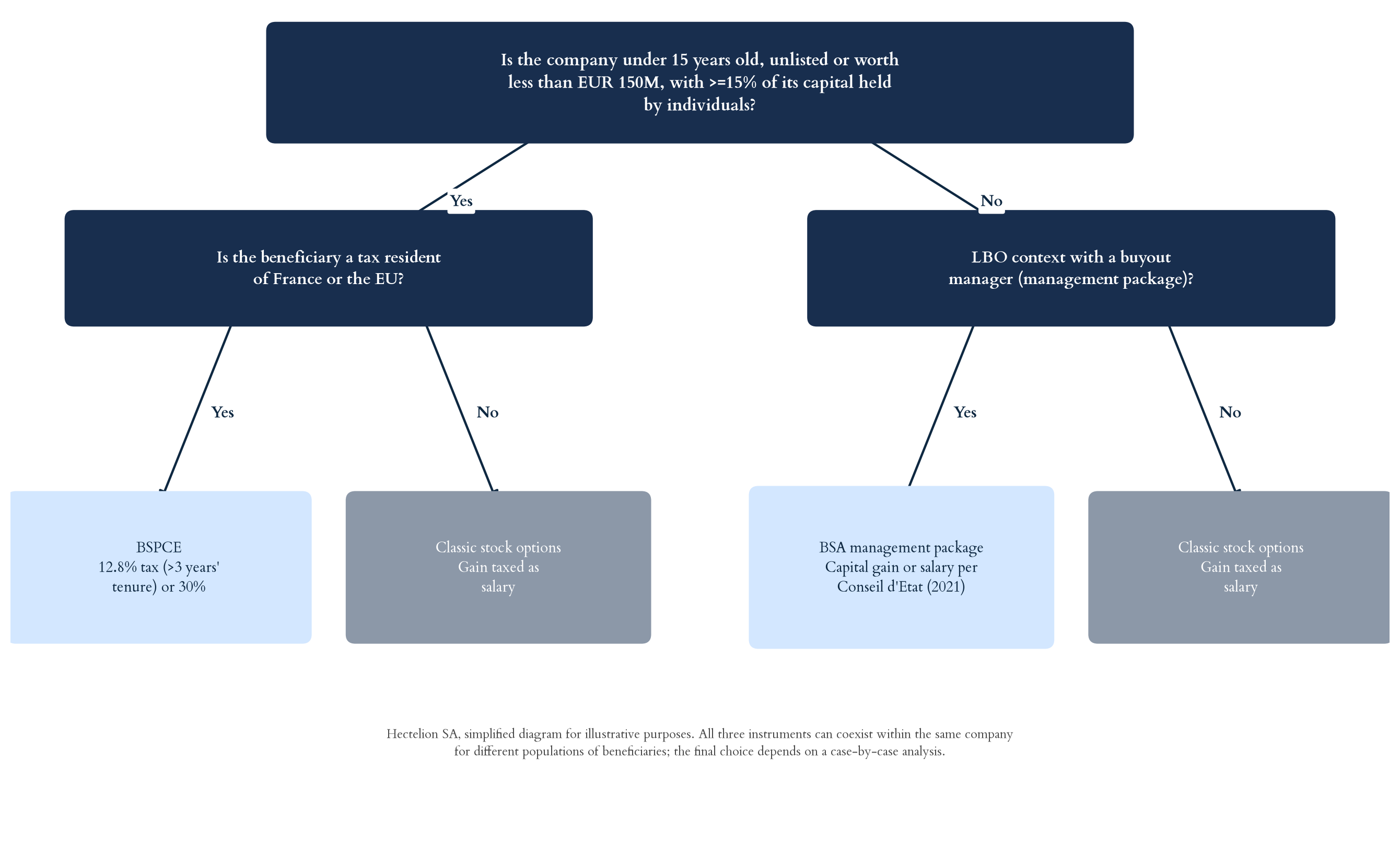
Diagram: which instrument at a glance?
The decision tree below summarises the three determining criteria, the company's BSPCE eligibility, the beneficiary's tax residence and the context of a possible LBO, to quickly orient the choice between BSPCE, BSA and classic stock options before a detailed analysis.
Who should you turn to for structuring and valuing these instruments?
Three criteria help select the right adviser. First, mastery of the eligibility conditions specific to each instrument, which change regularly, the BSPCE ownership threshold having changed, for instance, on 1 January 2026. Second, rigorous option valuation capability to set a defensible exercise price, a condition for the scheme's tax safety. Third, economic independence from traditional financial intermediaries, to objectively advise on the instrument best suited rather than the one the adviser knows best how to structure.
Hectelion performs these valuations as part of its financial instrument valuation service, drawing on dual French and Swiss expertise, documented in our dedicated article on the BSPCE and management packages as well as our article on the BSA, its valuation and structuring. The cost of these valuation engagements is covered in a dedicated article on the price of a BSA or BSPCE valuation.
Advantages: alignment, taxation, flexibility
- All three instruments align the beneficiary's interest with the company's performance, with no immediate cash outlay comparable to a cash bonus.
- The BSPCE offers the clearest tax advantage of the three, a flat 12.8% rate that remains well below salary taxation at progressive rates.
- Classic stock options offer the broadest flexibility, usable by any company limited by shares with no age or capitalisation condition.
- The BSA offers the greatest contractual flexibility in its structuring, which explains its preferred use in bespoke LBO management package structures.
Limits: eligibility constraints, tax reclassification, dilution
- The BSPCE becomes unavailable as soon as the company passes fifteen years of age or the individual-ownership threshold is no longer met, which excludes many mature SMEs.
- Classic stock options, more flexible on eligibility, remain less tax-efficient, which reduces their appeal against the BSPCE when the latter is available.
- The BSA carries a risk of reclassification as salary if the subscription price was not set at fair value or if the gain is treated as consideration for the functions performed rather than an investment, a risk clarified but not removed by the 2021 case law.
- All three instruments eventually dilute existing shareholders, which requires capping the overall volume within an option pool sized from the outset.
The 5 mistakes to avoid
Mistake 1: Granting BSPCE without checking the company's current eligibility
Granting BSPCE without rechecking the company's age and the individual-ownership threshold, lowered from 25% to 15% since 1 January 2026, exposes the scheme to the favourable regime being challenged by the tax authorities and to a retroactive, unfavourable reassessment for the beneficiary.
Mistake 2: Setting a BSA's exercise price below fair value
Subscribing a BSA below its real value at the grant date reveals, according to the Conseil d'État, a benefit immediately taxable as salary for the year of acquisition, regardless of how the later gain is taxed.
Mistake 3: Confusing BSPCE eligibility with that of classic stock options
Granting BSPCE to an employee who is not a French or EU tax resident, or to a company over fifteen years old, strips the scheme of its favourable regime and exposes it to a full reclassification as classic stock options, which are less tax-efficient.
Mistake 4: Selling BSA shares immediately after exercise without anticipating reclassification
Quickly reselling shares obtained through a BSA without their value having significantly increased exposes, under the Conseil d'État's case law, the entire gain to be taxed as salary, including the portion that might otherwise have qualified for capital gains treatment.
Mistake 5: Neglecting to document the valuation method used
Failing to document the objective valuation method used to set the exercise price, for unlisted companies, deprives the company of a decisive defence argument in the event of a tax audit into the preferential nature of the grant price.
Case 1: a BSPCE grant in a French startup
A French startup grants 10,000 BSPCE to an employee, with an exercise price set at €2.00 per share, equal to the share's fair value at the grant date. Four years later, the employee exercises the warrants when the share's fair value reaches €25.00, for a total gain of (25.00 minus 2.00) multiplied by 10,000, or €230,000. Since the employee has worked in the company for more than three years, the gain is taxed at the flat rate of 12.8%, or €29,440, for a net gain of €200,560, without prejudice to any social levies that may apply depending on the beneficiary's situation.
Case 2: a stock option grant in a Swiss company
An unlisted Swiss company grants 5,000 subscription options to a senior executive, with an exercise price set at CHF 10 per share, equal to fair value at grant. Three years later, the executive exercises the options when the share's fair value reaches CHF 35, for a gain of (35 minus 10) multiplied by 5,000, or CHF 125,000. Unlike the French BSPCE, Switzerland has no comparable flat favourable regime for this type of instrument: the gain is taxed as ordinary income, at combined federal and cantonal progressive rates, illustratively around 35% in this case, or about CHF 43,750 in tax for a net gain of CHF 81,250, the exact rate depending on the beneficiary's canton of residence.
Word from the CEO
"BSPCE, BSA and stock options are not three interchangeable variants of the same tool, they are three distinct legal instruments, whose eligibility and taxation radically change the beneficiary's net gain."
"In our French and Swiss practice, the costliest mistake is not the choice of instrument, but granting a BSPCE to a company or a beneficiary no longer eligible for it, or setting a BSA exercise price that was never backed by a rigorous valuation."
"A well-structured management package does not remove the tax risk, it makes it documentable, which changes everything in the event of an audit.", Aristide Ruot, Ph.D., Founder and Chief Executive Officer, Hectelion SA.
FAQ: the 10 essential questions on BSPCE, BSA and stock options
Introduction: what to know before the questions
The questions below cover the most frequent concerns Hectelion hears from executives and employees about choosing between BSPCE, BSA and stock options, complementing the definitions and worked cases detailed above.
Q1: What is the essential difference between BSPCE, BSA and stock options?
The BSPCE is reserved to young companies and benefits from a favourable flat tax, classic stock options are open to any company but less tax-efficient, and the BSA mainly serves as an LBO management package building block, with no favourable tax regime of its own.
Q2: Can a company over fifteen years old still grant BSPCE?
No, the maximum age of fifteen years since registration is a strict BSPCE eligibility condition, counted to the exact day at the warrant grant date.
Q3: Can an employee who is not a French tax resident benefit from a BSPCE?
In practice, the BSPCE's favourable regime assumes activity and taxation in France or another EU member state, which in effect excludes many non-resident beneficiaries, for whom classic stock options remain the available solution.
Q4: How is the exercise gain on a classic stock option taxed?
The exercise gain on a classic stock option is in principle taxed as salary, at progressive income tax rates, and subject to the specific social contributions set out in the Social Security Code, without the flat rate reserved to the BSPCE.
Q5: In what cases is a BSA's gain reclassified as salary?
According to the Conseil d'État, a BSA gain is reclassified as salary when it mainly stems from the person's role as officer or employee rather than their status as investor, for example when a disposal-price guarantee mechanism was put in place because of that role.
Q6: Has the BSPCE's ownership threshold changed recently?
Yes, article 25 of the 2026 Finance Act lowered the minimum threshold for direct, continuous individual ownership of the capital from 25% to 15%, for warrants granted since 1 January 2026.
Q7: Can all three instruments coexist within the same company?
Yes, a company eligible for the BSPCE can also grant classic stock options or BSAs to different populations of beneficiaries, depending on their tax residence, their status as employee or officer, and the context of the deal in question.
Q8: What is vesting and why use it with these instruments?
Vesting conditions the gradual acquisition of rights attached to the warrant or option on the beneficiary's extended presence in the company, often paired with a cliff clause that delays the acquisition of the first rights, to prevent a quick departure from triggering a disproportionate gain.
Q9: How do you secure the exercise price of a BSPCE, BSA or stock option?
The exercise price must be documented through an objective method for valuing the share's fair value at the grant date, an explicit requirement of the Commercial Code for unlisted companies and a decisive defence argument in the event of a tax audit.
Q10: What happens if the beneficiary leaves the company before vesting ends?
Absent vested rights, unvested warrants or options are in principle forfeited, unless the grant plan provides otherwise, which is why the length and pace of vesting are among the most negotiated points at grant.
Estimate the value of your company with Acontos, Hectelion's online simulator
To take this further with a concrete figure, Hectelion offers Acontos, its online audit, due diligence and business valuation tool. Powered by Anthropic's Claude Sonnet 5 artificial intelligence and calibrated on Hectelion's methodology, it reads your accounts, normalises EBITDA, applies real sector multiples and rebuilds a net debt bridge to estimate the value of your shares within minutes, a useful step before setting the exercise price of a BSPCE, a BSA or a stock option. Launch the valuation simulator for free: the tool is confidential, retains no documents and does not replace a formal valuation, but it gives a reliable first order of magnitude before discussing it with our team.
Conclusion: BSPCE, BSA and stock options, three instruments for three distinct situations
The BSPCE, the BSA and classic stock options share the same mechanism, the right to subscribe shares at a price fixed in advance, but they are neither open to the same companies, nor reserved to the same beneficiaries, nor taxed the same way. The BSPCE concentrates the clearest tax advantage, at the cost of the strictest eligibility conditions; classic stock options offer the broadest flexibility, at the cost of less favourable taxation; the BSA offers the greatest contractual flexibility, at the cost of a reclassification risk that only rigorous structuring can keep under control.
The choice between the three is therefore not a matter of general preference, but of an accurate diagnosis of the company's eligibility, the beneficiary's tax residence and the context of the deal. An eligible young French company gains nothing from forgoing the BSPCE regime in favour of classic stock options, except for non-resident beneficiaries for whom the BSPCE is unavailable; an LBO buyout manager has no access to the BSPCE for lack of sufficient target-company age, which explains the BSA's persistent place in these structures despite its reclassification risk.
In both cases, rigorously documenting the exercise price through an objective valuation method remains the best protection against a later challenge by the tax authorities, whichever instrument is chosen.
Summary
The BSPCE, the BSA and classic stock options are three distinct instruments for giving a beneficiary a stake in a company's capital. The BSPCE is reserved to companies under fifteen years old, unlisted or with a market capitalisation below €150 million, whose capital has been held at least 15% by individuals since 1 January 2026, and benefits from a flat 12.8% rate beyond three years of the beneficiary's tenure. Classic stock options are open to any company limited by shares but taxed as salary. The BSA, used in management packages, has its gain qualified as capital gain or salary depending on whether the Conseil d'État finds it to be consideration for the functions performed.
The two worked cases illustrate these two logics: a BSPCE grant in France generating a net gain of €200,560 after a flat 12.8% tax, and a stock option grant in Switzerland generating a net gain of CHF 81,250 after ordinary taxation at progressive rates, for lack of a favourable regime comparable to the French BSPCE.
Hectelion supports the structuring and valuation of these instruments as part of its financial instrument valuation engagements, with particular attention to documenting the fair value used to set the exercise price.
Sources
- CMS Francis Lefebvre Avocats, the Conseil d'État clarifies the tax treatment of management packages
- French Commercial Code, article L.225-177 on share subscription or purchase options
- French Social Security Code, article L.137-13 on the specific employer contribution
- French Directorate General of Public Finances, BOI-RSA-ES-20-40-10, BSPCE eligibility conditions
- French Directorate General of Public Finances, BOI-RSA-ES-20-40-40, tax regime for the BSPCE disposal gain
Author
Aristide Ruot, Ph.D.
Founder | Chief Executive Officer, Hectelion SA