Levered Beta and Cost of Debt: the Missing Components of the WACC
Relevered beta and cost of debt: the two blind spots of the WACC, explained.

Introduction: beta and the cost of debt, the WACC's two blind spots
An investment committee validating a discount rate almost always focuses on a single figure: the weighted average cost of capital, or WACC. Yet that rate aggregates intermediate assumptions that are rarely questioned, and two of them account for most of the modelling errors we observe in our engagements: beta and the cost of debt. Hectelion has already detailed the full construction of the weighted average cost of capital (WACC): understanding, calculating and using it, as well as the adjustment of the size premium in the WACC and business valuation; this article does not revisit either topic and refers the reader to those two publications for the general WACC formula and for calibrating the size premium. It focuses exclusively on two specific and often misunderstood components: the transition from an unlevered beta drawn from listed comparables to a levered beta at the target capital structure of the company being valued, and the rigorous estimation of the cost of debt before and after tax.
The equity beta measures the sensitivity of a stock's return to market movements; it is one of the two input parameters of the cost of equity in the Capital Asset Pricing Model (CAPM). The problem is that no unlisted company has an observable beta: it must be borrowed from listed comparables, then adjusted so that it reflects the financial structure of the company being valued rather than that of the comparables.
« An alternative is to play the role of a ratings agency and assign a rating to a firm based upon its financial ratios ; this rating is called a synthetic rating. », Aswath Damodaran.
This quotation illustrates the second component addressed here: in the absence of a public credit rating, the cost of debt of an unlisted SME must be reconstructed from its own financial ratios, its observed banking terms, or its actual finance costs. Three tensions converge in 2026: rising interest rates have made the cost of debt far more sensitive than it was in a near-zero-rate environment; the proliferation of listed comparables databases has made it easier to access sector betas without always verifying their underlying financial structure; and pressure on engagement timelines pushes practitioners to copy a beta or a credit spread rather than rebuild it for the entity being valued. This article therefore sets out, in order, the Hamada formula for relevering a beta, the usual methods for estimating the cost of debt, the most frequent errors, and two complete worked cases, one for a French SME and one for a Swiss SME.
Secure your next valuation with a rigorously documented WACC
A poorly relevered beta or an approximate cost of debt can shift enterprise value by several percentage points. To have the construction of your WACC, or your entire valuation file, validated by the Hectelion team, book a first 30-minute call. We review your beta, target capital structure and cost of debt assumptions before any transaction or financing decision.
Acontos: estimate your business value online, for free
Before going into the detail, note that Hectelion has developed Acontos, an online audit, due diligence and business valuation tool, powered by Claude Sonnet 5 by Anthropic and calibrated using Hectelion's methodology. From your accounts, it produces a first estimate of your shares' value within minutes, free of charge and without retaining any document. Launch the valuation simulator to get an order of magnitude, then continue reading to understand what drives it.
Definition: what are unlevered beta, levered beta and the cost of debt?
The unlevered beta (or asset beta) measures the systematic risk of a business independently of how it is financed. It is obtained by stripping the effect of leverage out of the observed beta of a listed comparable company, that is, its levered beta, the one measured directly on the equity market, which captures both the operating risk and the financial risk carried by that company's debt. The target levered beta (or relevered beta) is the reverse operation: the average unlevered beta of a panel of comparables is taken and relevered to the target capital structure of the company being valued, that is, the structure retained for the WACC, which is almost never identical either to that of the listed comparables or to the current accounting structure of the company being valued.
The cost of debt is the rate of return required by the company's creditors. It enters the WACC after applying the tax shield linked to the deductibility of interest: after-tax cost of debt equals pre-tax cost of debt multiplied by (one minus the tax rate). Unlike the cost of equity, it cannot be derived from a single market model; it must be reconstructed from observed borrowing data, actual or synthetic credit ratings, or the finance costs actually borne by the company.
Origin: from Hamada (1972) to modern cost of debt estimation methods
The formula for moving between unlevered beta and levered beta bears the name of its author, Robert S. Hamada, professor of finance at the University of Chicago, who published it in 1972 in the Journal of Finance. Hamada combines two earlier contributions: the Modigliani and Miller theorem on capital structure, according to which leverage amplifies the risk borne by shareholders without changing the overall economic risk of the company, and the CAPM, which links that risk to beta. The result is a mechanical relationship between a stock's observed beta, the company's debt-to-equity ratio and its tax rate.
The estimation of the cost of debt has followed a different path. As long as a company is rated by a credit agency, its cost of debt can be read directly from the bond or bank market through the spread associated with its rating. Since the vast majority of unlisted SMEs have no public rating, market practice has developed substitute methods: the synthetic rating popularised by Aswath Damodaran, professor at the New York University Stern School of Business, which infers an indicative rating from the company's financial ratios, and direct observation methods based on the borrowing terms actually obtained by the company.
Why a raw sector beta is never enough for an unlisted SME
- An average sector beta published by a data provider captures the average financial structure of the sector's listed companies, which is rarely that of the SME being valued. A heavily indebted company within a panel of comparables pulls the average beta upward, and vice versa.
- Unlevered beta isolates pure operating risk, which makes it comparable across companies with different financial structures. Without this adjustment, comparing the raw betas of two comparables with opposite leverage amounts to comparing heterogeneous quantities.
- The target capital structure retained for an SME's WACC is, by construction, almost never the one observed by listed comparables on the market. Relevering the average unlevered beta to that target structure, rather than to the panel's average structure, is the only way to keep beta consistent with the rest of the WACC.
- The tax rate enters directly into the Hamada formula. Omitting this adjustment, or applying the wrong tax rate, mechanically distorts the levered beta and, in turn, the cost of equity.
- Conversely, a poorly relevered beta propagates through the entire valuation chain: it affects the cost of equity, hence the WACC, hence the discounting of all future cash flows. An error of a few tenths on beta can shift enterprise value by several percentage points, which justifies the time we devote to this adjustment in our engagements.
How to unlever the beta of listed comparables
The first step is to assemble a panel of listed companies comparable in terms of activity, market and operating risk profile. For each one, the observed beta (levered beta), the debt-to-equity ratio at market value, and the applicable effective tax rate are collected. The unlevering formula, derived from Hamada assuming a debt beta of zero, is written as: unlevered beta equals levered beta divided by the quantity one plus, the complementary tax rate multiplied by the debt-to-equity ratio. This formula is applied to each comparable, and the average, or the median if the panel contains outliers, of the individual unlevered betas is then retained to obtain the sector unlevered beta.
One methodological point is systematically checked at Hectelion: the debt-to-equity ratio must be measured at the market value of equity, not at book value. For a listed company, market capitalisation replaces the book value of equity in the denominator. Using book value almost always overstates the real weight of debt and, as a result, understates the unlevered beta obtained.
How to relever beta to the target structure: the Hamada formula
Once the sector unlevered beta has been obtained, it must be relevered to the target capital structure retained for the company being valued, that is, the long-term financing structure judged sustainable for that company, not its instantaneous accounting structure. The formula, known as Hamada's, is written in its classic version as: levered beta equals unlevered beta multiplied by the quantity one plus, the complementary tax rate multiplied by the target debt-to-equity ratio. The complementary tax rate denotes one minus the tax rate of the company being valued, which may differ from the average rate used to unlever the comparables.
This classic version assumes that debt carries no systematic risk, that is, a debt beta equal to zero. A modified version, known as modified Hamada or Harris and Pringle depending on the author, retains a slightly positive debt beta for heavily indebted companies or those carrying risky debt, which dampens the amplification of beta by leverage. In the practice of Franco-Swiss SMEs, the classic version remains the most widely used because debt beta is difficult to estimate reliably in the absence of a bond listing; we retain a non-zero debt beta only when the company carries subordinated or mezzanine debt whose risk is documented.
How to estimate the cost of debt using the observed marginal rate and the rating spread
The most direct method consists of observing the marginal borrowing rate actually obtained by the company on a recent financing with a maturity comparable to the target debt retained in the WACC. A bank loan or a credit line renegotiated in the twelve to twenty-four months preceding the valuation date gives a reliable indication of the current cost of debt, provided market conditions have not changed significantly since then.
When no recent borrowing data is available, the synthetic rating method developed by Aswath Damodaran can be used to reconstruct an indicative cost of debt. It consists of calculating the company's interest coverage ratio, that is, EBIT divided by interest expense, then matching that ratio to an indicative credit rating using a correspondence table (which differs by company size), and finally adding the credit spread associated with that rating to the risk-free rate to obtain the pre-tax cost of debt. The correspondence tables between coverage ratio and rating, as well as the spreads associated with each rating, evolve with market conditions; they must always be refreshed as of the valuation date rather than copied from an earlier report. The table below illustrates the logic of the method, for illustrative purposes only, with no fixed market value.
| Interest coverage ratio (EBIT / interest expense) | Indicative synthetic rating | Credit risk reading |
|---|---|---|
| Above 8.0x | Category A | Low credit risk, tight default spread |
| Between 4.0x and 8.0x | Category BBB | Investment grade, moderate spread |
| Between 2.0x and 4.0x | Category BB | Speculative grade, significantly wider spread |
| Below 2.0x | Category B and below | High credit risk, wide spread |
Illustrative table, inspired by the logic of the synthetic rating method. The interest coverage thresholds and the associated credit spreads vary by company size and by market conditions at the valuation date; they must be checked against an up-to-date source before any numerical use.
How to estimate the cost of debt using the implied rate and adjust for the tax shield
A third method, known as the implied rate method, consists of dividing the finance costs recorded over the period by the average outstanding interest-bearing financial debt over the same period. This approach has the advantage of relying solely on the company's accounting data, without recourse to an external correspondence table, but it can be biased if debt has varied significantly during the period or if it mixes instruments with very different rates, for example low-rate senior debt and a shareholder current account remunerated at a high rate.
In practice at Hectelion, the three methods (observed marginal rate, synthetic rating, implied rate) are systematically cross-checked: when they converge on a narrow range, the retained pre-tax cost of debt is robust; when they diverge, the gap is documented and explained rather than arbitrarily resolved. Once the pre-tax cost of debt has been set, the tax adjustment is applied systematically: after-tax cost of debt equals pre-tax cost of debt multiplied by one minus the company's effective tax rate. This tax rate must be the marginal rate actually applicable to the company being valued, which may differ from the statutory rate where tax credits, loss carryforwards or special regimes apply; absent contrary information, we retain the statutory corporate tax rate applicable in the company's jurisdiction.
When to recalculate the beta and the cost of debt of a company being valued
A change in the target capital structure requires the levered beta to be recalculated immediately: additional debt raised to finance an acquisition, deleveraging after an asset disposal, or simply a revision of the company's financial policy all change the target debt-to-equity ratio used in the Hamada formula. Likewise, any significant change in the applicable tax rate, for example a change of tax regime or jurisdiction, must be carried through into the calculation.
On the cost of debt side, a recent refinancing, a renegotiation of bank covenants, or a significant deterioration or improvement in the company's credit ratios warrant a re-estimation. In a transaction context, the target post-deal cost of debt, not the company's historical cost of debt before the takeover, is the relevant parameter for the prospective WACC used in the DCF.
Who to call on to get these two parameters right
Three criteria help in choosing a provider for this stage of the WACC: the ability to build and verify a relevant panel of listed comparables and to extract market-value capital structure data from it, mastery of the alternative methods for estimating the cost of debt beyond simply reading a quoted bank rate, and independence from the parties to the transaction in order to document defensible assumptions in the event of a dispute.
Hectelion works on these two parameters as part of its business valuation and financial structuring engagements, with dual Franco-Swiss expertise and economic independence from traditional financial intermediaries. Hectelion is not FINMA-licensed and does not work on listed transactions; its WACC work concerns unlisted companies, in the context of MBOs, LBOs, OBOs, family successions or intragroup mergers.
Advantages: rigour, comparability, defensibility
A correctly built levered beta makes comparison across companies homogeneous regardless of their respective financial structures, which improves the rigour of the entire valuation file. A cost of debt cross-checked across several methods offers direct comparability with market conditions actually observed by similarly profiled companies, rather than with an isolated quoted rate. Finally, explicit documentation of these two parameters, cited comparables panel, applied formula, cross-checked cost of debt methods, makes the WACC defensible before an auditor, a co-shareholder or an opposing party in a valuation dispute.
Limits: simplifying assumptions, data availability, residual subjectivity
The Hamada formula rests on simplifying assumptions, notably a zero debt beta in its classic version, which may depart from reality for heavily indebted companies or those carrying risky debt. Data availability is also a real constraint: a relevant panel of listed comparables does not exist for every sector, particularly for niche or highly local activities, and the market-value capital structure data of comparables is not always published with the same freshness. Finally, a degree of residual subjectivity remains in the choice of the comparables panel, in the average or median weighting retained, and in the arbitration between cost of debt methods when they diverge; this subjectivity must be documented rather than hidden behind a single figure presented as objective.
The 5 mistakes to avoid when calculating beta and the cost of debt
Mistake 1: Relevering beta to the current accounting structure instead of the target structure
Using the debt-to-equity ratio observed on the latest balance sheet, rather than the long-term target capital structure retained for the WACC, introduces an inconsistency between the levered beta and the rest of the WACC parameters. The target structure must be the same in the Hamada formula and in the WACC weighting.
Mistake 2: Measuring the debt-to-equity ratio at book value instead of market value
For listed comparables, market capitalisation must replace the book value of equity in the denominator of the ratio. Conflating the two values systematically biases the resulting unlevered beta, most often downward.
Mistake 3: Copying a dated credit spread or reference rate without refreshing it
The credit spreads associated with synthetic ratings and risk-free rates move with market conditions. Reusing a correspondence table or a rate used in an earlier report, without checking its validity as of the current valuation date, exposes the analysis to a cost of debt that is out of step with the real market.
Mistake 4: Forgetting the tax adjustment on the cost of debt or applying the wrong tax rate
The cost of debt that enters the WACC is an after-tax cost. Omitting this adjustment, or applying a theoretical tax rate without checking the effective rate actually applicable to the company being valued, systematically overstates the cost of debt and, as a result, the WACC.
Mistake 5: Cross-checking only a single cost of debt estimation method
Relying solely on the implied rate, or solely on a synthetic rating, without comparing the result against a second method, deprives the valuer of a warning signal in the event of an accounting anomaly or stale market data. Cross-checking at least two methods is the practice we apply systematically at Hectelion.
Case 1: Relevered beta and cost of debt for a French industrial SME
A French industrial SME specialising in process equipment for the food industry is being valued as part of a family succession.
- Target capital structure retained for the WACC: EUR 12.5 million of equity and EUR 7.5 million of financial debt, a target debt-to-equity ratio of 0.60.
- Tax rate: statutory corporate tax rate of 25.0%, in line with Article 219 of the French General Tax Code.
- Average unlevered beta of the panel of European listed comparables in the industrial equipment sector, after adjusting each comparable to its own market-value capital structure: 0.85.
- Hamada formula applied to the target structure: levered beta equals 0.85 multiplied by the quantity one plus, 0.75 (that is, one minus 25.0%) multiplied by 0.60; the term in brackets equals 0.75 multiplied by 0.60, that is, 0.45.
- Resulting levered beta: 0.85 multiplied by 1.45, that is, 1.2325, rounded to 1.23.
- EBIT of EUR 2.4 million and interest expense of EUR 0.3 million over the latest year, giving an interest coverage ratio of 2.4 divided by 0.3, that is, 8.0x, corresponding, for illustrative purposes, to a Category A synthetic rating and an indicative credit spread of 1.0%.
- Illustrative risk-free rate retained for this maturity: 3.0%, giving a pre-tax cost of debt under the synthetic rating method of 3.0% plus 1.0%, that is, 4.0%.
- Cross-checked implied rate method: EUR 0.3 million of interest expense divided by EUR 7.5 million of average outstanding debt, also 4.0%; the two methods converge exactly, reinforcing the reliability of the pre-tax cost of debt retained at 4.0%.
- After-tax cost of debt: 4.0% multiplied by the quantity one minus 25.0%, that is, 4.0% multiplied by 0.75, that is, 3.0%.
This levered beta of 1.23 and this after-tax cost of debt of 3.0% are the two input parameters carried forward into the full WACC calculation, whose weighting and integration into the cost of equity are detailed in our dedicated publication on the weighted average cost of capital (WACC).
Case 2: Relevered beta and cost of debt for a Swiss services SME (CHF)
A Swiss business services SME, based in French-speaking Switzerland, is being valued as part of an MBO transaction.
- Target capital structure retained: CHF 18.0 million of equity and CHF 7.2 million of financial debt, a target debt-to-equity ratio of 0.40.
- Effective tax rate retained, combining federal, cantonal and communal tax: 14.0%, consistent with the convention Hectelion applies in its work for Swiss SMEs of this profile.
- Average unlevered beta of the panel of European listed comparables in the business services sector: 0.70.
- Hamada formula applied: levered beta equals 0.70 multiplied by the quantity one plus, 0.86 (that is, one minus 14.0%) multiplied by 0.40; the term in brackets equals 0.86 multiplied by 0.40, that is, 0.344.
- Resulting levered beta: 0.70 multiplied by 1.344, that is, 0.9408, rounded to 0.94.
- Bank credit line refinanced eighteen months before the valuation date at an observed marginal rate of SARON, the Swiss franc reference rate published daily by SIX in connection with the Swiss National Bank, plus 2.0%; with an illustrative SARON of 1.0% at the valuation date, this marginal rate works out at 3.0%.
- Cross-checked implied rate method: CHF 0.216 million of interest expense over the year, divided by CHF 7.2 million of average outstanding debt, also 3.0%; the two methods converge, confirming a pre-tax cost of debt of 3.0%.
- After-tax cost of debt: 3.0% multiplied by the quantity one minus 14.0%, that is, 3.0% multiplied by 0.86, that is, 2.58%.
This levered beta of 0.94 and this after-tax cost of debt of 2.58% are carried forward, as in the French case, into the full WACC calculation whose general methodology is detailed in our dedicated publication.
| Parameter | Case 1: France SME | Case 2: Switzerland SME |
|---|---|---|
| Unlevered beta of comparables | 0.85 | 0.70 |
| Target D/E ratio | 0.60 | 0.40 |
| Tax rate | 25.0% | 14.0% |
| Levered beta (Hamada) | 1.23 | 0.94 |
| Cost of debt method | Synthetic rating + implied rate | Marginal rate (SARON) + implied rate |
| Pre-tax cost of debt | 4.00% | 3.00% |
| After-tax cost of debt | 3.00% | 2.58% |
Summary table of the two worked cases. The panel unlevered betas, the SARON and the risk-free rate are retained for illustrative purposes to support the methodological demonstration; they must be refreshed as of the date of each valuation.
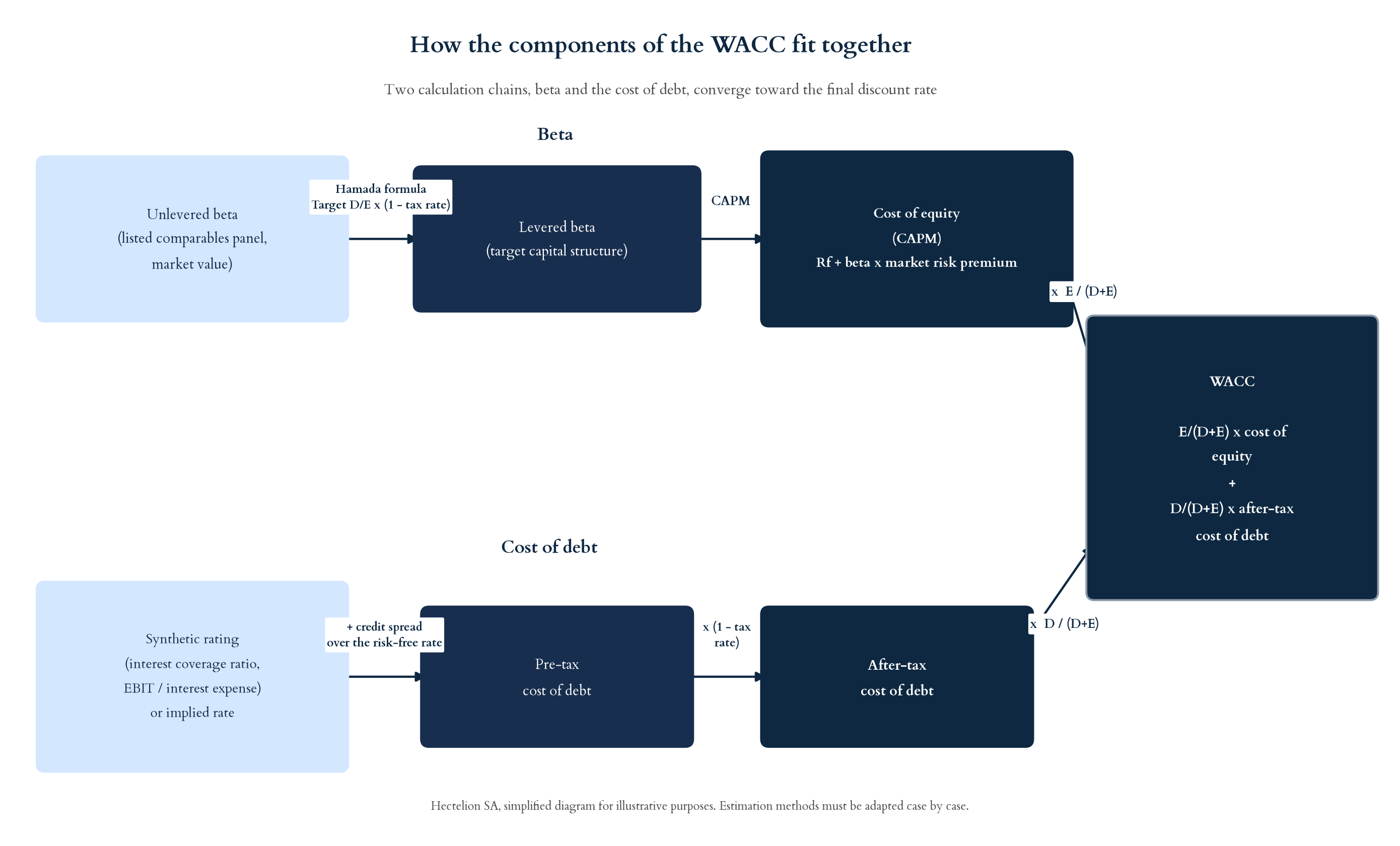
Diagram: how the components of the WACC fit together
The diagram below visually summarises how these two chains of parameters come together in the final WACC, from the unlevered beta relevered via the Hamada formula through to the cost of equity, and from the synthetic rating or implied rate through to the after-tax cost of debt. The two converge, weighted by the target weights E/(D+E) and D/(D+E), to form the single discount rate used throughout the rest of this article.
Sensitivity of the final WACC and of enterprise value to beta and the cost of debt
To measure the practical weight of these two parameters, let us revisit Case 1, the French industrial SME presented above. The target capital structure weighs EUR 12.5 million of equity and EUR 7.5 million of financial debt, that is, target weights of 62.5% for equity and 37.5% for debt. The levered beta under the Hamada formula works out at 1.23 and the after-tax cost of debt at 3.0%.
To turn these two parameters into a full WACC, the CAPM cost of equity is still needed, that is, the risk-free rate plus beta multiplied by the market risk premium. For this mechanical demonstration alone, and only for it, we reuse the illustrative risk-free rate of 3.0% already used above for Case 1 and retain an illustrative market risk premium of 5.0%, with no fixed market value; both rates must be refreshed as of the date of any real valuation. The base-case WACC then works out at 6.84%, weighted 62.5% on a cost of equity of 9.15% and 37.5% on the after-tax cost of debt of 3.0%.
Two levers are then tested in isolation, all else being equal:
- the levered beta varies by plus or minus 0.2 around 1.23, leaving the cost of debt unchanged;
- the after-tax cost of debt varies by plus or minus 1 point around 3.0%, leaving beta unchanged.
The impact on enterprise value is estimated through the sensitivity of a discounted perpetuity with constant growth, that is, enterprise value equals normalised cash flow divided by the quantity WACC minus the growth rate; this approximation makes the percentage impact independent of the level of cash flow retained, as long as the base-case WACC is compared with that of the tested scenario. The growth rate retained for this demonstration alone is 2.0%, for illustrative purposes.
| Scenario | Levered beta | After-tax cost of debt | Resulting WACC | WACC change | Impact on enterprise value |
|---|---|---|---|---|---|
| Base case | 1.23 | 3.00% | 6.84% | 0.00 point | 0.0% |
| Levered beta -0.2 | 1.03 | 3.00% (unchanged) | 6.22% | -0.63 point | +14.8% |
| Levered beta +0.2 | 1.43 | 3.00% (unchanged) | 7.47% | +0.63 point | -11.4% |
| After-tax cost of debt -1 point | 1.23 (unchanged) | 2.00% | 6.47% | -0.38 point | +8.4% |
| After-tax cost of debt +1 point | 1.23 (unchanged) | 4.00% | 7.22% | +0.38 point | -7.2% |
Sensitivity table built mechanically from the Case 1 figures and the formulas set out in this article. The risk-free rate, the market risk premium and the growth rate retained for this demonstration are illustrative and must be recalculated for any real engagement.
A downloadable Excel calculator, built from these same formulas, is available at the bottom of this article: it lets you reproduce this sensitivity analysis using the beta, cost of debt, capital structure and growth rate specific to your own file.
Word from the CEO
« In my early years of practice, I too often copied the sector beta published by a data terminal without checking which capital structure it corresponded to. I learned, sometimes the hard way on contested files, that this adjustment is never a side detail. »
« I systematically ask my team to cross-check at least two methods for the cost of debt before folding it into the WACC. When the implied rate and the synthetic rating agree, I know the assumption will hold up against an auditor or an opposing party. »
« I remain convinced that rigour on these two parameters, beta and the cost of debt, is what distinguishes a defensible WACC from a cosmetic one. That is the standard I try to pass on in every Hectelion engagement. »
Aristide Ruot, Ph.D., Founder and Chief Executive Officer of Hectelion SA.
FAQ: the 10 essential questions on beta and the cost of debt in the WACC
Introduction: what to keep in mind before the questions
The ten questions below cover the points that come up most often in our discussions with business owners, auditors and investors on relevering beta and estimating the cost of debt. They complement, without repeating, the questions addressed in our publications dedicated to the general WACC and to the size premium.
Q1: What is the difference between unlevered beta and levered beta?
Unlevered beta measures the operating risk of a business independently of its financing; levered beta adds the financial risk linked to the leverage of a given capital structure. The observed beta of listed comparables is unlevered to isolate operating risk, then relevered to the target capital structure of the company being valued.
Q2: Why not use the observed beta of a listed comparable directly?
Because that beta embeds the comparable's financial structure, which almost always differs from the target structure retained for the company being valued. Using it without adjustment would apply to the company being valued a level of financial risk that is not its own.
Q3: Does the Hamada formula apply to every SME?
It applies to most unlisted SMEs, provided a relevant panel of listed comparables is available. Its classic version assumes a zero debt beta, a reasonable assumption for conventional senior debt, but a questionable one for a company carrying significant subordinated or mezzanine debt, where a modified version is preferable.
Q4: Should the debt-to-equity ratio be measured at book value or at market value?
At market value for listed comparables, since it is market capitalisation that reflects the economic value of equity. For the target structure of the company being valued itself, which is unlisted, the capital structure judged sustainable over time is retained, most often expressed from the estimated enterprise value.
Q5: What is the difference between the pre-tax and after-tax cost of debt?
The pre-tax cost of debt is the gross rate of return required by creditors. The after-tax cost of debt removes the tax saving linked to the deductibility of interest, by multiplying it by one minus the tax rate. It is this after-tax cost that enters the WACC.
Q6: How can the cost of debt of an SME with no public credit rating be estimated?
Three main methods: observing the marginal rate actually obtained on a recent loan, the synthetic rating method which infers an indicative rating from the interest coverage ratio, and the implied rate method which relates interest expense to average outstanding debt. We recommend cross-checking at least two of these methods.
Q7: What is the interest coverage ratio and what is it used for?
It is the ratio of EBIT to interest expense over a period. It measures the company's ability to service its debt from its operating result and is the main input of the synthetic rating method.
Q8: Is the risk-free rate used for the cost of debt the same as the one used for the cost of equity?
It is the same long-maturity risk-free rate concept, but it must be consistent in currency and maturity with the debt being valued. The full construction of the cost of equity from the risk-free rate is detailed in our publication dedicated to the general WACC.
Q9: Should beta and the cost of debt be reassessed every year?
Not necessarily every year, but systematically upon a change in the target capital structure, a significant refinancing, or ahead of any transaction or fundraising where the WACC is used as the discount rate.
Q10: Are these two parameters enough to build a complete WACC?
No. The levered beta and the after-tax cost of debt are two inputs among others: they still need to be combined with the market risk premium, where applicable with a size premium or a specific risk premium, and with the target weights of debt and equity. These steps are detailed in our publications dedicated to the weighted average cost of capital (WACC) and to the size premium.
Estimate the value of your business with Acontos, Hectelion's online simulator
To extend this reading with a concrete figure, Hectelion makes available Acontos, its online audit, due diligence and business valuation tool. Powered by Claude Sonnet 5 by Anthropic and calibrated using Hectelion's methodology, it reads your accounts, normalises EBITDA, applies real sector multiples and reconstructs a net debt bridge to estimate the value of your shares within minutes. Launch the valuation simulator for free: the tool is confidential, retains no document, and does not replace a formal valuation, but it gives a reliable first order of magnitude before discussing it with our teams.
Conclusion: treating beta and the cost of debt as engagement-specific parameters, not default inputs
A WACC is never stronger than its least-questioned parameters. Levered beta and the after-tax cost of debt, because they seem secondary next to the market risk premium or the size premium, are precisely the two components most often copied rather than rebuilt. Yet the Hamada formula and the cross-checked methods for estimating the cost of debt do not require sophisticated tools: they require rigour on the retained capital structure, on the market value of comparables, and on consistency across data sources.
Treating these two parameters as engagement-specific elements in their own right, documented and cross-checked, rather than as default inputs inherited from an earlier report, changes the robustness of the final WACC and, with it, the defensibility of the entire valuation.
Summary
This article focused on two WACC components deliberately left aside by our publications dedicated to the general WACC and to the size premium: beta and the cost of debt. The unlevered beta, obtained from a panel of listed comparables adjusted to market value, must be relevered to the target capital structure of the company being valued using the Hamada formula, which combines the target debt-to-equity ratio and the applicable tax rate.
The cost of debt, in the absence of a public credit rating for the vast majority of SMEs, is reconstructed from the observed marginal borrowing rate, the synthetic rating method based on the interest coverage ratio, or the implied rate calculated from interest expense and average outstanding debt; these methods must be cross-checked before settling on the retained assumption, then adjusted for the tax shield.
The two worked cases, one for a French industrial SME and one for a Swiss services SME, show how these calculations fit together in practice, with capital structures, tax rates and cost of debt methods that differ on either side of the Franco-Swiss border.
These two parameters are only part of the WACC: their full integration with the market risk premium, the size premium where applicable, and the target financing weights, is detailed in our dedicated publications, to which this article deliberately refers rather than duplicating them.
Sources
- Damodaran, Aswath (New York University Stern School of Business), Estimating a synthetic rating and cost of debt
- French General Tax Code, Article 219, statutory corporate tax rate
- Hamada, Robert S. (University of Chicago Booth School of Business), The Effect of the Firm's Capital Structure on the Systematic Risk of Common Stocks, Journal of Finance, 1972
- International Valuation Standards Council, International Valuation Standards, current edition
- Modigliani, Franco and Miller, Merton H. (American Economic Association), The Cost of Capital, Corporation Finance and the Theory of Investment, American Economic Review, 1958
- S&P Global Ratings, S&P Global Ratings Definitions
- Swiss National Bank, economic note on SARON's response to reserves provided by the SNB
Author
Aristide Ruot, Ph.D.
Founder | Chief Executive Officer, Hectelion SA