Transposition (Switzerland) vs Contribution-and-Sale 150-0 B Ter (France): Franco-Swiss Tax Symmetry Before a Share Sale
Swiss transposition vs French contribution-and-sale.

Introduction: Franco-Swiss tax symmetry when facing a share sale
A shareholder preparing to sell a company, whether based in Geneva or Lyon, faces the same temptation: housing shares in a structure they control themselves before the sale, to reduce or defer tax on the capital gain. Switzerland and France have each built a safeguard to contain this reflex, and the two safeguards mirror each other with striking precision, within a broader context of substantial differences between the two tax systems when a business is sold (see our comparative article Business sale: key differences between France and Switzerland). In Switzerland, transposition (Transponierung), codified at article 20a paragraph 1 letter b of the Federal Direct Tax Act (LIFD), recharacterises as taxable investment income the excess between the contribution price and the par value of the shares, as soon as the contributor controls at least 50% of the receiving company after the transaction.
"The proceeds from the transfer of a participation [...] in which the seller or the person making the contribution holds a participation of at least 50% of the capital after the transfer [are taxed], to the extent that the total consideration received exceeds the sum of the par value of the transferred participation and the reserves arising from capital contributions.", article 20a paragraph 1 letter b LIFD.
In France, contribution-and-sale (apport-cession) under article 150-0 B ter of the French General Tax Code (CGI) follows an inverse but related logic: rather than penalising a contribution to a controlled company, it encourages it by placing the capital gain into tax deferral, provided the beneficiary company reinvests a substantial share of the proceeds if it resells quickly. Three facts make this comparison particularly useful in 2026:
- The 2026 French Finance Act tightened the contribution-and-sale regime, raising the reinvestment quota from 60% to 70% of the sale proceeds and the reinvestment deadline from 2 to 3 years.
- On 1 October 2025, the Federal Supreme Court issued a ruling from Geneva that illustrates the Swiss transposition mechanism with particular clarity.
- Franco-Swiss executives who hold shares on both sides of the border must choose between two legal frameworks that do not overlap, at the risk of structuring a transaction that is costly or challengeable in one of the two countries.
This article details the definition of each mechanism, their origin, the reasons to compare them, their practical implementation, the control threshold specific to each jurisdiction, the suspect-transaction period, Swiss federal case law, the situations that trigger the risk, the advantages, the limitations, the 5 most costly mistakes, two fully worked examples, and a 10-question FAQ.
Secure your next cross-border share sale with Franco-Swiss structuring expertise
Before contributing or selling shares on either side of the border, talk to a specialist with dual Franco-Swiss expertise. Book a 30-minute slot to discuss your situation: tax residence, shareholding structure, sale horizon, and the most defensible structure in front of the relevant tax authority.
Acontos: estimate the value of your business online for free
Before going into detail, you should know that Hectelion has developed Acontos, an online tool for audit, due diligence and business valuation, powered by Claude Sonnet 5 by Anthropic and calibrated on the Hectelion methodology. From your accounts, it produces within minutes a first estimate of the value of your shares, free of charge and without storing any document. Launch the valuation simulator to obtain an order of magnitude, then read on to understand what drives it.
Definition: what are Swiss transposition and French contribution-and-sale?
Transposition occurs when a Swiss shareholder contributes or sells shares held in their private wealth to a company they control to the extent of at least 50% of the capital after the transaction, for a price above the par value of the transferred shares and the capital contribution reserves attached to them. The excess is then no longer treated as a private capital gain but recharacterised as taxable investment income, exactly as if it were a dividend paid by the receiving company. The mechanism targets a precise workaround: without it, a shareholder could turn a future taxable dividend into an exempt capital gain, simply by selling their shares to their own holding company before having it resell them or grow them within that structure.
Contribution-and-sale, governed by article 150-0 B ter of the CGI, addresses a different concern: it does not seek to prevent a contribution to a controlled company, but to prevent such a contribution from being used solely to artificially clear a capital gain without any genuine economic reinvestment. The gain recognised on contribution to a holding company subject to corporate income tax and controlled by the contributor is placed into tax deferral. If the holding company sells the contributed shares within 3 years of the contribution, this deferral is maintained only if it reinvests at least 70% of the sale proceeds into an eligible economic activity, within 3 years of the sale, and retains the assets so acquired for 5 years.
The two regimes share a common foundation, control by the seller of the receiving structure, and a common trigger, a price above a historical value reference. But one immediately penalises the excess at the time of transfer, while the other only penalises it in the event of a quick resale without sufficient reinvestment. For a detailed look at the French mechanism in isolation, see our dedicated article on contribution-and-sale 150-0 B ter and the 2026 Finance Act, and for the alternative transfer strategy, our comparative article gift before sale vs contribution-and-sale 150-0 B ter.
Origin: two safeguards born to prevent the same tax manoeuvre
Swiss transposition originates in administrative practice and then in Federal Supreme Court case law, which progressively built the theory of tax avoidance applicable to the sale of a participation to a company dominated by the seller, before its codification at article 20a LIFD, which entered into force on 1 January 2007 as part of the federal act on urgent measures for business taxation. Until 2020, a minimum participation threshold applied to certain variants of the mechanism; the corporate tax reform that entered into force on 1 January 2020 strengthened the consistency of the regime.
French contribution-and-sale is, for its part, an explicit legislative regime, introduced to allow an entrepreneur to reorganise their business assets without penalising immediate taxation, provided a genuine economic reinvestment logic is maintained rather than a mere tax arbitrage. Act no. 2026-103 of 19 February 2026 tightened these conditions for sales of contributed shares carried out from 21 February 2026 onward: the reinvestment quota was raised from 60% to 70% of the sale proceeds, the reinvestment deadline was extended from 2 to 3 years, and the holding period for reinvested assets was extended from 1 to 5 years.
Why compare transposition and contribution-and-sale before a share sale
- A Franco-Swiss executive restructuring their shareholding on both sides of the border must know that housing Swiss shares in a holding company they control is far from tax-neutral, whereas the symmetrical transaction in France can, under conditions, defer tax rather than trigger it.
- The comparison avoids a frequent conceptual mix-up: believing that the French deferral mechanism also protects against Swiss recharacterisation, or vice versa, when the two legal systems largely ignore each other.
- Both regimes keep evolving: Switzerland strengthened transposition in 2007 and again in 2020, France has just tightened contribution-and-sale in 2026, which calls for active monitoring rather than mechanical application of rules learned years ago.
- The comparison sheds light on a genuine strategic choice: an entrepreneur considering moving their tax residence between the two countries before a sale must anticipate which of the two regimes will apply to their transaction.
- Both mechanisms share the same substantive requirement, documenting the value retained through an independent valuation, which makes this a natural field for structuring supported by a firm with dual Franco-Swiss expertise.
How a transposition is structured in Switzerland
The transaction is built in several steps. The shareholder creates or mobilises a company, most often a personal holding company (see our article on the process of creating a holding company in Switzerland), of which they will hold at least 50% of the capital after the transaction. They transfer their shares in the operating company to this structure, at a price that in principle corresponds to fair market value. If this price exceeds the sum of the par value of the transferred shares and the capital contribution reserves attached to them, the excess is immediately recharacterised as taxable investment income for the tax period of the transaction, without waiting for the receiving company to actually distribute a dividend. The consideration received by the contributor may take the form of a cash price, a debt acknowledgement from the receiving company, or new shares in that company: the form of the consideration does not change the characterisation if its total amount exceeds the threshold.
How a contribution-and-sale is structured in France
The French sequence is different. The contributor creates or mobilises a holding company subject to corporate income tax, which they control within the meaning of article 150-0 B ter III. They contribute their shares to this holding company at fair market value, which triggers recognition of a capital gain automatically placed into tax deferral if the legal conditions are met, with no election to exercise. The holding company then sells the contributed shares to the final buyer. If this sale occurs within 3 years of the contribution, the holding company must reinvest at least 70% of the sale proceeds into an eligible economic activity, within 3 years of the sale, then retain the assets so acquired for 5 years, failing which the deferral is retroactively clawed back with late-payment interest. Once the holding company has held the shares for more than 3 years before the sale, no reinvestment obligation applies any longer to maintain the deferral.
The control threshold: 50% in Switzerland, a different criterion from French control
This is the point requiring the most rigour in the comparison, because the two thresholds do not overlap. In Switzerland, article 20a paragraph 1 letter b LIFD sets a single, arithmetic criterion: the contributor must hold, after the transaction, at least 50% of the capital of the receiving company. There is neither a presumption nor an alternative de facto control criterion: only the share of capital held after the transfer counts.
French law adopts a markedly more flexible definition of control at article 150-0 B ter III 2°. A taxpayer is considered to control the beneficiary company when they hold, directly or indirectly, the majority of voting rights or of rights in corporate profits, including through their spouse, ascendants, descendants or siblings; or when they alone hold that majority under an agreement with other shareholders; or when they in fact exercise decision-making power. The CGI adds a presumption of control from 33.33% of voting rights or profit rights, if no other shareholder holds a larger share. A dispersed French shareholding can therefore trigger the control characterisation, and hence the application of article 150-0 B ter, at a holding level well below the Swiss 50% threshold, while a minority holding of 42% or 45% in Switzerland escapes transposition entirely, for failing to reach a majority of the capital.
The suspect-transaction period: three years on both sides of the border, for different reasons
The two legal systems converge numerically around a 3-year period, but monitor radically different events. In France, the 3-year period runs from the contribution and triggers the reinvestment obligation if the holding company sells the contributed shares before it expires: it is a monitoring period for resale by the receiving structure, after the contribution itself.
Article 20a paragraph 1 letter b LIFD, for its part, provides for no comparable multi-year monitoring window: the condition of holding at least 50% of the capital is assessed at the very moment of the transfer of the shares, and the price excess is taxed as of that transaction if the threshold is crossed. Only the neighbouring variant of article 20a paragraph 1 letter a, relating to the sale of a participation of at least 20% followed by a distribution of substance, expressly imposes a 5-year monitoring period after the sale. Transposition in the strict sense of letter b therefore plays out in an instant, that of the contribution, while French contribution-and-sale can potentially replay for 3 years after the initial transaction.
Direct symmetry table between Swiss transposition and French contribution-and-sale
The two preceding sections detail separately the control threshold and the period specific to each jurisdiction. The following table sets them side by side, with the legal basis and associated recharacterisation risk, for a synthetic reading before turning to case law and practice.
| Criterion | Swiss transposition | French contribution-and-sale |
|---|---|---|
| Control threshold | At least 50% of the capital of the receiving company after the transaction, a single arithmetic criterion | Majority of voting rights or profits, agreement between shareholders, or de facto power; presumption from 33.33% if no other shareholder holds a larger share |
| Suspect-transaction period | None: the condition is assessed instantaneously, at the very moment of the share transfer | 3 years from the contribution; a sale by the holding company within this period triggers the reinvestment obligation |
| Legal basis | Article 20a paragraph 1 letter b of the Federal Direct Tax Act (LIFD) | Article 150-0 B ter of the French General Tax Code (CGI) |
| Recharacterisation risk | Immediate taxation of the excess as investment income, with no tolerance or good-faith condition | Retroactive clawback of the deferral if the 70% reinvestment quota is not met within the legal deadline, with late-payment interest calculated from the contribution |
This table confirms that the two figures of 50% and 3 years, which might suggest a numerical symmetry, in fact cover opposite legal logics: an instantaneous holding threshold on the Swiss side, a resale monitoring window on the French side.
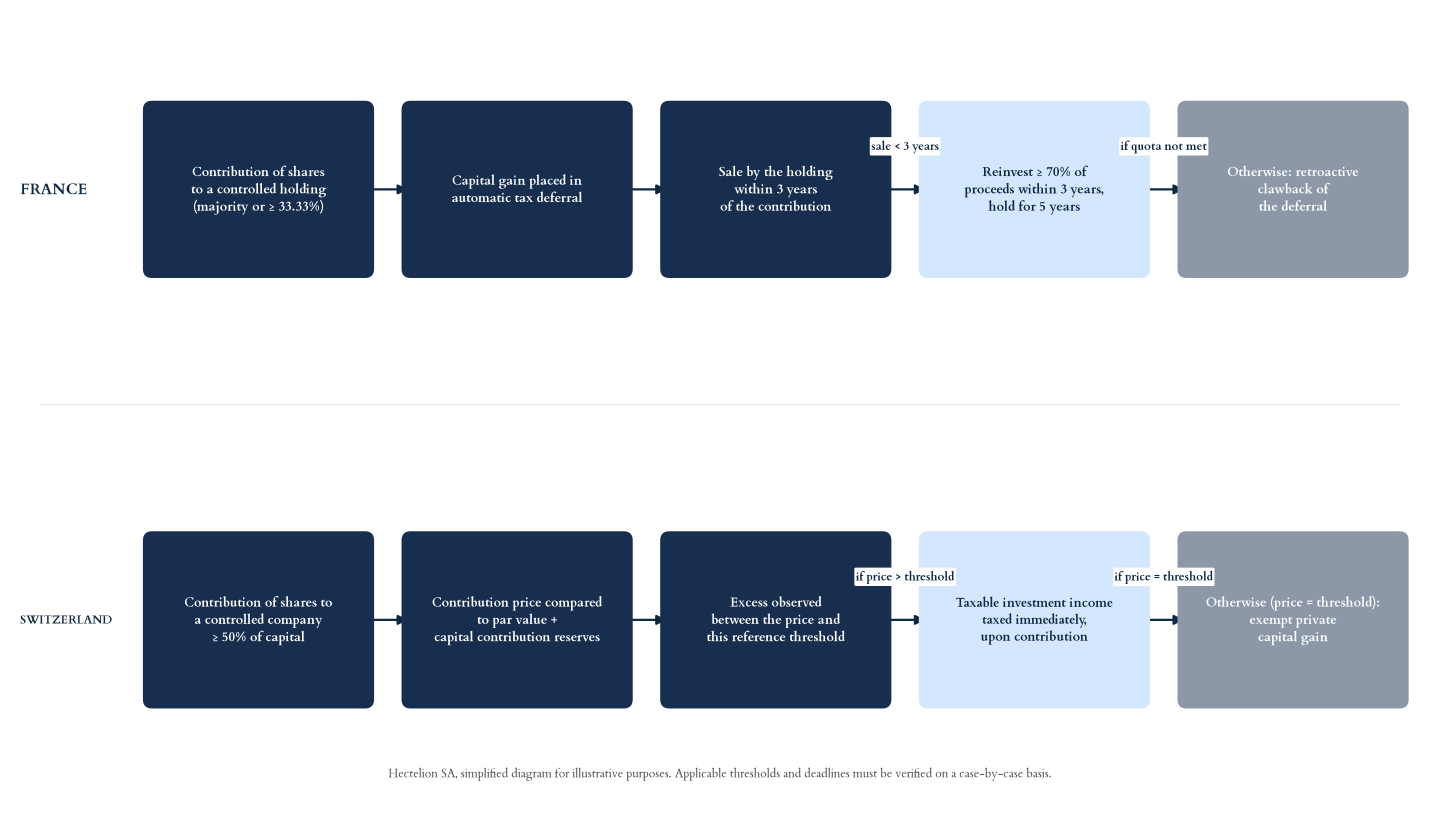
Diagram: the French contribution-and-sale mechanism against Swiss transposition
The two preceding sections and the table above detail the control threshold and the period specific to each jurisdiction. The diagram below sets out side by side the key steps of the two mechanisms, from the share transfer through to the maintenance or loss of the tax benefit, with the exact thresholds and deadlines described above.
Swiss case law on transposition: what the Federal Supreme Court says
The Federal Supreme Court has had the opportunity to apply article 20a paragraph 1 letter b LIFD concretely in a recent ruling from Geneva. In that case, a taxpayer had contributed 30 shares of a company to their personal holding company; the Geneva tax authority assessed the fair market value of these shares at CHF 780,000, against a par value of CHF 30,000, and taxed the difference of CHF 750,000 as investment income under transposition.
"This amount corresponded to the difference between the fair market value of the 30 shares of the Company, contributed by the taxpayer to the holding company (CHF 780,000), and their par value (CHF 30,000).", Federal Supreme Court, TF 9C_233/2025 of 1 October 2025.
This decision illustrates, with figures to support it, the very mechanism described by the law: no actual dividend distribution is required, the gap between fair market value and par value is enough to trigger taxation as of the contribution. An earlier Federal Supreme Court ruling, conversely, recalls the limit of the regime: when an in-kind contribution is remunerated with new shares whose par value corresponds to the intrinsic value of the shares transferred, the transaction by definition generates no taxable excess, for lack of any gap between the consideration received and the par-value reference.
When the risk of transposition or abusive contribution-and-sale is triggered
The risk of transposition materialises as soon as a Swiss shareholder considers housing their shares in a personal structure before a sale to a third party, in particular to organise an MBO, an OBO or a family group restructuring, without having checked whether the contribution price respects the par value increased by the capital contribution reserves. The risk of abusive contribution-and-sale materialises, conversely, when the French holding company resells the shares quickly after the contribution without having identified an eligible economic reinvestment, or when the contribution transaction has no documentable purpose other than the immediate tax neutralisation of the capital gain. In both cases, the warning sign is the same: a contribution or sale price above a historical value reference, combined with the seller's control over the receiving structure.
Who to engage to secure a Franco-Swiss structuring
Three profiles are needed on either side of the border. A Swiss tax lawyer, to assess compliance with the 50% threshold and the computation of capital contribution reserves before any transposition transaction. A French tax lawyer, to structure the contribution-and-sale, assess the risk of abuse of law within the meaning of article L64 of the French Book of Tax Procedures, and, where appropriate, request a tax ruling under article L. 80 B of the same code. An independent valuer, to document the fair market value retained, whether the Swiss contribution price or the French contribution value, since this value directly determines the taxable base or the extent of the deferred capital gain in both countries. Hectelion steps in precisely on this last point, as part of a Franco-Swiss financial structuring mandate, in coordination with tax advisors in both jurisdictions, never substituting for their legal and tax advisory role, and within the scope of Hectelion's business valuation practice, which is not FINMA-licensed and does not act on listed transactions.
Advantages: deferral, control retention and entrepreneurial continuity
French contribution-and-sale offers an immediate cash advantage since no tax is due at the time of the contribution, which preserves the full sale proceeds for reinvestment and keeps the seller in control of their capital rather than transferring it or seeing it immediately reduced by tax. Swiss transposition, while it penalises a price excess, in no way prohibits restructuring: a contribution made at par value, or accompanied by sufficient capital contribution reserves, remains entirely feasible without triggering taxation, which leaves real room for advance planning. When the transaction is less about a sale to a third party than a family transfer, both countries also offer dedicated regimes, such as the Dutreil Pact and gifting before transferring a business in France, which can usefully combine with well-documented upstream structuring. In both countries, documenting the value retained through an independent valuation protects the taxpayer from a later tax reassessment, whether it concerns the Swiss fair market value or the French contribution value.
Limits: rigidity, reinvestment constraint and recharacterisation risk
Swiss transposition applies almost automatically and immediately: as soon as the 50% threshold and the par-value excess are both met, taxation occurs with no tolerance or good-faith condition, leaving little room for negotiation after the transaction. French contribution-and-sale, conversely, makes maintaining the deferral conditional on genuine reinvestment within a period now extended to 3 years if the sale occurs within 3 years of the contribution, turning part of the sale proceeds into a redeployment constraint rather than freely available liquidity: any outflow from the holding company to the executive's private wealth, whether by dividend or otherwise, becomes taxable again at that point. In both systems, a poorly documented contribution value exposes the taxpayer to a reassessment covering the entire gap observed, with late-payment interest calculated from the date of the transaction.
The 5 mistakes to avoid
Mistake 1: confusing the Swiss 50% threshold with the French control threshold
Applying the French 33.33% control-presumption threshold to a Swiss transaction, or conversely requiring a strict 50% majority to qualify control in France, leads to a flawed analysis in both directions: the two legal systems use distinct definitions that do not transfer from one country to the other.
Mistake 2: forgetting capital contribution reserves when computing the Swiss threshold
The Swiss triggering threshold is not limited to the par value of the shares: it includes the capital contribution reserves attached to them. Omitting this second term from the calculation leads to overestimating the taxable amount, or wrongly underestimating the risk of a transaction that wrongly appeared to be below the threshold.
Mistake 3: selling too soon after the contribution in France without a reinvestment plan
Having the holding company sell the contributed shares less than 3 years after the contribution, without having identified in advance an eligible economic activity for the 70% reinvestment of the proceeds, exposes the taxpayer to a brutal retroactive clawback of the deferral, with late-payment interest calculated from the date of the contribution.
Mistake 4: underestimating the new quota and new deadlines of the 2026 reform
Since Act no. 2026-103 of 19 February 2026, three distinct parameters of contribution-and-sale have been tightened: the reinvestment quota, raised from 60% to 70% of the sale proceeds, the reinvestment deadline, extended from 2 to 3 years, and the holding period for reinvested assets, extended from 1 to 5 years. Still reasoning on the former thresholds exposes the taxpayer to underfunding the mandatory reinvestment.
Mistake 5: structuring a Franco-Swiss transaction without coordination between the two tax systems
An executive restructuring Swiss and French shares in the same transaction, for example through a single holding company, without having the treatment of each leg separately validated by a tax advisor in each country, risks securing the French leg while unintentionally triggering a taxable transposition on the Swiss side, or the reverse.
Case 1: transposition of a Swiss family SME valued at CHF 3.2 million
A shareholder holds the entire share capital of a Swiss industrial SME, whose total par value amounts to CHF 100,000 and to which are attached capital contribution reserves of CHF 50,000, built up during a previous capital increase. After a potential buyer expressed interest, the shareholder wishes to first house the shares in a personal holding company they will control at 100% after the transaction, before letting this structure carry the final negotiation.
- Structure considered: contribution of all the shares to a newly created personal holding company, at the fair market value of CHF 3,200,000, documented by an independent valuation report.
- Triggering threshold: par value (CHF 100,000) plus capital contribution reserves (CHF 50,000), i.e. CHF 150,000.
- Control after the transaction: 100% of the holding company's capital, well above the 50% threshold under article 20a paragraph 1 letter b LIFD.
The contribution price of CHF 3,200,000 exceeds the CHF 150,000 threshold: the excess of CHF 3,050,000 is recharacterised as taxable investment income under transposition, at the very moment of the contribution, without waiting for a later distribution. Using, for illustration, a combined marginal rate (federal, cantonal and communal) of 29% applicable to this income at this wealth level, the tax due amounts to CHF 884,500 (3,050,000 × 29%).
| Item | Amount |
|---|---|
| Contribution price (fair market value) | CHF 3,200,000 |
| Threshold (par value + contribution reserves) | CHF 150,000 |
| Excess recharacterised as taxable income | CHF 3,050,000 |
| Tax due (illustrative rate of 29%) | CHF 884,500 |
By way of comparison, had the shareholder sold their shares directly to an independent third party at the same price of CHF 3,200,000, without first contributing them to a structure they control, the gain would in principle have fallen under the private capital gain regime on movable wealth, with no income tax due. Transposition therefore turns here a gain that would in principle be tax-free into income taxed up to CHF 884,500, for the sole reason that the receiving structure is controlled by the seller themselves. This outcome could have been avoided, or significantly reduced, by capping the contribution price at the par value increased by the contribution reserves, or by selling directly on market terms to an unrelated third party before any internal restructuring.
Case 2: contribution-and-sale of a French consulting-firm stake valued at EUR 4.5 million
A French executive holds all the shares of an engineering consulting firm, valued at EUR 4.5 million, historically acquired for EUR 150,000. A private equity fund offers to buy the business, but the executive first wishes to contribute the shares to a holding company they control at 100%, to retain control of the sale proceeds and reinvest them into new entrepreneurial projects.
- Structure chosen: contribution of all the shares to a newly created holding company subject to corporate income tax, at the fair market value of EUR 4.5 million.
- Contribution gain: EUR 4.5 million less EUR 150,000 historical acquisition cost, i.e. EUR 4,350,000 placed into automatic tax deferral, with no tax due at the time of the contribution.
- Sale by the holding company: occurring 14 months after the contribution, hence within the 3-year period that triggers the reinvestment obligation, at the same price of EUR 4.5 million, with no additional taxable gain at the holding company level.
Under the reinvestment quota raised to 70% by Act no. 2026-103 of 19 February 2026, the holding company must reinvest at least EUR 3,150,000 into an eligible economic activity, within 3 years of the sale, to retain the deferral on the entire capital gain. The assets so acquired through reinvestment must then be retained for 5 years. The remaining EUR 1,350,000, i.e. 30% of the proceeds, remain freely usable by the holding company without jeopardising the deferral.
| Item | Amount |
|---|---|
| Sale proceeds received by the holding company | EUR 4,500,000 |
| Mandatory reinvestment quota (70%) | EUR 3,150,000 |
| Balance freely available to the holding company (30%) | EUR 1,350,000 |
| Immediate tax on the EUR 4,350,000 capital gain | EUR 0 (deferred) |
By way of comparison, a direct sale by the executive, with no prior contribution, would have generated a taxable gain of EUR 4,350,000, taxed under the flat tax (prélèvement forfaitaire unique) at 30%, i.e. EUR 1,305,000 of immediate tax and a personal net amount of EUR 3,195,000. Contribution-and-sale avoids this immediate levy and preserves the full EUR 4.5 million at the holding-company level, at the cost of a reinvestment constraint of EUR 3,150,000 within the legal deadline: the value remains business capital to be redeployed through the holding company, not private wealth immediately available to the executive without further taxation in the event of a distribution.
Case 3: a binational executive choosing between a Swiss holding and a French holding
Mr Thomas Lemoine, a French-Swiss dual national, has been tax-resident in Switzerland, in the canton of Vaud, since 2016. He holds all the shares of Lemoine Ingénierie SAS, an operating company registered in France, whose share capital (total par value) amounts to EUR 120,000 and to which are attached capital contribution reserves of EUR 30,000, i.e. a combined threshold of EUR 150,000. An industrial group offers to buy the company for a fair market value of EUR 2,600,000. Before the sale, Mr Lemoine considers contributing his shares to a holding company he would control at 100%, and is weighing whether to set up this holding company in Switzerland or in France.
- Option A, Swiss holding: because Mr Lemoine is a Swiss tax resident, article 20a paragraph 1 letter b LIFD applies to his personal situation as soon as he contributes shares to a company he controls to at least 50% of the capital, regardless of the nationality of this receiving company or of the participation transferred.
- Option B, French holding: setting up a French holding company subject to corporate income tax instead changes nothing in his Swiss exposure, since transposition targets the personal situation of the contributor subject to federal direct tax, not the nationality of the receiving structure.
Converted at the average exchange rate published by the Swiss National Bank for September 2026 (EUR 1 = CHF 0.943), the EUR 2,600,000 contribution price represents approximately CHF 2,451,800, and the combined EUR 150,000 threshold approximately CHF 141,450 (par value converted to CHF 113,160, plus contribution reserves converted to CHF 28,290). The taxable excess therefore amounts to CHF 2,310,350. At the illustrative marginal rate of 29% already used in Case 1, the tax due reaches CHF 670,002, whether Mr Lemoine houses his holding company in Lausanne or in Lyon: the Swiss tax outcome does not depend on the country where the receiving company is incorporated, but on his own tax residence and the control he exercises over it.
| Item | Amount |
|---|---|
| Contribution price (fair market value), converted to CHF | CHF 2,451,800 |
| Threshold (par value + contribution reserves), converted to CHF | CHF 141,450 |
| Excess recharacterised as taxable income | CHF 2,310,350 |
| Tax due, option A or B (illustrative rate of 29%) | CHF 670,002 |
| Comparison: direct sale without a controlled holding company (exempt private gain) | CHF 0 |
The French holding company opens no tax deferral here that would offset this cost: article 150-0 B ter addresses French income taxation, to which Mr Lemoine, a Swiss tax resident, is not subject on this gain. Changing the holding company's nationality therefore does not move the Swiss tax problem an inch. The only arbitrage genuinely available to him is to cap the contribution price at the CHF 141,450 threshold, or to sell directly to an independent third party with no prior contribution to a structure he controls, which qualifies as an exempt private capital gain for a Swiss tax resident on the same value of CHF 2,451,800.
Message from the Managing Director
"I too often see executives approach Swiss transposition and French contribution-and-sale as two variants of the same problem, when in fact they are two legal frameworks built on opposite logics: one penalises a price excess at the moment of transfer, the other conditions a deferral on future reinvestment. I always start by setting out this distinction before talking figures."
"In a Franco-Swiss matter, I never settle for validating the French leg or the Swiss leg in isolation. I have seen structures perfectly secured on the contribution-and-sale side trigger, without anyone having anticipated it, a taxable transposition on the Swiss side, simply because no one had checked the 50% threshold at the right moment."
"My role at Hectelion is not to substitute for Swiss and French tax lawyers on these structures, but to document, independently and defensibly in both jurisdictions, the value retained for the contribution or the sale. That is often the weakest point of the file when facing a tax audit, and it is precisely where I can add the most value."
Aristide Ruot, Ph.D.
FAQ: the 10 essential questions on transposition and contribution-and-sale
Introduction: what to remember before the questions
This FAQ gathers the questions most frequently asked by Franco-Swiss executives considering restructuring their shareholding before a share sale, with deliberately concise answers that point back to the article's detailed sections for more precision.
Q1: What actually triggers transposition in Switzerland?
Two cumulative conditions: the contributor holds at least 50% of the receiving company's capital after the transaction, and the price received exceeds the sum of the par value of the transferred shares and the capital contribution reserves attached to them.
Q2: What triggers the French contribution-and-sale reinvestment obligation?
The sale, by the holding company that received the contribution, of the contributed shares within 3 years of the contribution: beyond this period, no reinvestment obligation applies any longer to maintain the deferral.
Q3: Are the Swiss 50% threshold and the French control threshold comparable?
No, they are two distinct concepts: the Swiss threshold is a single arithmetic share of 50% of the capital, while French control can be established from 33.33% of voting rights by presumption, or through de facto decision-making power with no numerical threshold.
Q4: What happens if the Swiss contribution price equals the par value?
No transposition is triggered, for lack of an excess: Federal Supreme Court case law confirms that consideration exactly matching the par value, or the intrinsic value of the shares received in exchange, generates no taxable income.
Q5: Can a Franco-Swiss executive combine structuring in Switzerland and in France?
Yes, but each leg must be validated separately by a tax advisor in each jurisdiction: the two legal systems do not recognise each other, and securing one never automatically protects the other.
Q6: Does the French 70% reinvestment quota also apply in Switzerland?
No, the notion of a reinvestment quota does not exist in the Swiss transposition mechanism, which simply taxes the price excess immediately at the time of the contribution, with no subsequent redeployment condition.
Q7: Can Swiss transposition be avoided legally?
Yes, in particular by capping the contribution price at the par value increased by capital contribution reserves, or by selling the shares directly to an independent third party not controlled by the seller, rather than to a structure they dominate.
Q8: What does a French taxpayer risk by failing to meet the reinvestment quota?
The tax deferral lapses in proportion to the amount not reinvested, making the capital gain immediately taxable for the contributor, increased by late-payment interest calculated from the date of the initial contribution.
Q9: Does transposition apply only to Swiss companies?
The mechanism targets the Swiss taxation of the contributor subject to federal direct tax: it applies as soon as the transferred shares and the receiving company fall within the Swiss taxation of the individual concerned, regardless of the parties' nationality.
Q10: Is a tax ruling needed before a transposition or contribution-and-sale transaction?
Nothing legally requires it in either country, but practice strongly recommends seeking an advance cantonal tax ruling in Switzerland, or a ruling under article L. 80 B of the French Book of Tax Procedures in France, to secure the characterisation before carrying out the transaction (see our article on the French value ruling and the Swiss ruling to secure the tax value of a business).
Estimate the value of your business with Acontos, Hectelion's online simulator
To extend this reading into a concrete figure, Hectelion offers Acontos, its online tool for audit, due diligence and business valuation. Powered by Claude Sonnet 5 by Anthropic and calibrated on the Hectelion methodology, it reads your accounts, normalises EBITDA, applies real sector multiples and rebuilds the net debt bridge to estimate the value of your shares within minutes. Launch the valuation simulator free of charge: the tool is confidential, stores no document and does not replace a formal valuation, but it gives a reliable first order of magnitude before you discuss it with our team.
Conclusion: the same requirement for economic substance, two distinct frameworks
Swiss transposition and French contribution-and-sale are not two variants of the same regime: they are two answers to two different tax risks. The first penalises, from the moment of transfer, a contribution price exceeding a par-value reference, to prevent a future dividend from being converted into an exempt capital gain. The second grants a conditional deferral tied to genuine economic reinvestment, to prevent a contribution from being used only to artificially clear a capital gain with no economic development in return.
The Swiss worked example shows that a contribution at market price, with no attention paid to par value and contribution reserves, can turn a gain that would in principle be exempt into income taxed to the tune of several hundred thousand francs. The French worked example shows, conversely, that a full tax deferral comes at the cost of a reinvestment constraint now more demanding since the reform of 21 February 2026, without, however, triggering any immediate tax.
For a Franco-Swiss executive, the lesson common to both mechanisms is the same: the control exercised over the receiving structure, and the value retained for the transaction, must be documented and anticipated before any restructuring, never after. It is this discipline, far more than isolated knowledge of either piece of legislation, that protects the executive from an unpleasant tax surprise on either side of the border.
Article summary
Swiss transposition (art. 20a para. 1 let. b LIFD) recharacterises as taxable investment income the excess between the contribution price of shares to a company controlled by the contributor to at least 50%, and the sum of their par value and capital contribution reserves, with no reinvestment condition or multi-year monitoring period. French contribution-and-sale (art. 150-0 B ter CGI) places the contribution gain to a controlled holding company into tax deferral, subject to a reinvestment condition now set at 70% of the proceeds if the holding company sells the contributed shares within 3 years of the contribution, under Act no. 2026-103 of 19 February 2026.
The Swiss control threshold (arithmetic 50%) and the French threshold (majority, agreement between shareholders, de facto power, or a 33.33% presumption) do not overlap, just as the French 3-year suspect period after the contribution has no equivalent under the Swiss letter b, which is assessed at the very moment of transfer. The Federal Supreme Court ruling of 1 October 2025 concretely illustrates this mechanism on a contribution valued at CHF 780,000 against a par value of CHF 30,000.
The two worked examples in this article show very different amounts depending on the country and mechanism involved, but the same conclusion: documenting the value retained through an independent valuation, and anticipating the applicable control threshold in each jurisdiction, is what secures the tax position of any restructuring carried out ahead of a share sale.
Sources
- Swiss Federal Tax Administration (AFC), circular no. 29b on reorganisations, chapter on transposition
- Bensaid Avocats, transposition under Swiss tax law, domination threshold and mechanism
- BOFiP, ACTU-2026-00099, tightening of the contribution-and-sale quota and deadlines by the 2026 Finance Act
- Bucher Tax, transposition of participations under Swiss tax law
- ClicImpôts, commentary on the BOFiP guidance on article 150-0 B ter consistent with the 2026 Finance Act
- Fedlex, consolidated text of article 20a of the Federal Direct Tax Act (LIFD)
- Légifrance, text in force of article 150-0 B ter of the French General Tax Code
- Légifrance, Act no. 2026-103 of 19 February 2026, article 11 raising the contribution-and-sale quota and deadlines
- Philippe Kenel, transposition, an exception to the exemption of private capital gains
- Federal Supreme Court, TF 9C_233/2025 of 1 October 2025, application of transposition to a Geneva contribution
- Federal Supreme Court, TF 2C_879/2008 of 20 April 2009, in-kind contribution with no taxable excess
Author
Aristide Ruot, Ph.D.
Founder | Chief Executive Officer, Hectelion SA