PIK (Payment In Kind): Definition, Mechanics and Calculation of Capitalized Interest
PIK (Payment In Kind) debt capitalizes interest instead of paying cash.

Introduction: when leveraged financing chooses not to pay its interest in cash
Why can the principal of an acquisition debt be higher at exit than at closing, even though no additional drawdown has been made? The answer often lies in a specific mechanism, PIK debt, short for payment in kind. Under this arrangement, the contractual interest is not paid in cash at each due date but capitalized, meaning added to the principal, which then grows by compounding until repayment. Hectelion already describes this mechanism in its glossary entry on PIK; this article details how it works, how it is calculated, and the risks it carries for executives, investors and lenders involved in a leveraged transaction.
"Given that its payment is deferred, PIK interest is generally priced higher than cash interest.", BlackRock, Inside Alternatives.
Three trends are converging to put PIK back at the center of structuring discussions in 2026.
- Direct lending (private credit) has taken a growing share of mid-market LBO financing, at the expense of the traditional syndicated bank market, and direct lending funds now structure a large share of these transactions with greater contractual latitude than banks, particularly on capitalization options.
- The rise in reference rates since 2022 has tightened interest coverage from available cash flow, pushing more borrowers and sponsors to negotiate PIK toggle clauses as early as the initial documentation rather than in restructuring.
- According to Oak Hill Advisors, cited by T. Rowe Price, the share of loans that switched to PIK by amendment rose from 2.6% in 2021 to 6.1% in the third quarter of 2025 in US direct lending, a sign that PIK is increasingly used to manage credit stress rather than to fund healthy growth.
This article covers, in turn, the origin of PIK, the reasons for using it, its calculation method, a comparative table of PIK versus cash interest versus PIK toggle, the situations that justify its use, the professionals to involve, its advantages and limitations, its specific risks, the five most common mistakes, two numerical cases in France and Switzerland, a word from its CEO, a frequently asked questions section and a final summary.
Secure the structuring of your PIK tranche before it structures your exit
A PIK tranche miscalibrated at closing often becomes, five years later, the item that absorbs the value the transaction was meant to create for shareholders. Before finalizing the mix between senior debt, private debt and PIK, book a thirty-minute call with Hectelion to have your financing structure's trajectory tested over the full holding period, not just the closing-year figures.
Acontos: estimate the value of your company online for free
Before going into detail, you should know that Hectelion has developed Acontos, an online audit, due diligence and business valuation tool, powered by Anthropic's Claude Sonnet 5 artificial intelligence and calibrated on Hectelion's methodology. Based on your accounts, it produces a first estimate of the value of your shares within minutes, free of charge and without retaining any document. Launch the valuation simulator to get an order of magnitude, then keep reading to understand what drives it.
Definition: what is PIK (Payment In Kind) debt?
PIK debt refers to a debt instrument whose contractual interest is not settled in cash on each payment date but capitalized, meaning added to the outstanding principal. The lender therefore receives no periodic cash flow; it is paid in full, principal plus accrued interest, at maturity or upon early repayment, most often as a single bullet repayment. PIK comes in three main forms. Full PIK capitalizes the entire coupon over the whole life of the instrument. Partial PIK combines a cash component, generally used to cover the reference rate, with a capitalized component applied to part of the margin. PIK toggle, finally, gives the borrower the ability to choose, period by period, between cash payment, full capitalization or a mix of the two, subject to the conditions set out in the credit documentation.
In the capital structure of a leveraged transaction, PIK debt typically sits above equity and below senior debt, often at the level of a mezzanine tranche or a unitranche debt structured with a capitalized component. It can also be issued at the level of a holding company separate from the borrower of the senior facilities, in order to isolate the capitalization risk from the covenants of the bank debt or of the underlying Term Loan A or Term Loan B, which is why PIK notes issued by a holdco are often referred to as "holdco PIK notes" in Anglo-Saxon market practice. Unlike a classic second lien, which remains a bank or syndicated loan with regular cash service, a PIK instrument requires no cash outlay before maturity, making it a tool for preserving available cash flow rather than a simple additional layer of subordination.
Origin: from the 1980s high yield market to the resurgence of private debt
PIK originates in the US high yield bond market of the 1980s, a period during which large leveraged buyouts relied on capitalized subordinated instruments to close the financing of acquisitions whose senior debt service was already absorbing most of the available EBITDA. PIK toggle, which adds the ability to choose between cash and capitalization each period, became widespread in the mid-2000s, as the large-cap LBO market already combined a high proportion of covenant-lite terms with growing demand for cash flow flexibility. Its use has logically resurfaced at every phase of monetary tightening or liquidity stress, with mezzanine lenders and private debt funds viewing it as a tool to keep financing transactions whose cash interest coverage would otherwise have proven too tight without this safety valve.
Since 2022, the rise in reference rates and the partial withdrawal of banks from mid-market financing have reinforced the role of private debt in this segment, a market in which direct lending funds have broader contractual flexibility than bank syndications to include capitalization clauses. Dechert notes, in a March 2025 briefing on PIK toggle clauses, that credit documentation now defines the capitalization base more precisely, distinguishing whether it applies to the margin alone or to the full coupon, including the component indexed to a reference rate such as SOFR or EURIBOR, and limiting the number of consecutive periods during which the option can be exercised.
Why use PIK interest capitalization
- PIK capitalization preserves available cash during the first years following an acquisition, a period during which senior debt service, integration investments and working capital needs already absorb most of the cash flows generated by the target.
- It increases the total debt capacity of a transaction without immediately eroding the cash interest coverage ratio, since the PIK component requires no outlay before maturity.
- It bridges the financing gap between equity contributions and available senior debt when the bank market becomes more selective, a role now played heavily by private debt funds in mid-market financing.
- It offers an attractive return to mezzanine lenders who accept subordination and a deferral of their income, with the PIK rate structurally higher than the cash rate of a comparable instrument to compensate for this deferred risk.
- When structured as a PIK toggle, it gives the borrower contractual room to absorb a temporary liquidity shock without triggering a default, by temporarily switching the service of its subordinated debt to capitalization rather than cash.
How capitalized PIK interest is calculated
Calculating PIK interest follows the same logic as any compound interest, except that the interest is never paid during the instrument's life but added to the principal on each capitalization date. The general formula is: principal at maturity equals initial principal multiplied by one plus the periodic rate, raised to the power of the number of capitalization periods. The periodic rate corresponds to the contractual annual PIK rate divided by the capitalization frequency set out in the documentation, most often semi-annual in market practice, sometimes quarterly or annual depending on the instrument.
The method breaks down into six steps.
- Identify the initial principal of the PIK instrument and its contractual annual rate.
- Identify the capitalization frequency stipulated in the contract, which determines the length of each period.
- Convert the annual rate into a periodic rate by dividing it by the number of periods per year.
- Apply this periodic rate to the principal at the start of the period, including interest already capitalized, which produces the interest-on-interest effect inherent to any compounding.
- In the specific case of a PIK toggle, apply capitalization only to the periods for which the PIK option was actually exercised, with other periods remaining subject to standard cash payment.
- Project the resulting principal through to the planned exit or repayment date, in order to measure the debt actually owed at that point rather than the nominal principal at closing alone, an exercise essential to any net debt bridge or business valuation involving a structure carrying PIK debt.
On the accounting side, the IFRS Interpretations Committee notes, in its work on the presentation of interest for certain financial instruments, that the effective interest rate method applies a constant rate to the carrying amount at the start of the period to calculate the period's interest expense, with accrued interest then being added to the carrying amount of the instrument when it is not settled in cash. Applied to a PIK instrument, this mechanic results in the effective rate being applied to a balance that grows each period, which is the accounting counterpart of the compounding effect already described on the financial side.
PIK vs cash interest vs PIK toggle: the comparative table
The table below summarizes the structural differences between the three interest profiles found in a subordinated or mezzanine debt tranche.
| Criterion | Cash interest | PIK (full PIK) | PIK toggle |
|---|---|---|---|
| Interest payment | Cash on each due date | Fully capitalized into principal | Borrower's choice, period by period |
| Impact on cash flow | Periodic outlay | No outlay before maturity | Variable depending on the option exercised |
| Relative rate level | Reference rate | Higher than cash, deferral premium | Mark-up when the option is exercised |
| Principal evolution | Constant (excluding amortization) | Growing by compounding over the full term | Growing only over PIK-elected periods |
| Contractual flexibility | None | None, automatic capitalization | High, subject to covenant conditions |
| Lender risk profile | Immediate visibility on cash return | Deferred and growing credit risk | Risk monitored period by period |
| Typical use | Senior debt and Term Loan A/B | Mezzanine or holdco notes, high yield bonds | Unitranche and direct lending in periods of stress |
The rate and risk levels shown are relative orders of magnitude between the three profiles and do not constitute a market quote for any given transaction.
When to use a PIK tranche or a PIK toggle
The use of a PIK tranche is primarily justified in an LBO or MBO whose business plan calls for significant integration or add-on investments during the first two or three years, a period during which available cash should primarily service senior debt rather than a subordinated tranche. It is also warranted in growth financing for a company that has not yet reached a level of cash generation sufficient to cover an entirely cash-pay debt service, without wanting to dilute its shareholders through an additional equity contribution. PIK toggle, for its part, finds its place as early as the initial documentation of a mezzanine tranche or a unitranche debt when the sponsor wants to reserve contractual flexibility in the event of a cyclical downturn, without renegotiating the entire credit. It can also be activated during the life of the instrument, by way of amendment, when a company goes through a temporary liquidity squeeze and seeks to avoid a costly bridge loan or a heavier renegotiation with its senior lenders.
Who to call on to structure or audit a PIK tranche
Structuring or auditing PIK debt requires three combined skills. The first is the ability to model the full trajectory of the capitalized principal through to the planned maturity or exit date, not just its level at closing, in order to measure the real impact on leverage and on equity value. The second is a detailed understanding of the credit documentation, particularly the clauses governing the capitalization base, the number of PIK-able periods and the conditions for exercising a toggle, points on which lenders are inserting increasingly precise protections. The third is economic independence from the traditional financial intermediaries who arrange or distribute these instruments, so as to give an opinion free of any distribution conflict.
Hectelion acts, as part of its financial structuring and financial due diligence engagements, to model these PIK trajectories alongside the executives and investors of Franco-Swiss SMEs and mid-sized companies, drawing on dual expertise in French and Swiss market practice. When the transaction involves refinancing through M&A advisory, the analysis of existing PIK debt is systematically integrated into the bridge between enterprise value and equity value. It should be noted, however, that Hectelion is not FINMA-licensed and does not act on the issuance or listing of PIK notes publicly traded on the high yield bond market; its scope of work covers unlisted companies, in the context of LBOs, MBOs, MBIs, OBOs, family business transfers or intragroup transactions.
Advantages: cash preservation, contractual flexibility and controlled leverage
The first advantage of PIK debt is the cash preservation it provides during the years when the cash generated by the target must primarily fund integration, working capital or senior debt service. The second advantage lies in the contractual flexibility offered by PIK toggle, which lets the borrower adjust, period by period, the amount of cash actually paid out of the company without triggering a default or reopening a full negotiation with its lenders. The third advantage is the ability to increase a transaction's total debt capacity, and therefore limit the dilution of existing shareholders or management, while keeping a leverage trajectory that remains manageable provided the PIK principal is correctly projected through to maturity as early as the structuring phase.
Limitations: cumulative cost, dilution of net return and dependence on exit valuation
The first limitation of PIK debt is its cumulative cost, consistently higher than that of equivalent cash interest, since the lender demands a premium to accept the deferral of its income and the resulting growing credit risk. The second limitation relates to the dilution of the borrower's net return once compounding has built up over several years, with the gap between the apparent cost at closing and the cost actually borne at exit potentially significant if the capitalization period lengthens. The third limitation is the dependence of repayment on the exit valuation: since the PIK tranche is repaid as a bullet and mechanically grows each period, a delayed exit or one completed at a lower-than-expected valuation can consume a disproportionate share of equity value, to the detriment of shareholders and sometimes even of the mezzanine lenders themselves. By way of contrast, a revolving facility with a cash sweep clause mechanically reduces its outstanding balance by capturing available cash during the instrument's life; the subordinated PIK tranche, by contrast, benefits from no equivalent early-deleveraging mechanism and simply grows until its bullet maturity.
Risks associated with PIK debt: growing leverage, interest on interest and misalignment of interests
The first risk is growing leverage over time: at constant EBITDA, the leverage ratio of a company carrying PIK debt mechanically deteriorates at each capitalization period, even with no additional drawdown, since the net debt numerator increases while the EBITDA denominator does not automatically grow at the same pace. Moody's, for example, has included PIK toggle tranches in the adjusted debt calculation of a European issuer, which mechanically increased its leverage ratio and contributed to a ratings downgrade. The second risk is interest-on-interest itself: once the first interest payments have been capitalized, the PIK rate applies to a higher principal, which accelerates the growth of the balance in each subsequent period and can turn an initially minor tranche into the dominant item of the debt structure if maturity is distant. The third risk is the misalignment of interests between borrower and PIK lender: the sponsor or executive, who bears no immediate cash outlay, may be tempted to favor aggressive growth or a distribution through a dividend recapitalization rather than deleveraging, while the PIK lender sees its credit risk rise silently until maturity without receiving any intermediate market signal. S&P Global has pointed out that this dynamic can leave holders of PIK toggle notes with more debt at the precise moment the issuer's cash flow is shrinking, which illustrates the potentially procyclical nature of the mechanism in periods of stress.
The 5 mistakes to avoid
Mistake 1: Confusing the contractual nominal rate with the cost actually paid at maturity
Many executives focus solely on the annual rate shown in the term sheet without factoring in the compounding effect over the full holding period. Yet the real cost of a PIK tranche capitalized semi-annually over five years is noticeably higher than five times the nominal annual rate, as shown by the two numerical cases presented later in this article.
Mistake 2: Forgetting to re-project the PIK principal in the net debt bridge of a valuation
In a bridge between enterprise value and equity value, using the PIK principal at closing rather than its projected amount as of the valuation date systematically overstates the value of the shares. This mistake is common when the PIK balance does not appear separately in interim accounts, for lack of any associated cash payment.
Mistake 3: Activating a PIK toggle without re-reading the contractual limits of the documentation
Credit documentation sets limits on the number of periods during which the PIK option can be exercised, sometimes prohibiting its use over two consecutive periods, and specifies the exact calculation base for capitalization. Activating the option without checking these limits exposes the borrower to an unintended technical default or an incorrect capitalization calculation.
Mistake 4: Overlooking the misalignment of interests between borrower and lender during negotiation
A PIK toggle negotiated solely from the standpoint of the flexibility it offers the borrower, without factoring in the protections the lender will legitimately seek, often leads to an unbalanced clause that one of the two parties will try to renegotiate at the first sign of cash flow stress.
Mistake 5: Ignoring the differentiated tax and accounting treatment of PIK interest
The deductibility of accrued PIK interest and its treatment under the effective interest rate method follow specific rules, distinct from those of ordinary cash interest, and vary depending on whether the transaction is located in France or in Switzerland. Failing to anticipate this upfront, during structuring, can undermine some or all of the cash flow benefit being sought.
Case 1: an EUR 8 million PIK mezzanine tranche that grows by 62.9% in five years in a French industrial LBO
A private equity fund structures the acquisition of a French industrial subcontractor through an LBO combining bank senior debt and an EUR 8 million PIK mezzanine tranche, provided by a private debt fund.
- Annual PIK rate (illustrative structuring assumption): 10%, fully capitalized, with no cash component.
- Capitalization frequency: semi-annual, i.e. a periodic rate of 5% per half-year.
- Exit horizon planned by the fund: five years, i.e. ten capitalization periods.
| Date | Capitalized principal (EUR) |
|---|---|
| Closing (year 0) | 8,000,000 |
| End of year 1 | 8,820,000 |
| End of year 2 | 9,724,050 |
| End of year 3 | 10,720,765 |
| End of year 4 | 11,819,644 |
| End of year 5 (exit) | 13,031,157 |
- Calculation: EUR 8,000,000 multiplied by 1.05 to the power of 10 equals EUR 13,031,157 at exit, i.e. EUR 5,031,157 of capitalized interest over five years, a 62.9% increase in the initial principal with no additional drawdown.
- Comparison with simple cash interest of 10% per year with no capitalization at all: the sum of interest paid over five years would have reached EUR 4,000,000, paid as it accrued.
- Cost of compounding: the EUR 1,031,157 gap between the two scenarios, 25.8% more than the sum of simple interest, precisely measures the interest-on-interest effect inherent to PIK, which will weigh entirely on the exit price or on the net proceeds accruing to shareholders upon unwind.
Case 2: a CHF 15 million PIK toggle unitranche financing that grows by 30.2% in three years for a Swiss SME
A fast-growing Swiss industrial technology SME, still generating relatively little cash, raises CHF 15 million of unitranche financing from a private debt fund, structured with a PIK toggle option. During a liquidity squeeze linked to a capacity investment heavier than planned, the company's credit committee exercises the PIK option on the entire financing for three consecutive years.
- Applicable PIK rate when the option is exercised (illustrative assumption): 9% per year.
- Capitalization frequency: semi-annual, i.e. a periodic rate of 4.5% per half-year, over six periods.
| Date | Capitalized principal (CHF) |
|---|---|
| Closing (year 0) | 15,000,000 |
| End of year 1 | 16,380,375 |
| End of year 2 | 17,887,779 |
| End of year 3 (revert to cash pay) | 19,533,902 |
- Calculation: capitalization takes the principal from CHF 15,000,000 to CHF 19,533,902 over the three years, i.e. CHF 4,533,902 of capitalized interest, a 30.2% increase in the balance with no additional drawdown.
- Comparison with simple cash payment of 9% per year over three years: CHF 4,050,000 of interest paid as it accrued.
- Cost of compounding: the CHF 483,902 gap, 11.9% more than the sum of simple interest, captures the extra cost of capitalization over this shorter period than the French case.
- Trade-off: the company thus preserved CHF 4,050,000 of cash over three years, redirected to the capacity investment, but will have to repay CHF 483,902 more than if it had paid its interest in cash, a choice that is only rational if the return generated by that investment durably exceeds this deferral cost.
Impact of PIK on equity value at exit, at a constant enterprise multiple
Chart: the capitalization trajectory of PIK principal
The chart below picks up Case 1 presented above and compares, year by year, the PIK principal capitalized at 10% per year on a semi-annual basis against a cash-pay principal that would have remained constant at EUR 8,000,000. It makes visible the EUR 5,031,157 gap that directly adds to net debt, and therefore reduces equity value, at exit.
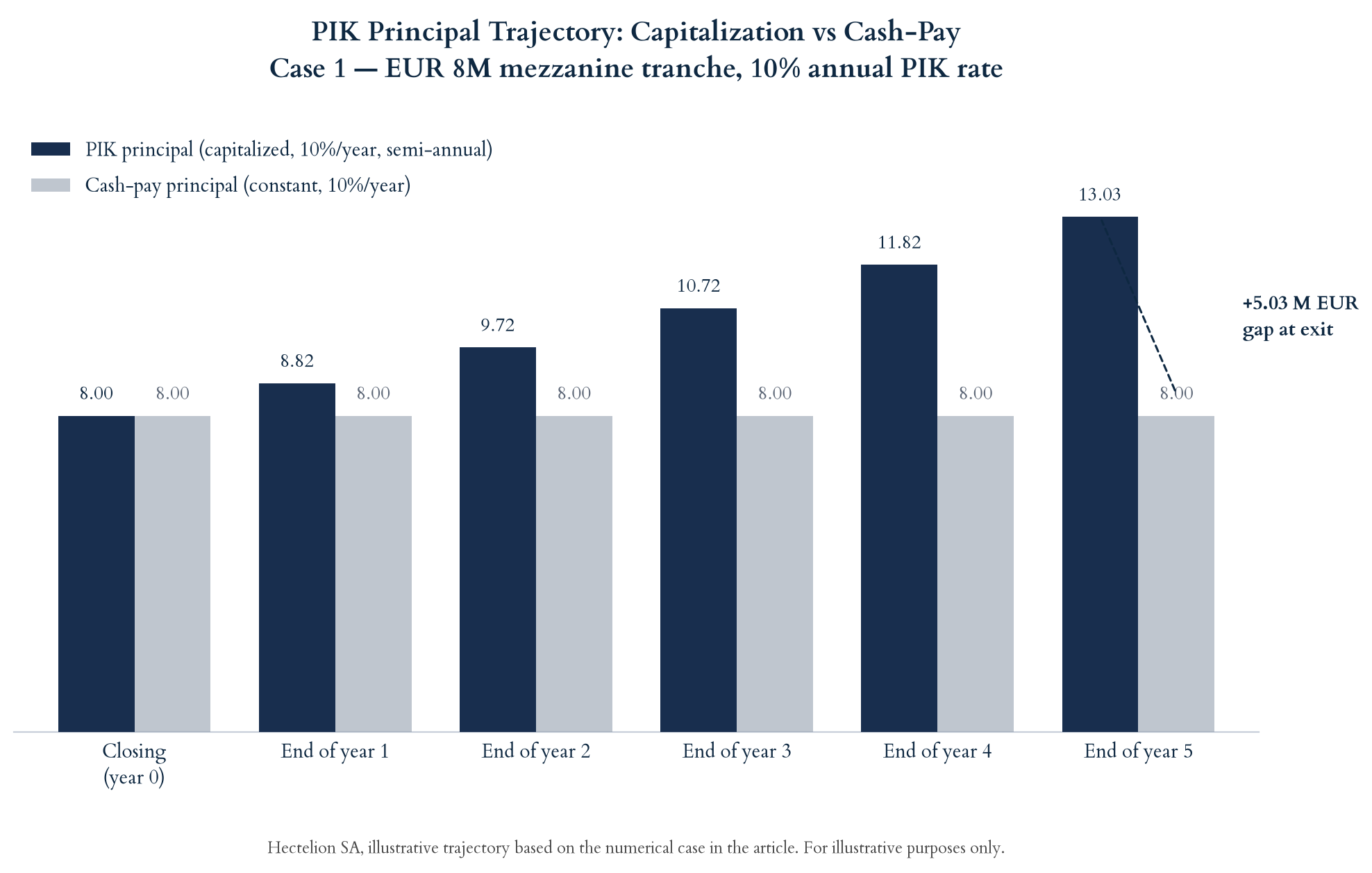
The bridge between enterprise value and equity value, or equity bridge, is built by subtracting net debt from the enterprise value retained at unwind. As long as enterprise value remains set by the same EBITDA multiple between closing and exit, that is, at a constant enterprise multiple, any change in the PIK principal flows through euro for euro, or franc for franc, to the equity value attributed to shareholders. This mechanism does not depend on any further assumption about the target's operating performance: it follows directly from the structure of the bridge, where capitalized PIK debt simply adds to the liabilities deducted from enterprise value.
Returning to Case 1 above: the EUR 8,000,000 PIK mezzanine tranche, capitalized at 10% semi-annually, reaches EUR 13,031,157 after five years, i.e. EUR 5,031,157 of additional PIK liability relative to the initial principal. At a strictly identical enterprise value between closing and exit, an assumption equivalent to applying the same exit multiple as the one applied at closing, this mechanical growth of the principal translates into:
- net debt EUR 5,031,157 higher at exit compared with a structure that had serviced the same instrument as cash interest, with a constant principal of EUR 8,000,000;
- equity value lower by the same amount, EUR 5,031,157, since the bridge only deducts net debt from enterprise value, with no other adjustment;
- a gap that results from no operational deterioration of the target whatsoever, but solely from the structuring choice between cash interest and capitalization.
This mechanical erosion of the equity bridge explains why an executive or a minority shareholder cannot simply track the nominal rate of a PIK tranche: it is the principal re-projected to the exit date, and its direct impact on the net debt bridge, that will determine the share of value actually received at unwind, whatever enterprise multiple is otherwise achieved.
A word from our CEO
"I regularly see financing structures where the PIK tranche was negotiated in a few lines of a term sheet, without anyone re-projecting its principal through to the planned exit date. Yet it is that figure, not the nominal rate shown at closing, that will determine what actually accrues to shareholders."
"I systematically recommend that clients treat the choice between cash interest, PIK and PIK toggle as a structuring decision in its own right, not as a minor line negotiated at the end of the process. The gap between the three profiles is measured in millions, not basis points."
"I am convinced that PIK debt remains a legitimate, and at times indispensable, tool for financing growth or an acquisition without diluting shareholders, provided it is calibrated against a realistic business plan and re-projected with the same rigor as conventional senior debt."
Aristide Ruot, Ph.D., Founder and Chief Executive Officer of Hectelion SA.
FAQ: the 10 essential questions on PIK (Payment In Kind) debt
Introduction: what to know before the questions
The following questions cover the clarification points most frequently raised by executives, investors and lenders facing a PIK debt tranche, whether in new financing or a renegotiation during the life of the instrument.
Q1: What exactly is PIK (Payment In Kind) interest?
PIK interest is contractual interest that is not paid in cash on the due date but added to the principal of the debt, which then increases by that amount for the following period. The lender receives the whole amount, principal plus accrued interest, at final repayment rather than as it accrues.
Q2: How is the capitalization of PIK interest calculated?
The final principal is obtained by multiplying the initial principal by one plus the periodic rate, raised to the power of the number of capitalization periods, with the periodic rate equal to the annual rate divided by the capitalization frequency stipulated in the contract, most often semi-annual.
Q3: What is the difference between PIK and PIK toggle?
PIK, or full PIK, systematically capitalizes the entire interest over the whole life of the instrument. PIK toggle gives the borrower the ability to choose, on each payment date, between cash settlement, full capitalization or a mix of the two, within the limits set by the credit documentation.
Q4: Is the PIK rate always higher than the cash rate?
Yes, in almost all cases observed in the market: the lender demands a premium to offset the deferral of its income and the growing credit risk linked to compounding, with that premium varying by instrument, borrower profile and prevailing market conditions, with no universal level applicable to every transaction.
Q5: How often is PIK interest capitalized?
Semi-annual capitalization is the most common frequency in market practice for mezzanine and unitranche tranches, but some instruments provide for quarterly or annual capitalization depending on what is set out in the credit documentation specific to each transaction.
Q6: Is PIK debt risky for the borrower?
It preserves cash in the short term but increases the principal owed at each period, which mechanically worsens the leverage ratio and concentrates repayment into a single, larger final maturity; the real risk therefore depends on the business plan's ability to eventually generate a valuation or cash flow sufficient to absorb this enlarged principal.
Q7: How is PIK debt treated in a business valuation or net debt bridge?
The PIK principal must be re-projected through to the chosen valuation date, rather than taken at its closing amount alone, in order to reflect the interest already capitalized as of that date in the net debt calculation and, by difference, in equity value.
Q8: Is PIK interest tax-deductible in France and in Switzerland?
In France, accrued PIK interest is generally deductible subject to the thin capitalization rules of Article 39 of the French General Tax Code. In Switzerland, its deductibility depends on the thin capitalization rules of the Federal Tax Administration and on documenting the arm's-length nature of the rate used.
Q9: In what types of transactions are PIK tranches most commonly found?
They are found mainly in mid-market LBOs, MBOs and MBIs partly financed by private debt, in high yield bonds issued by heavily leveraged groups, and in certain growth financings that seek to preserve available cash for investment rather than for debt service.
Q10: How should an executive negotiate a PIK toggle clause?
Before signing, the principal's trajectory should be modeled under several scenarios for how long the option is exercised, the contractual limits on the number of consecutive periods allowed should be checked, and the calculation base for capitalization, margin only or full coupon, should be clearly defined to avoid any disagreement over interpretation during the life of the financing.
Estimate the value of your company with Acontos, Hectelion's online simulator
To take this further with a concrete figure, Hectelion offers Acontos, its online audit, due diligence and business valuation tool. Powered by Anthropic's Claude Sonnet 5 artificial intelligence and calibrated on Hectelion's methodology, it reads your accounts, normalizes EBITDA, applies real sector multiples and rebuilds a net debt bridge to estimate the value of your shares within minutes. Launch the valuation simulator for free: the tool is confidential, retains no documents and does not replace a formal valuation, but it gives a reliable first order of magnitude before discussing it with our team.
Conclusion: PIK debt, a cash management tool whose cost is never visible at closing
PIK debt is neither a structuring anomaly nor a mere accounting artifice: it is a recognized cash preservation tool, whose real cost only becomes apparent once the principal has been re-projected through to maturity or exit. Between cash interest, full PIK and PIK toggle, the choice directly shapes the leverage trajectory, the alignment of interests between borrower and lender, and ultimately the share of value that will accrue to shareholders at the unwind of the transaction. The two numerical cases presented above show that a rate gap of a few points, combined with semi-annual capitalization over several years, can grow a principal by 30% to more than 60%, an order of magnitude that too many term sheets leave as a blind spot in negotiation.
Article summary
PIK debt capitalizes contractual interest into the principal rather than paying it in cash, under three main profiles: full PIK, which capitalizes the entire coupon, partial PIK, which combines a cash component with a capitalized component, and PIK toggle, which leaves the choice to the borrower period by period. The calculation follows the logic of compound interest, with a capitalization frequency most often semi-annual, and must always be re-projected through to maturity to measure the debt actually owed.
The use of PIK is justified by cash preservation, increased debt capacity and the flexibility offered in periods of stress, but it carries real risks: growing leverage, interest on interest and a misalignment of interests between the borrower, who pays out nothing, and the lender, whose credit risk rises silently until repayment.
The two numerical cases, one in France on an industrial LBO, the other in Switzerland on a unitranche financing, demonstrate through calculation that a PIK tranche's principal can grow by 30% to more than 60% over a three-to-five-year horizon, an order of magnitude that must systematically be built into the net debt bridge of any valuation involving a structure carrying PIK debt.
Hectelion supports Franco-Swiss executives and investors in structuring, auditing and modeling these instruments, with economic independence from traditional financial intermediaries and dual expertise in French and Swiss market practice.
Sources
- Banque de France, educational factsheet on mezzanine debt and its remuneration
- BlackRock, Inside Alternatives, what is PIK interest in private credit
- Dechert, The Cred, to PIK or not to PIK, March 2025 briefing on PIK toggle clauses
- Harper James, Knowledge Hub, guide to payment-in-kind loans
- IFRS Foundation, IFRS Interpretations Committee, presentation of interest for particular financial instruments
- Nasdaq, financial glossary, definition of pay-in-kind toggle notes
- S&P Global Market Intelligence, navigating payment-in-kind credit risk in private credit
- T. Rowe Price and Oak Hill Advisors, piking your spots in private credit
Author
Aristide Ruot, Ph.D.
Founder | Chief Executive Officer, Hectelion SA