SAFE vs KISS vs Convertible Note: Which Instrument for a Seed Fundraising Round?
SAFE, KISS or convertible note: choosing the right seed instrument.

Introduction: SAFE, KISS or Convertible Note, Which Instrument Should You Choose for a Seed Round?
A US investor, or simply one familiar with Silicon Valley practice, proposes closing a French or Swiss seed round with a SAFE, a KISS or a convertible note: should you sign as is, negotiate, or adapt it locally? The SAFE (Simple Agreement for Future Equity) is a financing contract created by accelerator Y Combinator in 2013, which promises future shares with no debt, no interest and no maturity date. The KISS and the convertible note pursue a similar goal, deferring a precise valuation negotiation to a later round, but with a legal structure that differs from the SAFE's.
"The SAFE is not a debt instrument... it is intended to be a flexible, founder-friendly tool for startups to raise money from investors.", Y Combinator.
Three factors make this choice a sensitive one in 2026:
- seed rounds increasingly mix US, French and Swiss investors in the same transaction;
- templates available online look alike without being equivalent, and confusing a SAFE, a KISS and a convertible note can cost several points of dilution;
- none of these three instruments has direct legal existence under French or Swiss law, which requires a local transposition before any signature.
This article compares the SAFE, the KISS and the convertible note against one another: their origin, their conversion mechanics, and their respective advantages and limitations. It then explains why the KISS, in particular, remains little used in French-Swiss practice, before pointing to the dedicated article on the BSA-AIR for the detailed question of transposition under French law, and to Swiss ad hoc convertible loan practice for Swiss law.
Secure the Structuring of Your Next Seed Round
Before signing a SAFE, a KISS or a convertible note, an independent review of the terms (cap, discount, interest, maturity) avoids dilution that is poorly anticipated at the next round of your fundraising. Book a 30-minute call with Hectelion to have your term sheets reviewed and their impact on your cap table modeled before you sign.
Acontos: Get a Free Online Estimate of Your Company's Value
Before diving into the detail, know that Hectelion has developed Acontos, an online audit, due diligence and business valuation tool, powered by Anthropic's Claude Sonnet 5 artificial intelligence and calibrated by Hectelion's methodology. Based on your accounts, it produces a first estimate of the value of your shares within minutes, free of charge and without retaining any document. Launch the valuation simulator to get an order of magnitude, then keep reading to understand what drives it.
Definition: What Are a SAFE, a KISS and a Convertible Note?
The SAFE (Simple Agreement for Future Equity) is an instrument created by accelerator Y Combinator in 2013: it is neither debt, nor shares, nor a bond with a maturity date. The investor pays in an amount in exchange for a promise of future shares, converted at the next qualifying round, or upon an exit or dissolution, with no accrued interest and no repayment date. The KISS (Keep It Simple Security), created by US accelerator 500 Startups, exists in two clearly distinct versions. The debt version behaves like a classic convertible debt instrument, with accrued interest and a maturity date at which principal and interest must be repaid or converted. The equity version, by contrast, is closer to the SAFE: it carries no interest and no maturity, and provides for no cash repayment. The convertible note, finally, is a genuine convertible debt instrument: it always carries an interest rate and a maturity date, and converts into shares at a qualifying round or, failing that, must be repaid in cash or extended by agreement between the parties.
All three instruments share a common goal: deferring the negotiation of a precise company valuation to a later round, while setting guardrails, a valuation cap or a discount, that reward the risk taken by the seed investor relative to investors in the next round. For the question of the SAFE's functional equivalent under French law, the BSA-AIR is covered in a dedicated article; this article focuses here on comparing the three Anglo-Saxon instruments themselves, without revisiting that transposition.
Origin: From the Convertible Note of Early Venture Rounds to Y Combinator's SAFE
The convertible note is the oldest of the three. It descends directly from the classic convertible loan used in US venture capital for decades to seed a company without immediately fixing its valuation, in exchange for an interest rate and a maturity date that protect the investor if the next round is slow to materialize. Y Combinator created the SAFE in 2013 to simplify this scheme: by removing interest and maturity, the accelerator wanted to offer a short, standardized document with no rate negotiation, designed for fast seed rounds between founders and business angels. On July 3, 2014, accelerator 500 Startups published the KISS in turn, explicitly positioning it as a compromise between the rigor of the convertible note and the simplicity of the SAFE: hence its two versions, debt and equity, which let investors choose their preferred degree of protection. The SAFE has since become the de facto standard across US markets for seed rounds, while the KISS has remained a more marginal instrument, used mainly by certain networks linked to 500 Startups.
Why Choose a Convertible Instrument for a Seed Round
- a convertible instrument avoids negotiating a precise valuation at a stage when it remains largely speculative: it defers that discussion to the next round, once the company has more traction to justify it;
- it sharply reduces the cost and time needed to structure the deal compared with a classic capital increase involving the issuance of new shares, since the template document typically runs only a few pages;
- it protects the seed investor against excessive dilution of their initial risk through the cap and the discount, which guarantee a more favorable conversion price than that offered to investors in the next round;
- it leaves founders' control of the company unchanged until conversion, since no new shares are issued before the qualifying round;
- the popularity of these templates, especially the SAFE, makes negotiations easier with foreign investors already familiar with them, who already understand the logic of the cap and the discount without having to learn a new format for each deal.
How a SAFE, a KISS or a Convertible Note Is Structured
Building these three instruments follows a common mechanic, with variants depending on the instrument chosen. First, the parties set the amount invested and choose the instrument: SAFE, KISS debt, KISS equity or convertible note. They then negotiate a valuation cap, which sets the maximum valuation at which the investor will convert their investment, regardless of the valuation actually reached at the next round. In parallel or as an alternative, they negotiate a discount, which guarantees the investor a conversion price set a given percentage below the price paid by investors at the qualifying round; see our article on pre-money and post-money valuation for the valuation mechanics to which this cap and discount apply. For the KISS debt and the convertible note, the parties also set an interest rate, which accrues on the principal until conversion or repayment, and a maturity date, at which the instrument must be converted, repaid or extended. The document then specifies the triggering events for conversion: a qualifying financing round above a minimum amount, a liquidity event (sale, merger), or the company's dissolution. Finally, at the time of conversion, the price per share used is the lower of the price derived from the cap and the price derived from the discount, which determines the number of shares issued to the seed investor.
When to Use a SAFE, a KISS or a Convertible Note
The table below summarizes the main criteria for choosing between the three instruments, in their original US version.
| Criterion | SAFE | KISS | Convertible Note |
|---|---|---|---|
| Legal nature | Sui generis contract, neither debt nor shares | Sui generis contract (equity) or convertible debt (debt) | Classic convertible debt |
| Creator, year | Y Combinator, 2013 | 500 Startups, July 2014 | Market practice, predating the SAFE |
| Accrued interest | None | None (equity) or a modest rate, often cited around 4 to 5% (debt) | Always a rate, generally a few percentage points, negotiated case by case |
| Maturity | None | None (equity) or a maturity, often cited around 18 months (debt) | Always a maturity, frequently between 18 and 24 months depending on the source |
| Cap and discount | Cap and/or discount, depending on the version negotiated | Cap and/or discount, depending on the version negotiated | Cap and/or discount, depending on the version negotiated |
| Template standardization | Very high, single widely adopted template | Medium, two coexisting versions, less widely distributed | Low, each note is drafted or adapted case by case |
| Direct legal existence under French or Swiss law | None | None | None as such, but the convertible loan logic is transposable |
| Frequency of use in French-Swiss practice | Rare in direct form, mainly serves as a reference for the BSA-AIR | Very rare, little known among local lawyers | Logic reused through ad hoc convertible loan agreements |
The interest rates and maturities cited above vary across templates and sources consulted; they are given for guidance only and must be negotiated case by case, not applied mechanically.
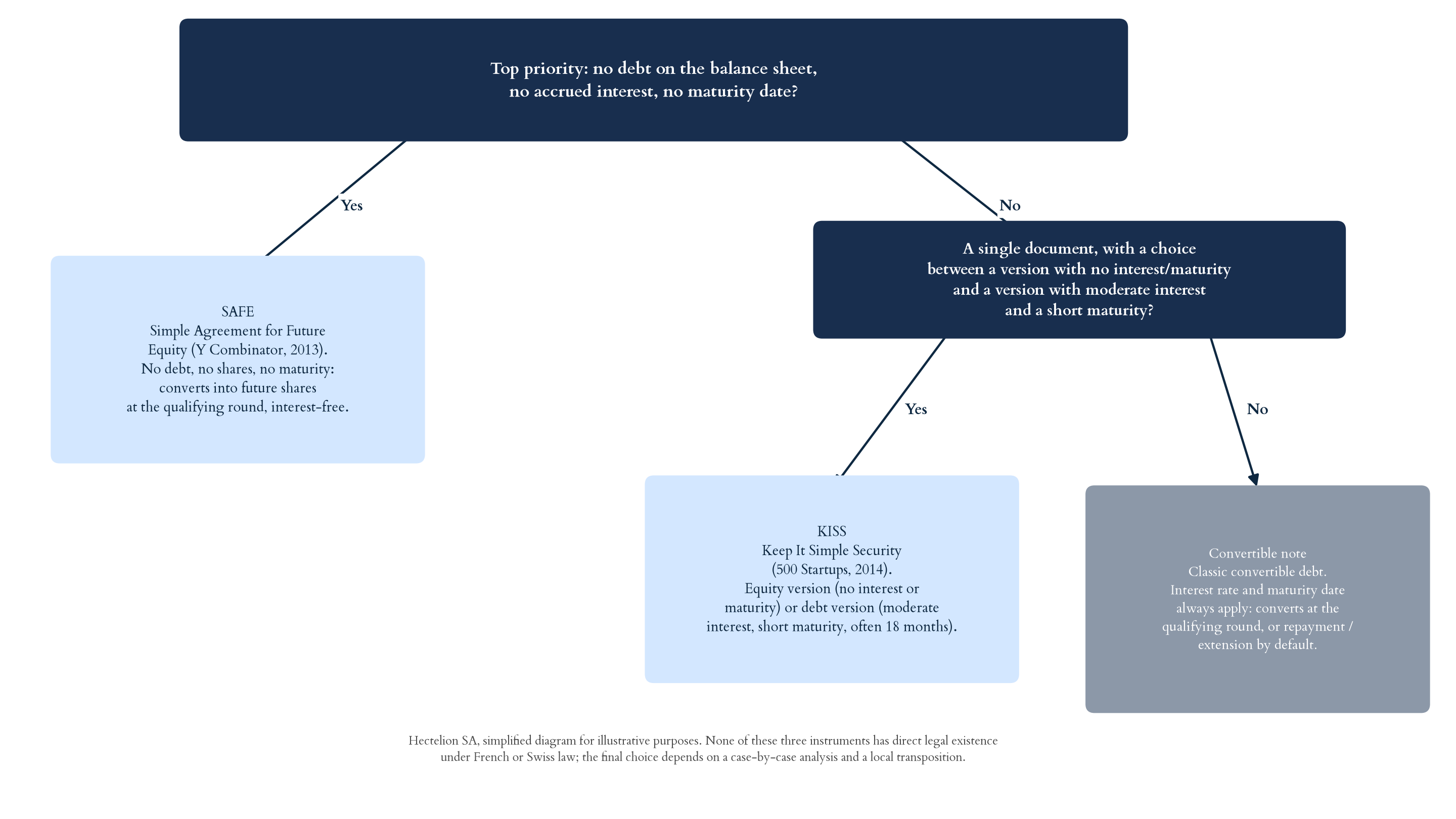
Diagram: SAFE, KISS or Convertible Note, Which Instrument to Choose?
The table above compares the three instruments criterion by criterion; the decision tree below draws a choice logic for a founder from it. It starts from the priority given to a complete absence of debt, interest and maturity, before weighing the flexibility of a single two-version document against the rigor of a classic convertible debt instrument.
The MFN Clause: The Often-Forgotten Parameter in the Comparison
Some SAFEs and some KISS documents, particularly when negotiated by experienced seed investors, include an additional clause that the standard Y Combinator and 500 Startups templates do not provide by default: the most favored nation (MFN) clause. This clause grants the seed investor the right to switch to the terms of a later instrument issued by the company before its qualifying round, if those terms prove more favorable than the ones originally accepted, for example a lower cap or a higher discount granted to an investor who came in after them.
The MFN clause addresses a specific concern of early investors: accepting terms that seem reasonable at signing, then discovering that the company granted materially better terms to other seed investors a few weeks later, without the first investors benefiting from them. Its mechanism requires, in practice, that the company inform its MFN investors of every new convertible instrument issued before the qualifying round, so they can exercise this switch right within the contractually agreed timeframe.
Like the cap and the discount already examined in this article, the MFN clause has no direct recognition under French or Swiss law: it raises the same legal transposition question, namely how to give it effect, in particular a retroactive adjustment of conversion terms, when the mechanism was designed for a US-law contract, within a BSA-AIR or an ad hoc convertible loan agreement. Its absence from an instrument should therefore never be read as an oversight by the drafter; it must be negotiated and transposed with the same rigor as the other parameters compared in this article.
Who to Call On to Choose and Structure Your Seed Instrument
Three areas of expertise should be brought together before signing one of these three instruments. First, legal counsel experienced in seed financings, able to identify whether the document proposed is a US template as is or a local adaptation, and to verify its compatibility with the applicable corporate law. Second, the ability to model the impact of the cap and the discount on the future cap table, beyond simply reading the document: a poorly calibrated cap can dilute founders far more than a classic capital increase negotiated directly. Third, knowledge of local market practice to assess our fundraising advisory fees and how the proposed terms compare with what is actually negotiated in France and Switzerland. Hectelion acts on this last point, in financial structuring and in M&A advisory, with dual French-Swiss expertise and economic independence from traditional financial intermediaries, which allows it to model dilution scenarios objectively before signature.
Advantages: Speed, Flexibility and Reduced Structuring Cost
These three instruments share common advantages, to varying degrees. Speed of execution is the most frequently cited: a SAFE or a KISS is often signed within a few days, with no lengthy negotiation of a full shareholders' agreement. Flexibility comes next: the choice between a cap, a discount, or a combination of the two, and for the KISS or the convertible note, the choice of an interest rate and a maturity, allows the instrument to be adjusted to the deal's risk profile. Reduced structuring cost, finally, follows directly from template standardization, particularly for the SAFE, whose single template keeps legal fees lower than a classic share issuance from the seed stage onward.
Limitations: Deferred Dilution, Legal Transposition and Maturity Risk
Deferred dilution is the limitation most often underestimated by founders: because no shares are issued at signing, the real impact on the cap table only appears at the next round, which can create a surprise effect if several SAFEs, KISS instruments or notes have accumulated with different caps. This also affects the dilution of management package instruments already in place, whether BSPCE, BSA or stock options. Legal transposition is the second limitation, specific to the French-Swiss context: none of these three instruments has direct legal existence under French or Swiss law, which requires adaptation work before signing, on pain of signing a document that is unenforceable or recharacterized. Maturity risk, finally, specifically concerns the KISS debt and the convertible note: if no qualifying round occurs before the maturity date, the instrument becomes legally due and payable, and an uncooperative holder could in theory demand repayment at a moment unfavorable to the company's cash position.
The 5 Mistakes to Avoid
Mistake 1: Treating KISS and SAFE as Interchangeable Instruments
The KISS and the SAFE look alike in their equity version, but the KISS debt carries interest and a maturity that the SAFE never has. Treating the two as equivalent means ignoring a difference in legal nature, not just in vocabulary.
Mistake 2: Signing a US Template Without Adapting It to French or Swiss Law
A SAFE, a KISS or a convertible note copied word for word from a US template can run into local corporate law, particularly on the deferred issuance of shares with no immediate consideration. In France, the BSA-AIR addresses precisely this difficulty; see our article SAFE vs BSA-AIR for the detail of this transposition.
Mistake 3: Ignoring the Cumulative Effect of Several Caps on Dilution
A cap negotiated in isolation always looks reasonable. Added to two or three other caps signed over the course of the seed stage, it can represent cumulative dilution far greater than that of a single equity round, particularly if the caps are much lower than the final qualifying round's valuation.
Mistake 4: Forgetting the Maturity Date of a KISS Debt or a Convertible Note
Unlike the SAFE, the KISS debt and the convertible note carry a firm maturity date. Failing to track it actively, or failing to anticipate a negotiated extension in the absence of a qualifying round, exposes the company to an inopportune demand for repayment of principal and accrued interest.
Mistake 5: Overlooking the Accounting and Tax Treatment of Accrued Interest
Accrued interest on a KISS debt or a convertible note has its own accounting and tax treatment, distinct from that of an interest-free instrument such as the SAFE or the KISS equity. Ignoring this upfront exposes the company to surprises when closing the accounts or at conversion.
Case 1: A French SaaS Company Drops a US KISS for a BSA-AIR Capped at EUR 3 Million
A French SaaS startup raises EUR 300,000 in a seed round from a US-based business angel, who initially proposes a KISS debt. After review, this document has no direct legal existence under French law; the parties replace it with a BSA-AIR carrying the same economics.
- Valuation cap: EUR 3,000,000, with no discount
- Shares on a fully diluted basis: 400,000
- Cap conversion price: 3,000,000 / 400,000, i.e. EUR 7.50 per share
- At the next Series A round, a pre-money valuation of EUR 6,000,000 on the same base of 400,000 shares, i.e. a round price of EUR 15 per share
- Since the cap is lower than the round price, it governs conversion: the seed investor receives 300,000 / 7.50, i.e. 40,000 shares, valued at EUR 600,000 at the Series A round price
They thereby double the value of their initial investment before the capital is even opened to new investors, which illustrates the function of the cap: rewarding the risk taken at the seed stage, independently of the discount.
Case 2: A Swiss Medtech Turns a CHF 500,000 KISS into an Ad Hoc Convertible Loan
A Swiss medtech company negotiates a CHF 500,000 bridge with a US seed fund, which proposes a KISS debt with a 6% interest rate and a 24-month maturity. This amount stays well below the thresholds that would trigger a prospectus requirement in Switzerland, as detailed in our article on how to raise funds in Switzerland without a prospectus. The company's Swiss counsel points out that the KISS has no direct legal existence under Swiss law and proposes an ad hoc convertible loan agreement, modeled on practice observed within the Swiss venture capital ecosystem, with the same economic parameters:
- Interest rate: 6%
- Maturity: 24 months
- Discount: 20%, with no cap
- A qualifying Series A round occurs 14 months later
- Accrued interest: CHF 500,000 x 6% x (14/12), i.e. CHF 35,000, for a total claim of CHF 535,000
- The Series A round values the company at CHF 6,000,000 pre-money on a base of 500,000 existing shares, i.e. a round price of CHF 12 per share
- With the 20% discount, the conversion price is set at 12 x 0.8, i.e. CHF 9.60 per share
- The lender then receives 535,000 / 9.60, i.e. approximately 55,729 shares
These shares are converted before the contractual 24-month maturity, thanks to the qualifying round that occurred in month fourteen.
A Word from Our CEO
"I regularly see cases where a French or Swiss founder signed a US SAFE or KISS without grasping its real implications under local law. The document reads as simple, but its apparent simplicity hides a conversion mechanic that can dilute far more than expected if it is not modeled in advance."
"I consistently recommend separating the choice of instrument, SAFE, KISS or convertible note, from its local legal transposition: these are two different decisions, negotiated at different points in the process, and conflating them wastes time for both parties."
"I believe our firm's economic independence is precisely what lets us model the impact of a cap or a discount on future dilution objectively, with no commercial interest in steering the negotiation one way or the other."
Aristide Ruot, Ph.D., Founder and CEO of Hectelion SA.
FAQ: The 10 Essential Questions on the SAFE, the KISS and the Convertible Note
Introduction: What to Know Before the Questions
This FAQ answers the most frequent questions from founders and investors facing a choice between a SAFE, a KISS and a convertible note in a French-Swiss seed round.
Q1: Do the SAFE, the KISS and the Convertible Note Have Legal Existence Under French or Swiss Law?
No, none of the three has direct legal existence under French or Swiss law. In France, the commonly used functional equivalent is the BSA-AIR. In Switzerland, practitioners use ad hoc convertible loan agreements, built on Swiss contract and corporate law.
Q2: Why Is the KISS So Rarely Used in France and Switzerland?
The KISS suffers from less standardization than the SAFE, with two coexisting versions (debt and equity) that complicate its reading, and from more limited distribution among local business lawyers, who are far more familiar with the SAFE and, in France, the BSA-AIR. This lower familiarity leads French and Swiss counsel in practice to propose a local transposition rather than directly adapting the KISS template.
Q3: What Is the Difference Between a SAFE and a Convertible Note?
The SAFE is not debt: it carries no interest and no maturity, and cannot give rise to a cash repayment. The convertible note is genuine convertible debt, which always carries an interest rate and a maturity date at which it must be repaid, converted or extended.
Q4: What Is the Difference Between a KISS Debt and a KISS Equity?
The KISS debt accrues interest and carries a maturity date, like a simplified convertible note. The KISS equity carries no interest and no maturity and is functionally close to the SAFE, while remaining a distinct document created by 500 Startups.
Q5: Do a KISS or a Convertible Note Count as Debt on the Company's Balance Sheet?
The KISS debt and the convertible note are debt instruments and must, in principle, be treated as such for accounting purposes until converted or repaid. The SAFE and the KISS equity are not debt instruments, and their accounting treatment differs; it must be verified with the company's accountant on a case-by-case basis.
Q6: How Is the Share Conversion Price of a SAFE, a KISS or a Convertible Note Calculated?
The conversion price used is the lower of the price derived from the valuation cap and the price derived from the discount, when both mechanisms coexist. This price, divided into the amount invested (plus accrued interest for a KISS debt or a convertible note), determines the number of shares issued to the seed investor.
Q7: What Happens If a Convertible Note or a KISS Debt Reaches Maturity Without a Qualifying Round?
The document generally provides for three possible outcomes: cash repayment of the principal and accrued interest, automatic conversion into shares under predefined terms at maturity, or a negotiated extension of the maturity date. The actual outcome depends strictly on the clauses signed, which makes careful reading essential before signature.
Q8: Can a French or Swiss Investor Sign a US SAFE or KISS Directly?
Nothing legally prevents signing a foreign-law contract, but doing so exposes the company and the investor to uncertainty over the enforcement of certain clauses under local law, particularly the deferred issuance of shares. This is why French-Swiss practice favors a local transposition rather than signing the US template as is.
Q9: Should You Prefer a Cap, a Discount, or Both?
A discount alone protects the investor in proportion to the qualifying round's valuation, whatever it turns out to be. A cap alone guarantees a floor price independent of that valuation, which protects the investor more if the company's value rises sharply between the two rounds. Combining both, with the lower price applying, is the most protective configuration for the investor, and therefore the most dilutive for founders if the company grows quickly.
Q10: What Role Does an Independent Expert Like Hectelion Play in Choosing the Instrument?
An independent expert models the impact of the cap, the discount and, where applicable, accrued interest on the cap table under different future valuation scenarios, before signature. This objective modeling, free of any commercial interest in steering the choice, lets founders and investors negotiate the instrument with full knowledge rather than on the reputation of the proposed template alone.
Estimate Your Company's Value with Acontos, Hectelion's Online Simulator
To follow up this reading with a concrete figure, Hectelion offers Acontos, its online audit, due diligence and business valuation tool. Powered by Anthropic's Claude Sonnet 5 artificial intelligence and calibrated by Hectelion's methodology, it reads your accounts, normalizes EBITDA, applies real sector multiples and rebuilds a net debt bridge to estimate the value of your shares within minutes. Launch the valuation simulator for free: the tool is confidential, retains no document and does not replace a formal valuation, but it gives a reliable first order of magnitude before discussing it with our team.
Conclusion: A Choice of Instrument That Never Dispenses with a Local Transposition
The SAFE, the KISS and the convertible note all three serve the same purpose, raising seed capital without immediately negotiating a definitive valuation, but with distinct legal structures that it would be unwise to treat as interchangeable. The SAFE has won the preference of the US market through its simplicity and complete absence of debt. The KISS, by offering two versions, provides real flexibility but faces more limited distribution, particularly among French and Swiss practitioners, which explains its marginal use in French-speaking Europe. The convertible note remains the reference when the parties explicitly want a debt instrument, with interest and maturity. In all three cases, moving into French or Swiss law requires a transposition, via the BSA-AIR or an ad hoc convertible loan agreement, which must be anticipated from the negotiation of terms rather than treated as a mere signing formality.
Article Summary
The SAFE, created by Y Combinator in 2013, is neither debt nor shares: it converts into future shares with no interest and no maturity. The KISS, created by 500 Startups in July 2014, exists in two versions, a debt version close to a convertible debt instrument with interest and maturity, and an equity version close to the SAFE. The classic convertible note is a full convertible debt instrument, always carrying interest and a maturity date, which converts at a qualifying round or must otherwise be repaid.
None of the three instruments has direct legal existence under French or Swiss law. In France, the BSA-AIR is the most widely used functional equivalent. In Switzerland, practitioners use custom-built ad hoc convertible loan agreements. The KISS, in particular, remains rarely seen in French-speaking Europe, for lack of standardization and recognition comparable to the SAFE's among local lawyers.
The choice between a cap, a discount or a combination of the two directly determines the level of protection given to the seed investor and, in mirror, the level of dilution borne by founders at the next qualifying round. The two worked examples in this article illustrate this mechanic: a cap alone in France, a discount combined with accrued interest in Switzerland, with in both cases a verifiable calculation of the conversion price and the number of shares obtained.
Before signing any of these instruments, whether a US template or a local transposition, an independent modeling of its impact on the cap table remains the best protection against poorly anticipated dilution, for founders and investors alike.
Sources
- BetaKit, why 500 Startups Canada prefers the KISS over the SAFE
- Corporate Finance Institute, overview of the convertible note, cap, discount and conversion price
- Eqvista, comparison between the SAFE and the KISS
- Holloway, overview of standard convertible financing templates (SAFE, KISS, notes)
- SECA, Swiss Private Equity & Corporate Finance Association, standard convertible loan documentation for Swiss startups
- The Startup Law Blog, Joe Wallin, complete guide to convertible notes for founders
- VentureBeat, announcement of 500 Startups' publication of the KISS in July 2014
- VentureLab, a lawyer's perspective on negotiating convertible loans
- Wiggin and Dana LLP, choosing between a convertible note, a SAFE and a KISS to fund your venture
- Y Combinator, the SAFE, an open standard for seed financing
Author
Aristide Ruot, Ph.D.
Founder | CEO, Hectelion SA